







Rising Food Costs Overtake Housing as Canadians’ Top Financial Worry
With inflation still squeezing household budgets, Canadians say cutting grocery costs now outweighs concerns about housing costs, according to a new Nanos research poll conducted for CTV News.
The survey focused on areas of spending where Canadians would like to see more reduced costs in 2026
READ MORE ON OUR DAILY STOCK MARKET REPORTS – Gold Surge Boosts Miners as Small Caps and Dow Lag
Grocery costs proved to be top of mind for Canadians looking to save money this year at 52.3 per cent, followed by housing at 23.5 per cent and health care at 9.3 per cent.
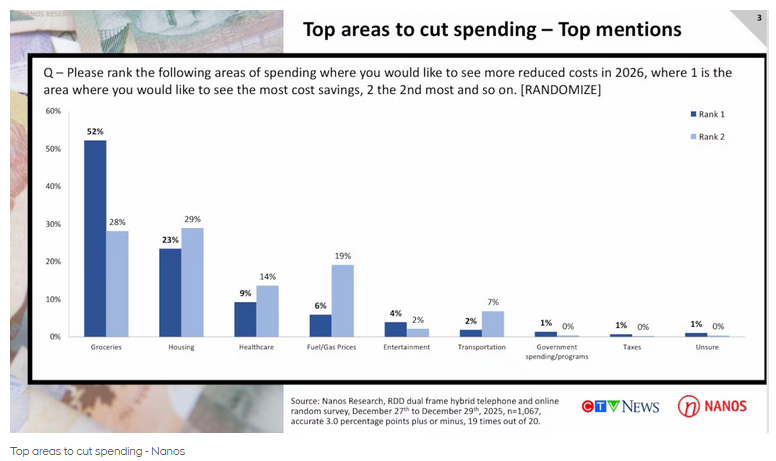
The area second-most desirable for spending cuts was housing at 29 per cent, followed closely by groceries at 28 per cent.
About half of those surveyed in regions across the country say grocery spending is where they would like to see the most relief for their wallets. The highest responses from the Prairie provinces coming in at 60.7 per cent and 55.8 per cent in the Atlantic region.

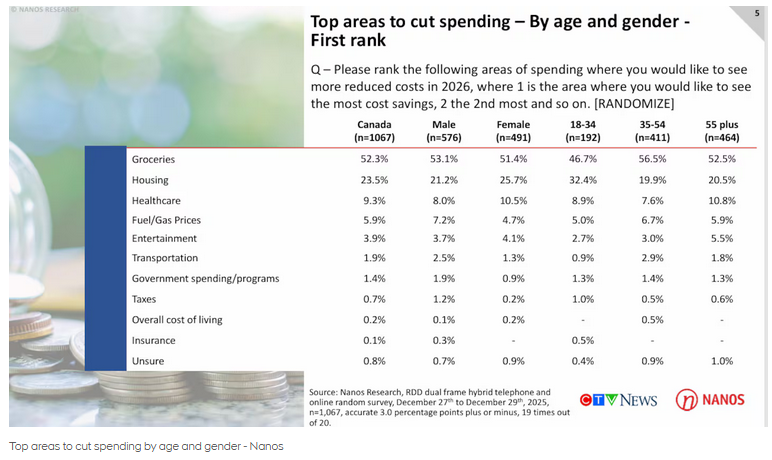
When it came to demographics, male respondents in the 35-54 age group made up the majority of those who expressed their desire for reduced grocery bill costs, coming in at 56.5 per cent.
Concerns for the reduction in housing costs may have come in at a distant second nationally, but residents in Quebec and B.C. are among the highest who want housing to be more affordable — Quebecers at 26.8 per cent and British Columbians at 28.7 per cent.
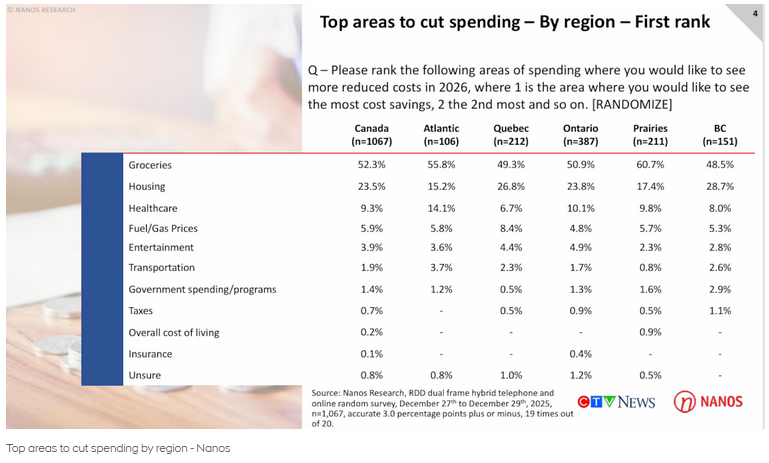
Health care came in third as an area to cut spending, with Atlantic provinces at 14.1 per cent and Ontario at 10.1 per cent.
Earlier this week, Prime Minister Mark Carney revealed a new set of affordability measures that include a boost to the GST credit, promised spending toward food suppliers, food banks and the creation of a National Food Security strategy to assist Canadians navigating shrinkflation.
Methodology
This research gauged the opinion of Canadians on areas of spending where they would like to see more reduced costs in 2026. Nanos conducted an RDD dual frame (land-and cell-lines) hybrid telephone and online random survey of 1,077 Canadians, 18 years of age or older, between December 27th and December 29th, 2025, as part of an omnibus survey. The margin of error for this survey is ±3.0 percentage points, 19 times out of 20.
This article was first reported by CTV News