





World Trade Expands Even as U.S. Shifts Toward Protectionism
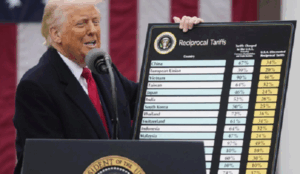
U.S. President Donald Trump has taken a wrecking ball to the global trading system.
Yet for all the ruptures of the past year – the highest U.S. import duties in decades, a brief moment of triple-digit tariff rates between the United States and China, and the uncertain future of the North American trade pact – global trade is flourishing.
Merchandise trade volumes rose by more than 4 per cent in 2025, “which is strong by the standards of the past decade,” Capital Economics said in a recent report. In November, goods trade jumped 5.3 per cent from a year earlier, according to the Netherlands Bureau for Economic Policy Analysis.
As the U.S. embraces protectionism, few countries have followed its example. If anything, the trade war has prompted others to pursue deeper relationships to counter a volatile Trump administration. The evidence is clear: The U.S. is trading less, while virtually everyone else is trading more.
READ MORE ON OUR DAILY STOCK MARKET REPORTS – Sustained Tech Rotation Sparks Broad Market Selloff
“Humans are traders. We’ve been trading for literally thousands of years,” said Stuart Bergman, chief economist at Export Development Canada. “I’ll go out on a limb here and suggest that we’ll probably continue to trade for another thousand years.”
Several factors have boosted shipments. The investment boom in artificial intelligence has meant that a deluge of computer chips and equipment are criss-crossing the globe. Lower interest rates have given households more breathing room to spend freely. And crucially, protectionism has been largely confined to the U.S.

“The fact that tariffs haven’t weakened trade outside the U.S. shouldn’t be too surprising for the simple yet underappreciated reason that tariffs have barely risen globally speaking,” Simon MacAdam, deputy chief global economist at Capital Economics, said last month in a report.
“Not only have countries mostly refrained from retaliating to U.S. tariffs – in contrast to the 1930s – but, Mexico aside, they have displayed little appetite for raising barriers with other trade partners; some like India have even liberalized trade,” he added.
In the early days of the trade war last year, Canada and China retaliated against U.S. tariffs with their own. Since then, the U.S. and China have dialled back their duties on one another, and Canada has scrapped the majority of its countertariffs to help with trade talks.
There is, to be sure, a whiff of protectionism in Canada. The federal government has brought in a tariff rate quota system for steel and duties on steel derivative products, in a bid to support the local industry. Various “Buy Canadian” rules are aimed at bolstering domestic procurement.
But the broader goal is diversification. The federal government aims to double non-U.S. exports to $600-billion annually over the next decade. Prime Minister Mark Carney has been globe-trotting to further investment and trade opportunities, with a visit to India expected in the coming weeks. At a recent diplomatic visit in Beijing, Ottawa said that it’s easing tariffs on Chinese electric vehicles, in exchange for lower duties on key agricultural exports.
Diversification is sorely needed. Given its reliance on the United States, Canada has taken a larger hit than most.
Over the first 11 months of 2025, exports to the U.S. fell 4.9 per cent, compared to the same period in 2024.
Shipments of autos, steel and aluminum have tumbled, owing to steep duties facing those products.
Exports to other countries, meanwhile, are on the upswing. But to a large degree, those figures are flattered by the speculative run-up in gold prices – something that could easily head into reverse.
“The only free lunch in economics is diversification,” said Mr. Bergman, a play on the saying about investing.
Other countries have emerged as relative winners in the trade war. American importers have shifted their supply chains to minimize costs, benefiting the likes of Thailand and Vietnam.
This wasn’t a new scenario for American companies. The U.S.-China decoupling began in Mr. Trump’s first term, when the President launched his trade war with Beijing. As a result, China’s share of U.S. imports has fallen to 9 per cent over the first eight months of 2025, from 21 per cent in 2017, according to a recent paper published by the National Bureau of Economic Research.

But even with the U.S. hit, China’s export machine is running strong. The country accounts for 18 per cent of global exports in real terms, up from 13.5 per cent in 2018, according to Capital Economics, which credits “steep price cuts” for the increase, along with some degree of U.S.-China trade via third countries. Year over year, trade volumes have also surged in emerging Asian economies and Latin America.
Canada is understandably in a vulnerable position, because the United States is still its primary customer. Beyond the U.S., Canadian companies are mostly selling more to existing clients, rather than developing new markets, and efforts at diversifying trade could take years to pay off. (India, which recently reached a free-trade agreement with the European Union, has expressed interest in buying more Canadian energy.)
The stakes are high for this year’s review of the North American trade agreement, given the potential for another hit to Canada’s export sector. But the overarching trend is that the world is trading more goods and services than ever – hence the need for Ottawa to deepen its relationships abroad.
“Businesses are incentivized to produce at the lowest cost and sell at the highest price, and that rarely ever happens in the same market,” Mr. Bergman said.
“We’ve been telling whoever would listen that globalization just won’t decline. It will definitely change, but it won’t decline.”
This article was first reported by The Globe and Mail