







Heightened Geopolitical Risk Sends Major Benchmarks Into Consolidation
The Canadian Vanguard Stock Market Report – Thursday February 19, 2026 Edition.
.
The Toronto Market
The Toronto Market Index
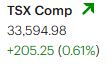
The S&P/TSX Composite Index advanced 205.25 points (+0.61%) to close at 33,594.98, marking a second consecutive session of strong gains. Despite opening below the prior close, the index quickly reversed early weakness, rallying more than 250 points within the first hour of trading on improved risk appetite and firm intraday momentum.
Following the initial surge, the market entered a two-hour consolidation phase, suggesting orderly profit-taking rather than distribution. Buying interest resumed into the afternoon session, driving a steady advance into the close and confirming underlying strength in the broader tape.
Technically, the session produced a constructive intraday reversal and a higher close, reinforcing short-term bullish momentum. Back-to-back strong closes increase the probability of near-term upside continuation, particularly if follow-through buying emerges in the next session. Key levels to monitor include immediate support at the prior day’s low and resistance near recent swing highs.
Overall, price action reflects improving sentiment and sustained institutional participation, positioning the index for a potential test of higher resistance levels in the near term.
Today’s TSX Market Statistics
Market breadth on the TSX was marginally positive, with advancing issues narrowly outpacing decliners. A total of 1,075 stocks advanced versus 1,033 that declined, resulting in an advancer-to-decliner ratio of 1.04:1. An additional 177 issues closed unchanged, indicating relatively balanced participation despite the index’s upward move.
New 52-week highs totaled 207, while 23 securities registered new 52-week lows. Although the highs-to-lows spread remained decisively positive, new highs declined from 291 in the previous session (with 29 new lows), suggesting a modest cooling in upside expansion.
Total trading volume reached 459,520,794 shares, representing an 8% decrease from yesterday’s 496,983,419 shares. The lighter volume alongside gains may indicate reduced conviction relative to the prior session, warranting close monitoring for follow-through strength in upcoming trading days.
Overall, breadth and leadership remain constructive, though slightly tempered compared to the previous session.
Today’s Toronto Market Wrap-Up Report
The S&P/TSX Composite Index attempted to regain upside momentum, reversing an early decline to finish near session highs. The constructive close reinforces the near-term recovery tone following recent volatility.
Sector Performance
Leadership was concentrated in cyclical and growth-oriented groups. The top-performing sectors were:
- Energy: +1.75%
- Information Technology: +1.47%
- Materials: +1.40%
Lagging sectors included:
- Financials: −0.33%
- Communication Services: −0.35%
- Consumer Discretionary: −0.41%
Six of the ten major sectors advanced, indicating relatively broad-based participation. The renewed strength in Technology suggests that the recent rotation away from growth equities may be moderating, at least in the short term. Energy and Materials leadership further signals improving risk appetite and commodity sensitivity within the broader market.
Precious Metals and Silver Outlook
Silver continues to strengthen its role as both a precious and industrial metal. Expanding solar panel manufacturing and other industrial applications have contributed to a multi-year structural supply deficit. Current projections indicate that 2026 could mark another year of industrial silver shortfall, with demand growth continuing to outpace supply expansion. This dynamic supports a constructive medium-term outlook for select silver producers.
Among earnings highlights:
- First Majestic Silver (TSX: AG) reported Q4 adjusted earnings of $0.30 per share, up sharply from $0.03 a year earlier, reflecting improved operating leverage.
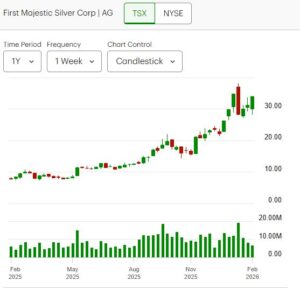
- Pan American Silver Corp (TSX: PAAS) gained 5.4% (+$4.32) to close at $83.30 on approximately 1 million shares traded. The stock, which had been consolidating in recent weeks, rebounded off its 50-day moving average — a technically constructive development.
Uranium Watch
Cameco (TSX: CCO) remains a name to monitor. While recent volatility has increased, the longer-term uranium supply-demand narrative remains intact. A period of price stabilization could provide a more favorable technical entry setup for investors building exposure to the nuclear energy theme.
Bottom Line
The TSX delivered a technically encouraging session marked by cyclical leadership, improving breadth, and signs of stabilization in growth equities. Commodity-linked equities continue to attract capital amid supportive structural supply-demand trends. Investors should watch for follow-through buying to confirm that the index is re-establishing a sustainable upward trajectory.
.
The US Markets
U.S. Market Indexes
U.S. equities delivered a mixed session, with most major benchmarks closing lower despite selective strength in small-cap names. The Dow Jones Industrial Average declined 267.50 points (−0.54%) to finish at 49,395.16, reflecting renewed pressure in cyclical and industrial components.
The S&P 500 fell 19.42 points (−0.28%) to close at 6,861.89, signaling modest broad-based weakness across sectors.
The Nasdaq Composite retreated 70.91 points (−0.31%) to 22,682.73, as technology stocks pulled back following two consecutive sessions of gains. The reversal suggests that near-term momentum in growth equities remains fragile. From a technical standpoint, the Nasdaq has yet to decisively reclaim higher resistance levels and remains vulnerable to further consolidation.
In contrast, the Russell 2000 Index gained 6.48 points (+0.24%) to close at 2,665.09. The small-cap benchmark recorded its second straight advance and was the only major U.S. index to finish in positive territory, indicating selective risk appetite rotation into domestically focused equities.

Today’s U.S. Market Statistics
New York Stock Exchange (NYSE): Market breadth on the New York Stock Exchange tilted negative, with declining issues outnumbering advancers. A total of 2,364 stocks declined versus 2,155 that advanced, while 414 issues closed unchanged. This produced a decliner-to-advancer ratio of approximately 1.10:1, reflecting modest distribution beneath the surface of the broader market.
The exchange recorded 288 new 52-week highs and 84 new 52-week lows, compared with 382 new highs and 70 new lows in the previous session. While the highs-to-lows differential remains positive, the contraction in new highs suggests a narrowing of upside leadership.
Total NYSE trading volume reached 5,247,694,035 shares, approximately 1% higher than the prior session’s 5,174,151,320 shares. The combination of negative breadth and slightly higher volume may indicate mild institutional selling pressure.
NASDAQ: On the NASDAQ, declining stocks narrowly exceeded advancers. There were 2,397 decliners compared with 2,320 advancers, with 363 issues unchanged — a decliner-to-advancer ratio of roughly 1.03:1, signaling relatively balanced but slightly negative breadth.
The exchange posted 103 new 52-week highs and 181 new 52-week lows, a notable deterioration from the prior session’s 178 new highs and 155 new lows. The expansion in new lows suggests increasing downside pressure, particularly within growth and momentum segments.
Total NASDAQ volume totaled 7,196,296,018 shares, down 9% from 7,904,401,312 shares in the previous session. The lighter volume on a session marked by weak breadth may reflect reduced conviction rather than aggressive liquidation.
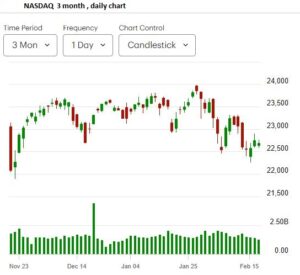
The NASDAQ is currently is not looking good. In fact if the above was the chart of a stock, we would hesitate to purchase such a stock. The bottom line is that the current market if tricky. The market goes up two sessions and declines the next session or goes up one session and declines the next two sessions and then the cycle repeats. Investors should be ready to exit the position if the market reverses after a purchase. It is a good to be very cautious with purchases at least the market improves. The focus should be to protect capital.
Overall Assessment
NYSE breadth reflects mild distribution with leadership narrowing, while NASDAQ internals show more pronounced weakness as new lows expand. Sustained deterioration in breadth — particularly on rising volume — would warrant a more defensive posture. Conversely, stabilization in new lows and renewed expansion in new highs would be needed to reassert a constructive intermediate-term outlook.
U.S. Market Wrap-Up Report
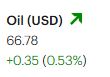
U.S. equities traded defensively as escalating geopolitical tensions surrounding Iran lifted crude prices and dampened broader risk appetite. Energy markets responded swiftly, with WTI and Brent crude posting solid gains for a second consecutive session, reinforcing inflation and supply-risk concerns.