Tariff Concerns and AI Disruption Fears Slam Markets
The Canadian Vanguard Stock Market Report – Monday February 23, 2026 Edition.
.
The Toronto Market
The Toronto Market Index
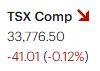
The S&P/TSX Composite Index declined by 41.01 points, or 0.12%, to close at 33,776.50. Supported by gains in precious and industrial metals, the Toronto market outperformed other North American markets today. Although the index remained in negative territory for most of the session, it recovered from its intraday low by the close.
Today’s TSX Market Statistics
On the TSX, declining issues outnumbered advancing issues. Specifically, there were 1,210 decliners and 976 advancers, resulting in a decliner-to-advancer ratio of 1.24 to 1—approximately six decliners for every five advancers—with 150 issues unchanged.
The exchange recorded 344 new 52-week highs and 59 new 52-week lows, compared with 356 new highs and 20 new lows on Friday.
Total trading volume on the TSX reached 495,272,325 shares, down 12% from the 558,609,068 shares traded on Friday. Lighter volume on a down session can be viewed as a constructive sign for the market, as it may indicate limited selling pressure.
Toronto Market Wrap-Up Report
Friday’s session showed encouraging momentum, but tariff uncertainty and global trade tensions once again pressured equities on Monday. While the TSX avoided a deeper pullback, sector rotation painted a cautious picture.
Basic Materials led the market, rising 2.80% and helping to moderate the broader index decline. Utilities, Telecommunications Services, and Energy followed, reinforcing a defensive tone with strength concentrated in hard assets and yield-oriented sectors.
On the downside, Technology plunged 5.76%, making it the session’s weakest sector by a wide margin. Financials fell 1.13%, while Industrials declined 1.55%. When both Technology and Financials underperform simultaneously, it often signals institutional risk reduction rather than routine sector rotation. The session carried a distinctly risk-averse tone.
Leadership: Precious Metals
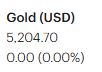
Gold and silver miners dominated the leadership board as investors sought safety.
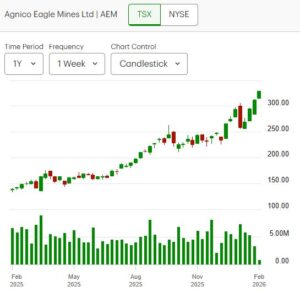
- Agnico Eagle Mines Ltd extended Friday’s 52-week high breakout with an additional 5.81% gain on Monday. Continued strength following a breakout is a constructive technical signal and warrants close monitoring for pullback entries.
- First Majestic Silver Corp and Wheaton Precious Metals Corp also demonstrated relative strength and remain strong candidates for watchlists if metals continue to attract capital.
Sustained leadership in precious metals typically reflects defensive positioning and inflation or geopolitical hedging.
Stock in Focus: Bombardier
Bombardier Inc., one of the stronger performers year-to-date, declined 4.77% in today’s session. Despite the pullback, the stock remains comfortably above its 25-day and 50-day moving averages, and the current price is not extended.
For traders, this suggests the move may represent normal consolidation rather than technical deterioration. Pullbacks toward key moving averages could present lower-risk entry opportunities if the broader market stabilizes.
Strategic Takeaway
- Market tone: Defensive
- Leadership: Precious metals and defensive sectors
- Weakness: Technology and Financials
- Bias: Risk management remains critical
Until Financials and Technology regain footing, traders may want to favor selective exposure, prioritize relative strength, and avoid aggressive positioning. In uncertain tape conditions, capital preservation remains the priority.
.
The US Markets
All major U.S. indexes closed in negative territory today—a true “red letter day,” as Sir Winston Churchill might have described it.
The Dow Jones Industrial Average fell 821.91 points, or 1.66%, to close at 48,804.06, marking its worst single-day decline in a month. The S&P 500 declined 71.76 points, or 1.04%, finishing at 6,837.75. The Nasdaq Composite dropped 258.80 points, or 1.13%, to end the session at 22,627.75.
Nasdaq index remains below both its 25-day and 50-day moving averages, a technical signal suggesting continued near-term weakness in technology stocks. The index has struggled to establish sustained short-term momentum, reinforcing the need for caution in the sector.
Russell 2000 index fell 42.79 points, or 1.61%, to close at 2,620.99. Small-cap stocks experienced notable selling pressure today. Although the Russell 2000 had performed relatively well over the past couple of months, it has now slipped below its 21-day moving average. With ongoing market volatility and frequent reversals, a cautious approach to trade planning remains advisable.

Today’s U.S. Market Statistics
New York Stock Exchange (NYSE): Declining issues outnumbered advancing issues. Specifically, there were 3,152 decliners, 1,435 advancers, and 336 issues unchanged, resulting in a decliner-to-advancer ratio of 2.19 to 1—approximately two decliners for every advancer.
The exchange recorded 390 new 52-week highs and 204 new 52-week lows, compared with 168 new 52-week highs and 51 new 52-week lows on Friday.
Total NYSE trading volume reached 5,709,731,488 shares, approximately 4% higher than the 5,501,487,268 shares traded on Friday.
NASDAQ: Declining stocks also outnumbered advancing stocks on the Nasdaq, with roughly two decliners for every advancer. There were 3,331 decliners and 1,444 advancers, producing a decliner-to-advancer ratio of 2.30 to 1, with 313 issues unchanged.
The exchange posted 178 new 52-week highs and 330 new 52-week lows, compared with 197 new highs and 176 new lows on Friday.
Total Nasdaq trading volume amounted to 8,483,334,403 shares, up 3% from Friday’s volume of 8,222,060,324 shares.
U.S. Market Wrap-Up Report
Tariff uncertainty and ongoing trade tensions continued to pressure sentiment today, while renewed AI-related disruption concerns added another layer of volatility. The combination triggered broad-based selling and a clear shift toward risk reduction.
Financials led the downside, marking the weakest-performing sector of the session. Technology and Consumer Discretionary followed closely behind, signaling that investors were trimming exposure in economically sensitive and higher-beta areas. When Financials weaken alongside Technology, it often reflects broader institutional caution rather than isolated sector rotation.
From a trading perspective, today’s action reinforces the importance of capital preservation. With multiple indexes breaking short-term support levels and volatility remaining elevated, position sizing and disciplined stop-loss management are critical.
Stocks to Watch
Despite the selloff, select names showed relative strength — often an early indicator of institutional accumulation.
- Corning (GLW) and Fabrinet (FN) both held up well.
These companies provide AI infrastructure exposure without carrying the stretched valuations typical of high-growth tech stocks. In a volatile tape, infrastructure and “picks-and-shovels” plays can sometimes outperform the more speculative AI names.
Relative strength during a weak market is worth noting. Traders may want to monitor pullbacks to support rather than chase extended moves.
Stock in The News: IBM
IBM declined 13.5%, closing at $223.35 on volume of 19.5 million shares, and finished below its 200-day moving average — a technically negative development that could invite additional selling pressure.
The catalyst appears tied to AI-driven modernization tools developed by Anthropic, which may automate aspects of COBOL system analysis and modernization. Since many enterprise mainframe environments still rely on COBOL — particularly those supported by IBM systems — investors are reassessing the long-term revenue implications.
For traders, the key question is whether this becomes:
- A sustained technical breakdown, or
- An overreaction that sets up a bounce near longer-term support.
A decisive reclaim of the 200-day moving average would improve the technical outlook. Until then, caution is warranted.
Technology Stocks Watch
SanDisk (SNDK): SanDisk gained 2.54% today after rising 5.6% on Friday, demonstrating short-term momentum even as the broader market weakened.
However, the stock is approaching extended territory. Traders may consider:
- Waiting for a constructive pullback toward support
- Watching for tight consolidation before new entries
- Avoiding chasing strength into resistance
Strong stocks in weak markets often become leadership candidates — but only if the broader market stabilizes.
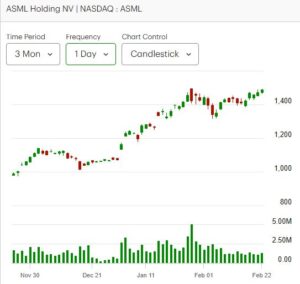
ASML Holding NV (ASML): The company supplies equipment to semiconductor manufacturers. ASML stock was up 1.11% or $16.40 and closed at $1,485.99 with 1.28M shares traded today.
Strategic Takeaway
- Market tone: Risk-off
- Leadership: Limited and selective
- Breadth: Weak
- Volatility: Elevated
Until the major indexes reclaim short-term moving averages and breadth improves, traders may want to emphasize defense, shorter time horizons, and selective exposure to relative strength names.
In this environment, patience is a position.
NOTICE TO READERS
The Canadian Vanguard Stock Market is about empowering you to build and manage wealth by yourself. There is certainly no magic in managing finances or wealth but one needs to know what to do and commit to doing what is needed. When you are ready to start the journey to Put Your Destiny In Your Own Hands, read The Canadian Vanguard every market day. If you need more information please Contact Us
Our readers are strongly advised to conduct their own research into individual stocks before making a purchase decision. In addition, investors are advised that past stock performance is no guarantee of future price appreciation. Any recommendation is not a guarantee of any particular stock’s future prices, and The Canadian Vanguard accepts no responsibility or liability for investors’ or readers’ purchases.
Stocks In The News/ Stocks To Watch and Market Strategy will soon be available but only to Paying Subscribers.
(c) This article is published by The Canadian Vanguard on February 23, 2026