






Cross-Canada Pipeline Pitch: Analysts Debate Economic Value of Alberta-Ontario Trade Route
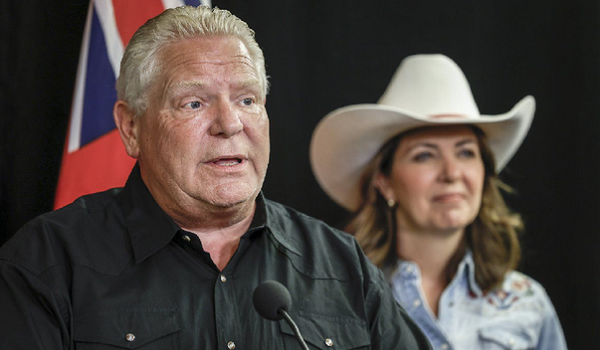
While Premiers Doug Ford and Danielle Smith touted the Alberta-Ontario pipeline project as building a more prosperous Canada, oil industry experts question whether this would be an economically viable project for the country.
“I am more skeptical about the economic wisdom of an Alberta-Ontario pipeline,” said Kent Fellows, a professor of economics at the University of Calgary.
“We have to think about the demand on the Ontario market because obviously it’s not as big of a market,” since the province sources the majority of their oil from another pipeline, he added.

On Monday, Ford and Smith met at the Calgary Stampede to pitch Canadians on the Northern Shield Energy Corridor, a 3,300-kilometre pipeline that would stretch across four provinces. It would run from Hardisty, Alta. through Regina and Winnipeg to refineries in Sarnia, Ont.
Northern Shield would move between 500,000 and 800,000 barrels of oil a day to Sarnia’s refineries. It’s currently the subject of a feasibility study led by Infrastructure Ontario, which includes consultations with 77 Indigenous communities. No timeline or budget is set.
It’s also unclear if Ontario has a large enough market for the additional oil barrels coming in from Alberta, said Fellows.
Sarnia already receives crude oil barrels from the Enbridge Canadian Mainline system in the prairies and is Canada’s largest oil transport system as part of the larger Mainline network. It runs from Edmonton, down to Gretna, Man., before crossing the Canada-U. S. border and connecting with the U.S. portion of the Mainline system, including the Line 5 pipeline.
“There are some serious concerns about trade disruptions along the Enbridge system line,” said Fellows, referring to Michigan’s legal disputes over the Line 5 oil pipeline due to environmental concerns and Canada’s current relationship with the U.S. government.
In a statement to the Star, Lisa Baiton, president of the Canadian Association of Petroleum Producers, said her organization would support “any new capacity that is commercially viable” in order to “unlock investment, production growth, and the infrastructure required to move Canadian oil to market efficiently.”
There’s still the issue of capacity; Ontario’s refineries can only process and store so many barrels of oil. For example, Sarnia’s three main refineries have a collective processing capacity of 270,000 to 285,000 barrels a day. Some of the unknowns of Ford and Smith’s pipeline include unanswered questions on what the price tag would look like, how long the project would take and if Alberta even has enough oil for the rest of the country.
The province produces roughly 4.2 million barrels of oil everyday, according to the Alberta Energy Regulator.
Carol Montreuil, vice-president of Eastern Canada and Economics at Canadian Fuels Association, the official association for petroleum refining, distribution and marketing in the country, said he believes that Alberta would have more than enough oil production to supply both the west coast pipeline and the Alberta-Ontario pipeline.
But market conditions will determine where the oil is needed most and if it can be produced at a reasonable cost.

“Anything we can do to bring more Canadian crude oil to eastern refineries is something that’s good,” he said. It would also cut out industry concerns of oil disruption by the Enbridge Canadian Mainline system, said Montreuil.
“There’s no doubt that you would be taking that vulnerability out of the question.”
Earlier this month, President Donald Trump has said he was not interested in extending the Canada-United States-Mexico Agreement (CUSMA). The ever-changing dynamic between Canada and the U.S. could disrupt the crude oil delivery and distribution to southern Ontario, according to Fellows.
This tension would have “devastating” short-term consequences for the region through gasoline shortages and sky-high gas prices due to limited supply if Enbridge could no longer operate that U.S. portion of the pipeline, said Fellows. Ford and Smith’s proposed pipeline is a way to “de-risk” these worst-case scenarios.
Oil industry analyst James Williams said the proposed pipeline could be expensive and a “hassle” to construct, which can go up to billions of dollars and possibly run through private properties.
“It just doesn’t seem to make any sense to me.”
The premiers’ announcement came at the heels of an announced federally-backed west coast pipeline, running from Alberta to the southern B.C. coast, with taxpayers responsible for significant part of the cost. The pipeline would carry up to one million barrels of oil and the cost could be between $35.2 billion and $43.7 billion. Several Indigenous communities have indicated they oppose the project.
This article was first reported by The Star