




Markets Rally as Bond Yields Retreat and Oil Prices Rise Only Modestly
The Canadian Vanguard Stock Market Report Thursday September 3, 2026 Edition
.
The Toronto Market
Thursday Toronto Market Index
The S&P/TSX Composite Index rallied 541.51 points, or 1.50%, to close at 36,633.12, marking another strong advance for the Toronto market.
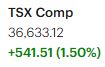

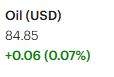
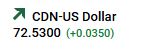
The TSX has now posted two consecutive sessions of strong gains, reversing a three-session losing streak and putting the index firmly back into advancing mode. Today’s price action was notably strong and bullish, with the index comfortably reclaiming and holding above the 36,000 level.
With momentum strengthening, the TSX could make a move toward the 37,000 level over the next several sessions, particularly if Canadian bond yields continue to trend lower, even gradually. A continued decline in yields could provide an additional tailwind for equities and help sustain the current rally.
Technical Picture
The market internals remain constructive. After two powerful advancing sessions, the TSX has moved back slightly above its 25-day moving average and remains well above its 50-day and 200-day moving averages.
Overall, the technical picture has improved considerably. The combination of strong price momentum, the recovery above the short-term moving average, and the index’s continued position well above its intermediate- and long-term moving averages suggests that bullish momentum has returned.
For traders and investors, the key levels to watch in the near term are 36,000 as important support and 37,000 as the next major upside target. A sustained move above 37,000 would further strengthen the bullish technical outlook.
Thursday’s TSX Market Statistics
Market breadth was strongly positive on Thursday, with advancing issues significantly outnumbering declining issues on the TSX. There were 1,575 advancers versus 575 decliners, producing an advancer-to-decliner ratio of 2.74:1—or approximately three advancing stocks for every declining stock. Another 167 issues were unchanged.
The strength in breadth confirms that Thursday’s rally was broad-based rather than being driven by only a handful of large-cap stocks. For traders and investors, this is an important indication of underlying market strength.
52-Week Highs and Lows
The TSX recorded 37 new 52-week highs and 52 new 52-week lows, compared with 40 new highs and 148 new lows on Wednesday.
While the number of new 52-week highs declined only slightly, the number of new 52-week lows fell dramatically—by approximately 65%. This represents a significant improvement in market breadth and suggests that downside pressure has eased considerably.
The new-high-to-new-low ratio improved to approximately 7:10, compared with 1:3 on Wednesday. Although new lows still outnumbered new highs, the substantial reduction in new lows represents a clear improvement in the underlying market structure.
Overall, the TSX’s internal indicators remained strong and bullish, with the market showing considerably better breadth than in the previous session.
Trading Volume
Total volume on the TSX reached 415.72 million shares, down approximately 9% from the 455.60 million shares traded on Wednesday.
The decline in volume is worth noting because the TSX index advanced strongly while overall trading activity decreased by slightly less than 10%. Ideally, continued upside would be accompanied by expanding volume, which would provide additional confirmation of the rally.
Nevertheless, Thursday’s combination of a strong index gain, highly positive advance-decline breadth, and a sharp reduction in new 52-week lows presents an encouraging picture for the broader market.
Bottom line: Thursday’s market internals were decisively bullish. The breadth figures suggest that the rally had broad participation, while the substantial decline in new 52-week lows indicates that selling pressure is receding. The lower trading volume is the main factor that warrants monitoring as the TSX attempts to extend its advance.
Thursday’s Toronto TSX Market Wrap-Up Report
The S&P/TSX Composite Index staged another powerful advance on Thursday, climbing 541.51 points, or 1.50%, to close at 36,633.12. The index decisively reclaimed the 36,000 level and extended its gains to two consecutive strong advancing sessions, following a three-session decline.
The character of Thursday’s market was notably bullish. The advance was broad-based, market breadth was strong, and several major sectors posted substantial gains. The TSX is now back above its 25-day moving average and remains well above its 50-day and 200-day moving averages, reinforcing the improving technical picture.
Interest Rates and Bond Yields
The recent volatility in global fixed-income markets has been an important factor for equities. Although the Bank of Canada has held its overnight policy rate at 2.25%, government bond yields had come under significant upward pressure recently, creating an additional headwind for stocks.
Thursday brought some relief as bond yields pulled back. The move was accompanied by comments from Federal Reserve Governor Christopher Waller, who indicated that he was not prepared to support an interest-rate hike. The combination of lower yields and less hawkish interest-rate expectations helped improve the tone across equity markets.
Lower yields are particularly relevant to the TSX because they can improve the relative attractiveness of equities and reduce pressure on interest-rate-sensitive sectors. The decline in yields also helped support precious and industrial metals, providing a significant boost to Canadian mining and basic-materials stocks.
Broad-Based Sector Rally
Thursday’s advance was not concentrated in just one or two areas of the market. Nine of the TSX’s ten major sectors finished higher, demonstrating broad participation in the rally.
Basic Materials led the market, advancing 2.80%, as metals prices strengthened and mining stocks rallied sharply. Industrials gained 2.54%, while Telecommunications Services, Technology and Financials advanced 1.90%, 1.73% and 1.40%, respectively.
Utilities were essentially flat, gaining only 0.04%. Energy was the only major sector to finish lower, declining 0.62%, making it the session’s clear laggard.
The breadth of the sector advance is encouraging because it indicates that Thursday’s strength was not simply the result of a few large-cap stocks pushing the index higher.
Strong Market Breadth and Improving Internals
The TSX’s internal statistics provided further confirmation of the strength of Thursday’s rally.
There were 1,575 advancing issues versus 575 declining issues, producing an advancer-to-decliner ratio of approximately 2.74:1—roughly three advancing stocks for every declining stock. Another 167 issues finished unchanged.
The new-high/new-low data also improved significantly. The TSX recorded 37 new 52-week highs and 52 new 52-week lows, compared with 40 new highs and 148 new lows on Wednesday.
While new 52-week lows still outnumbered new highs, the number of new lows plunged by approximately 65% from the previous session. This is an important improvement in market internals and suggests that downside pressure has eased considerably.
Taken together, the strong advance-decline ratio and dramatic reduction in new lows indicate that Thursday’s rally had substantial underlying participation.
Gold and Mining Stocks Continue to Strengthen
Gold-mining stocks continued their strong performance, building on Wednesday’s gains as precious-metals prices benefited from the improving interest-rate environment.
Agnico Eagle Mines Ltd. (AEM) gained 5.04%, closing at $285.82, with approximately 1.3 million shares traded.
Franco-Nevada Corp. (FNV) advanced 3.65% to $373.23 on approximately 334,900 shares.
SSR Mining Inc. gained 2.64%, closing at $53.60, with approximately 309,200 shares changing hands.
The strength in mining stocks was consistent with the broader 2.80% gain in the Basic Materials sector and was one of the important contributors to Thursday’s TSX advance.
Canadian Banks Participate in the Rally
The major Canadian banks also participated strongly in Thursday’s advance, with all six of the largest banks gaining more than 1%.
National Bank of Canada was the strongest performer among the group, advancing 1.83%.
Bank of Montreal (BMO) gained 1.78%, closing at $243.56 on approximately 1.7 million shares.
Royal Bank of Canada (RY) advanced 1.56%, closing at $292.37, with approximately 2.2 million shares traded.
The broad participation from the major banks was another positive feature of the session, particularly given the importance and weighting of financial stocks within the Canadian market.
Trading Volume: One Area to Watch
Despite the strong advance in the index, total TSX trading volume was somewhat lower than Wednesday’s level.
Approximately 415.72 million shares changed hands Thursday, compared with 455.60 million shares on Wednesday—a decline of roughly 9%.
The combination of a strong price advance and lower volume does not invalidate the rally, particularly given the exceptionally strong market breadth. However, traders should monitor volume closely if the TSX continues higher.
Ideally, a sustained breakout would eventually be accompanied by increasing participation and expanding volume, which would provide additional confirmation that institutional and broader market participation is supporting the move.
Outlook
The TSX’s technical and internal picture improved substantially over the past two sessions.
The index has reclaimed 36,000, moved back above its 25-day moving average, and remains comfortably above its 50-day and 200-day moving averages. At the same time, market breadth has strengthened considerably, the number of new 52-week lows has fallen sharply, and nine of ten major sectors finished higher.
The next major psychological level to watch is 37,000. If the TSX can maintain its momentum and bond yields continue to ease—even gradually—the index has a reasonable opportunity to challenge that level over the next several sessions.
However, the market remains highly volatile, and traders should not assume that two strong sessions necessarily establish a durable new uptrend. A reversal in bond yields, renewed geopolitical concerns, or a sharp deterioration in market breadth could quickly change the picture.
Key Takeaways for Traders and Investors
- Bullish momentum has returned: The TSX has posted two consecutive strong gains after its three-session decline.
- 36,000 has been reclaimed: The index closed comfortably above this important psychological level at 36,633.12.
- 37,000 is the next key upside level: A sustained move toward or through 37,000 would further strengthen the bullish technical picture.
- Market breadth is a major positive: Advancers outnumbered decliners by approximately 2.74:1, indicating broad participation.
- New lows dropped sharply: The 65% decline in new 52-week lows is an especially encouraging improvement in market internals.
- Sector participation was broad: Nine of ten major sectors finished higher, led by Basic Materials and Industrials.
- Mining stocks remain strong: Gold and precious-metals-related equities continued to outperform.
- Banks confirmed the strength: All six major Canadian banks advanced more than 1%.
- Bond yields remain important: Continued moderation in yields could provide additional support for equities.
- Volume needs monitoring: The TSX rallied strongly despite approximately 9% lower volume, so expanding volume on further advances would provide stronger confirmation.
- Risk management remains essential: Given the market’s elevated volatility, traders may want to consider scaling exposure rather than making an abrupt move from defensive positioning to full exposure.
Bottom line: Thursday was a decisively bullish session for the TSX. The combination of strong index performance, broad sector participation, a nearly 3-to-1 advance-decline ratio, and a dramatic reduction in new 52-week lows suggests that the rally has meaningful underlying support. The next few sessions will be important in determining whether this is simply a powerful short-term rebound or the beginning of a more sustained advance.
.
The US Markets
Thursday’s U.S. Market Indexes
U.S. equity markets staged a strong broad-based rally on Thursday, with three of the four major indexes gaining more than 1%. The Dow Jones Industrial Average advanced 624.16 points, or 1.18%, to close at 53,686.11. The S&P 500 gained 81.11 points, or 1.06%, finishing at 7,666.60, while the Nasdaq Composite rallied 366.23 points, or 1.40%, to 26,584.06.
The Russell 2000, which tracks smaller-cap stocks, gained 15.10 points, or 0.51%, to close at 2,968.27. It was clearly the laggard among the four major indexes, failing to participate fully in the broad market advance.
Interestingly, this represents a reversal in market leadership from Wednesday, when the Russell 2000 was the strongest performer among the major indexes. Thursday’s performance suggests that investors once again favoured the larger-cap and technology-oriented segments of the market.
Technical Picture Improves Significantly
The powerful gains over the past two sessions have substantially improved the technical position of the major U.S. benchmarks.
The Nasdaq Composite, S&P 500 and Dow Jones Industrial Average are now clearly above their 25-day, 50-day and 200-day moving averages. This is an encouraging development because the indexes are now positioned above their short-, intermediate- and longer-term trend indicators.
For traders, this strengthens the overall technical picture and suggests that the recent selling pressure has been reversed—at least for now.
The Russell 2000 presents a considerably less convincing picture. The small-cap index remains below both its 25-day and 50-day moving averages, although it remains comfortably above its 200-day moving average.
This divergence is worth watching. When small-cap stocks fail to participate in a broad market rally, it can indicate that investors remain selective and are still favouring larger, more established companies.
Small-Cap Weakness Warrants Attention
The Russell 2000’s position below its 25-day and 50-day moving averages makes it the weakest technically positioned of the four major indexes.
A decisive break below the 50-day moving average, particularly if accompanied by heavy trading volume, is often treated by technical traders as a warning signal. Conversely, a recovery above the 50-day moving average would improve the Russell 2000’s technical outlook.
.
Thursday’s U.S. Market Statistics
Thursday’s U.S. market rally was supported by strongly improved market internals on both the NYSE and Nasdaq. Breadth strengthened considerably, while the new-high/new-low data showed a meaningful reduction in downside pressure. Trading volume, meanwhile, remained relatively stable.
New York Stock Exchange (NYSE): Market breadth on the New York Stock Exchange was strongly positive. There were 3,003 advancing issues versus 1,517 declining issues, with 487 issues unchanged. This produced an advancer-to-decliner ratio of 2.00:1, meaning there were approximately two advancing stocks for every declining stock.
The NYSE also recorded 284 new 52-week highs and 186 new 52-week lows, compared with 150 new highs and 293 new lows on Wednesday.
This represented a substantial improvement in the market’s internal strength. The number of new 52-week highs increased by approximately 89%, while the number of new 52-week lows declined by approximately 37% from the previous session.
As a result, the new-high-to-new-low ratio improved to approximately 3:2, compared with roughly 1:2 on Wednesday. This is a significant reversal and indicates that upside participation expanded while downside pressure diminished.
The NYSE’s internal indicators therefore moved from a weaker position earlier in the week to a decidedly more bullish configuration on Thursday.
NYSE Trading Volume: Total NYSE volume reached approximately 4.917 billion shares, compared with 4.873 billion shares on Wednesday—an increase of less than 1%.
The fact that the market rallied sharply while trading volume remained essentially unchanged is noteworthy. The rally was therefore accompanied by strong breadth and improved new-high/new-low statistics without a meaningful expansion in volume.
For traders, continued upside accompanied by increasing volume would provide additional confirmation of the strength and sustainability of the move.
Nasdaq: The Nasdaq also recorded positive market breadth, with 3,064 advancing issues versus 1,780 declining issues and 455 issues unchanged. The resulting advancer-to-decliner ratio was 1.72:1, or approximately seven advancing stocks for every four declining stocks.
This marked the second consecutive session of positive Nasdaq breadth, an encouraging development following the weaker internal conditions earlier in the week.
The Nasdaq recorded 147 new 52-week highs and 164 new 52-week lows, compared with 90 new highs and 239 new lows on Wednesday.
The improvement was substantial. New 52-week highs increased by approximately 63%, while new 52-week lows declined by approximately 31%.
Consequently, the new-high-to-new-low ratio improved dramatically to approximately 9:10, compared with roughly 1:5 on Wednesday. Although new lows still slightly outnumbered new highs, the change in the ratio represents a significant improvement in the market’s underlying condition.
The Nasdaq’s internal indicators therefore strengthened considerably and moved in a more bullish direction.
Nasdaq Trading Volume: Total Nasdaq volume reached approximately 7.615 billion shares, down about 2% from Wednesday’s 7.747 billion shares.
The Nasdaq nevertheless posted a strong gain despite the modest decline in volume. As with the NYSE, the absence of a significant increase in volume means that traders should watch future sessions for evidence of expanding participation.
Overall U.S. Market Internals
Thursday’s statistics provide substantial confirmation of the strength of the market rally.
The most encouraging development was not simply the strong performance of the major indexes, but the simultaneous improvement in their underlying market internals. Both the NYSE and Nasdaq recorded positive breadth, while the number of new 52-week highs increased significantly and the number of new 52-week lows declined sharply.
The NYSE was particularly impressive, with a 2:1 advance-decline ratio and new highs outnumbering new lows. The Nasdaq’s breadth was somewhat weaker, but it nevertheless showed a substantial improvement in its new-high/new-low relationship.
Trading volume did not expand materially on either exchange. That is the primary factor that prevents the internal statistics from providing an even stronger confirmation of the rally.
Bottom line: Thursday’s U.S. market internals were clearly stronger and more bullish than Wednesday’s. The combination of strong advance-decline breadth, a sharp increase in new 52-week highs, and a substantial decline in new 52-week lows indicates that the negative internal trend seen earlier in the week has been decisively interrupted. If these improvements persist—and particularly if volume expands as the indexes continue higher—the case for a more durable market advance will become considerably stronger.
.
Thursday’s U.S. Market Wrap-Up Report
U.S. equity markets staged a powerful broad-based rally on Thursday, extending the strong performance from Wednesday and significantly improving the market’s technical and internal picture.
The Dow Jones Industrial Average gained 1.18%, the S&P 500 advanced 1.06%, and the Nasdaq Composite rallied 1.40%. The Russell 2000 gained only 0.51%, making small-cap stocks the clear laggard despite having been the strongest performer among the major indexes on Wednesday.
The rally was supported in part by a retreat in U.S. Treasury yields following comments from Federal Reserve Governor Christopher Waller, who indicated that he was not prepared to support an interest-rate hike. The decline in yields helped ease some of the pressure that higher interest rates have recently placed on equities.
A Significant Improvement in Market Internals
One of the most encouraging aspects of Thursday’s rally was the improvement in the market’s internal statistics.
On the NYSE, advancing issues outnumbered declining issues by 3,003 to 1,517, producing a strong 2.00:1 advance-decline ratio. More importantly, the exchange recorded 284 new 52-week highs versus 186 new 52-week lows, compared with 150 highs and 293 lows on Wednesday.
That represents a substantial improvement. New 52-week highs increased by approximately 89%, while new 52-week lows declined by roughly 37%. The new-high-to-new-low ratio consequently improved from approximately 1:2 on Wednesday to 3:2 on Thursday.
The Nasdaq also showed improving internal strength. Advancers outnumbered decliners 3,064 to 1,780, producing a 1.72:1 advance-decline ratio. New 52-week highs increased to 147 from 90, while new lows declined to 164 from 239. The new-high-to-new-low ratio improved dramatically from approximately 1:5 to 9:10.
These figures suggest that Thursday’s rally was supported by broad market participation and a significant reduction in downside pressure, rather than being driven exclusively by a small group of large-cap stocks.
Major Indexes Reclaim Important Moving Averages
The two-day rally has also produced a significant improvement in the technical picture.
The Nasdaq Composite, S&P 500 and Dow Jones Industrial Average are now clearly above their 25-day, 50-day and 200-day moving averages. This is an important technical development because the three major indexes have now regained their short-, intermediate- and long-term trend indicators.
The Russell 2000 remains the exception. The small-cap index is still below its 25-day and 50-day moving averages, although it remains comfortably above its 200-day moving average.
This divergence deserves attention. A continued failure by small-cap stocks to participate could indicate that investors remain selective and are still concentrating capital in larger-cap companies. Conversely, a recovery by the Russell 2000 above its 50-day moving average would provide another important signal that risk appetite is broadening.
Sector Performance: Thursday also produced a relatively broad improvement across U.S. sectors.
Industrials led the advance, gaining 2.15%, followed by Financials, which rose 1.72%. Consumer Discretionary, Technology, Utilities and Telecommunications Services gained 1.31%, 1.28%, 0.96% and 0.82%, respectively.
Basic Materials increased 0.41%, while Healthcare gained 0.27%.
Energy was the only lagging major sector, declining 0.73%.
The leadership from Industrials and Financials is noteworthy because it demonstrates that Thursday’s rally extended beyond the technology sector and included economically sensitive areas of the market.
Individual Stocks in Focus
The technology sector received additional support from strong performances among several major companies.
Snowflake (SNOW) was one of the session’s standout performers after delivering a well-received earnings report Thursday morning. The stock surged 16.60%, closing at $356.48, with approximately 21.8 million shares traded.
Dell Technologies (DELL) continued its strong post-earnings performance. After gaining approximately 16% on Wednesday following its upbeat earnings report, Dell advanced another 4.58% on Thursday, closing at $514.42 on approximately 20.3 million shares.
Tesla (TSLA) also continued to outperform, gaining 5.42% to close at $376.36, with approximately 63 million shares traded.
The strong moves in these individual stocks demonstrate that traders are still rewarding companies that deliver strong earnings, positive guidance or compelling growth expectations.
Volume, Positive, but Not Yet a Strong Confirmation: The improvement in market breadth occurred without a significant increase in overall trading volume.
NYSE volume reached approximately 4.917 billion shares, essentially unchanged from Wednesday’s 4.873 billion shares. Nasdaq volume was approximately 7.615 billion shares, about 2% below Wednesday’s 7.747 billion shares.
The fact that the major indexes rallied strongly while volume remained relatively stable is not necessarily negative, particularly given the substantial improvement in breadth and new-high/new-low statistics. However, expanding volume on additional advancing sessions would provide stronger confirmation that the rally has broad institutional support.
What Traders and Investors Should Watch: The market has experienced considerable volatility and can change direction quickly. Nevertheless, the combination of Wednesday’s and Thursday’s strong performances has materially improved the near-term technical picture.
For traders who moved heavily into cash or substantially reduced exposure during the recent period of volatility, the current environment may warrant reassessing market exposure rather than assuming that the previous downtrend will automatically resume.
That does not necessarily mean moving immediately from a defensive position to full exposure. In a volatile market, scaling into positions gradually can provide a more measured approach while allowing traders to respond to confirmation—or failure—of the current rally.
The market can change trends quickly. Capital preservation therefore remains important, and traders should be prepared to reduce risk or protect profits if the market reverses sharply.
The August employment report, scheduled for release before Friday’s opening bell, is another important potential catalyst. The reaction in Treasury yields and interest-rate expectations following the report could have a significant influence on equities.
Key Takeaways for Traders and Investors
- The short-term market trend has turned more constructive. The Dow, S&P 500 and Nasdaq are now above their 25-day, 50-day and 200-day moving averages.
- Market breadth strongly supports the rally. The NYSE recorded a 2:1 advance-decline ratio, while Nasdaq breadth was 1.72:1.
- New-high/new-low statistics improved dramatically. New highs increased while new lows declined sharply on both exchanges.
- The NYSE produced particularly strong internals, with new 52-week highs actually exceeding new 52-week lows.
- Small-caps remain a weak spot. The Russell 2000 is still below its 25-day and 50-day moving averages.
- Bond yields remain a major market driver. A sustained decline in yields could provide additional support for equities, while renewed upward pressure could quickly challenge the rally.
- Volume has not yet expanded materially. Stronger volume accompanying future gains would provide additional confirmation.
- Friday’s employment report could increase volatility. Traders should be prepared for potentially significant moves following the release.
- Gradual positioning may be preferable to an all-or-nothing approach in an environment where the market can change direction rapidly.
- Risk management remains critical. Traders should be prepared to protect capital or take profits if the current rally fails to hold its newly reclaimed technical levels.
Bottom Line
Thursday was a significant improvement in both the price action and the internal health of the U.S. equity market. The major indexes posted strong gains, market breadth was firmly positive, new 52-week highs increased substantially, new lows declined sharply, and the Dow, S&P 500 and Nasdaq reclaimed their major moving averages.
The evidence therefore increasingly favours a short-term bullish bias, although the market remains volatile and the rally still needs to prove that it can persist. The next several sessions—particularly the market’s reaction to Friday’s employment report—will be important in determining whether the current two-day surge develops into a more durable advance or remains another powerful but temporary rebound.
.
NOTICE TO READERS
The Canadian Vanguard Stock Market is about empowering you to build and manage your wealth by yourself. There is certainly no magic in managing finances or wealth but one needs to know what to do and commit to doing what is needed. When you are ready to start the journey to Take Charge and Put Your Destiny In Your Own Hands, start with reading The Canadian Vanguard every market day. If and when you need more related information or to advertise your business products or services in The Canadian Vanguard, Contact Us
Our readers are strongly advised to conduct their own research into individual stocks before making a purchase decision. In addition, investors are advised that past stock performance is no guarantee of future price appreciation. Any recommendation is not a guarantee of any particular stock’s future prices, and The Canadian Vanguard accepts no responsibility or liability for investors’ or readers’ purchases.
Stocks In The News/ Stocks To Watch and Market Strategy will soon be available only to Paying Subscribers. The dollar sign “$” in the Toronto Market section in the articles only stands for Canadian dollar and in the US market section “$” stands for US dollar.
(c) This article is published by The Canadian Vanguard on September 3, 2026