






Extended Trading Sessions Set to Modernize Canadian Equity Markets
A new platform launched by CIX Trading Inc. has brought extended trading hours to Canada, allowing investors to buy and sell domestic stocks earlier in the morning and well into the evening.
Stocks currently trade on Canadian exchanges between 9:30 a.m. and 4 p.m. ET each weekday. Beginning Monday, CIX will allow trading from 8 a.m. to 5 p.m. before moving to a 7 a.m. to 8 p.m. schedule later this year. Eventually, CIX plans to offer trading 23 hours per day, Monday through Friday.
The launch caps off a years-long process of regulatory scrutiny, fundraising and technical trials. CIX’s mission is to modernize Canadian capital markets by offering new features – most notably extended hours, but also fractional trading, which makes it possible to buy less than one full share – that have long been available in other jurisdictions such as the United States.

“What we are really trying to do is get to a level playing field from an access perspective,” said Jeff Foster, a two-decade veteran of Toronto Stock Exchange parent TMX Group Ltd. who is now the founder and chief executive officer of CIX. “Nowadays, you’re competing with sports betting, U.S. stock trading and crypto. All of that has a really smooth customer experience.”
“All these other asset classes are basically 24/7 now and then you have Canadian equities still at 9:30 to 4.”
CIX is currently licensed to operate as an alternative trading system (ATS), which does not directly list securities like a stock exchange. Rather, ATS platforms compete to be the venue of choice for the actual buying and selling of securities by offering small stock price differences. Having the most attractive price for a particular security at any given time among all venues is referred as being “top of book.”
Mr. Foster said the goal is to eventually become a full-fledged exchange as the latest challenger to the hegemonic TSX.
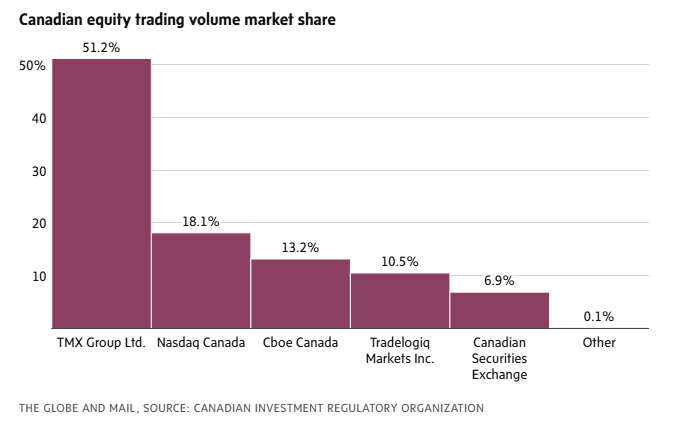
TMX currently controls roughly half the Canadian equity trading market, according to data from the Canadian Investment Regulatory Organization. However, TMX recently announced the acquisition of Cboe Canada, previously known as the NEO Exchange. Once the deal closes, TMX will handle roughly two-thirds of Canada’s equity trading volume.
When CIX was seeking regulatory approval, TMX submitted a letter to the Ontario Securities Commission warning the upstart’s plan poses a potential threat to the stability and integrity of Canada’s capital markets.
“Any implementation of such fundamental changes must be preceded by a commercially reasonable lead time to mitigate systemic risk and ensure the operational readiness of all stakeholders,” the letter said. “Failure to do so may have profoundly disruptive consequences for the stability and integrity of the Canadian capital markets.”
In an e-mailed response to questions about whether TMX is considering offering extended trading hours on the venues it controls, spokesperson Catherine Kee said the company was engaged in “a collaborative, stakeholder-driven extended trading hours initiative” and it will “update the marketplace on this initiative later this year.”
Canadian investors have been able to buy and sell U.S. stocks at virtually any time of day for years, thanks in part to Canadian-backed U.S. fintech startup Blue Ocean Technologies LLC, which pioneered the American overnight trading market.
As stock trading has become increasingly global, with investors in Asian and European time zones looking to transact in North American securities during their own working hours, other countries have also started keeping their markets open for longer.
In July, the London Stock Exchange Group announced plans to launch LSE 24, which will allow near-continuous trading of LSE-listed securities from Monday to Friday. Testing will begin later this year, with plans to make exchange-traded funds (ETFs) the first asset class available through the LSE 24 platform in the first half of 2027.
“Once we get that up and running it would be perfectly natural for us to introduce trading of regular equities,” LSEG CEO David Schwimmer said in an interview at the company’s new Toronto office.
Banks and brokerage firms are not the driving forces behind the demand for longer trading hours, he said. In fact, “a lot of banks and brokers are not excited about this,” he said.
All five of Canada’s largest banks declined to comment on this story.
“For a lot of banks and brokers, that is an extra cost structure. ‘Am I going to need to man all these exchanges 24 hours a day?’,” Mr. Schwimmer said. “What it will really mean is they will have to have people keep an eye on it.”
“It is not something that they would vote for. It’s being driven by other trends,” he said.
The twin trends of crypto investing raising retail expectations for around-the-clock trading and the increasing globalization of interest in equities in different markets are two key drivers, Mr. Schwimmer said. Rising global volatility, he said, is also making longer trading days a necessity.
“We are clearly now in a period where geopolitical risk has returned to the fore and things happen all the time, including at night and on weekends and outside of trading hours – sometimes intentionally outside of trading hours,” Mr. Schwimmer said.

“If you know you have market exposure and you’re like, ‘Why do I have to wait until 8 o’clock tomorrow morning to deal with this?’ You put all those things together and it’s like expectations have changed.”
CIX is targeting a 1-per-cent market share within its first month of operations and 5 per cent by the end of its first year. Longer-term, Mr. Foster said the aim is to capture 20 per cent of the market, which would put his company ahead of the TSX Venture Exchange and second only to the TSX itself.
Right now, banks and brokers are under no obligation to execute any trades on CIX, even if the prices offered on its venues are top of book. That is because Canadian trading platforms must have a minimum of 2.5-per-cent market share, among other requirements, in order to gain what is known as protected status.
While the higher-profile features of CIX will attract popular attention, Mr. Foster is confident that the technology underpinning his platform – Imperative Execution Inc.’s IntelligentCross – will ultimately convince traders to ship orders there.
Since launching in September, 2018, IntelligentCross has become the largest ATS venue by market share in the U.S. It uses artificial intelligence to match the most shares possible at the best time possible to improve what traders refer to as execution quality.
“It isn’t like most engines, where you are just trying to match the highest number of shares possible,” Mr. Foster said.
“That is probably the biggest differentiator we have and that is where we are going to see a lot of our success come from.”
This article was first reported by The Globe and Mail