







Short-Term Mortgage Trend Leaves Canadian Homeowners Vulnerable to Economic Shocks
A record-low number of homeowners are opting for long-term fixed-rate mortgages, and economists say a reliance on cheaper, less-stable products could leave the housing market more susceptible to monetary policy changes and outside forces like oil price shocks from the war in Iran.
Just 8.8 per cent of Canadians signed a fixed mortgage with a term of five years or longer this summer, according to a data analysis by National Bank. It’s a major change from the prepandemic era, when nearly 50 per cent of homeowners signed long-term fixed mortgages.
National Bank senior economist Daren King, who authored the study, said that the recent spike in bond yields – which lenders base their mortgage rates on – and the corresponding hikes in long-term fixed mortgage rates mean that even fewer consumers will choose them in the coming months. The data in Mr. King’s report reflects trends until July, 2026.

Mr. King said the housing market could remain even more sluggish than expected if homeowners are increasingly rate-sensitive, especially since the Bank of Canada is expected to raise interest rates in the coming months and bond yields continue to soar near two-year highs and drive up the cost of borrowing.
“In August and September the recovery to the housing market stopped,” Mr. King said. “At first, it was caused with uncertainty from the U.S. trade conflict, but now it’s more of the impact of rising interest rates.”
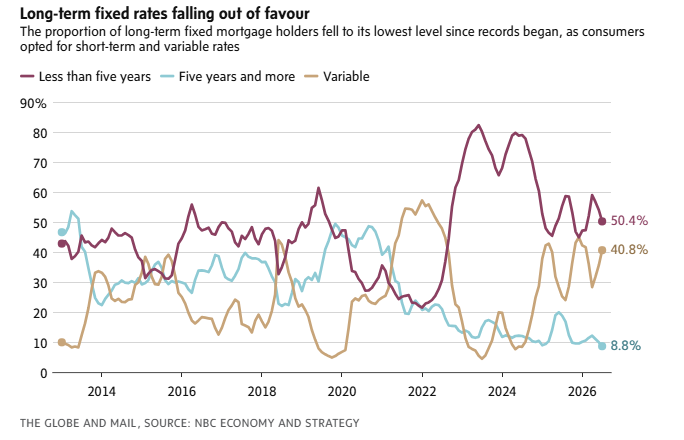
The decrease in long-term fixed rate borrowing accelerated around 2022, when less than 20 per cent of consumers were choosing those mortgages. They instead opted for short-term fixed rates at a time when all mortgage rates were high, betting that borrowing costs would drop quickly. More than 80 per cent of shoppers were choosing a fixed-term shorter than five years at the peak of that trend in mid-2023.
The advantage of shorter-term mortgages has greatly diminished. Victor Tran, an Ontario-based mortgage broker, said three-year fixed rates are currently only 0.1 per cent cheaper than five-year fixed rates.
That’s part of the reason why variable rates have been making a comeback in 2026, with more than 40 per cent of consumers signing one, up from less than 10 per cent in 2024. Variable rates are also nearly one percentage point cheaper than fixed rates right now.
But variable rates come with their own risks. Financial markets have priced in the likelihood of four Bank of Canada rate hikes by mid-2027, which would bring variable rates up to the mid-4-per-cent range, a level comparable with current five-year fixed rates.
Kari Norman, a senior economist with Desjardins, said oil price shocks caused by the war in Iran and the impact of the U.S. trade war on the Canadian economy are examples of how variable or short-term mortgage holders carry more immediate risk.
“Who would have thought that we’d have an oil price shock this year. We couldn’t have anticipated that a year ago,” Ms. Norman said.
She said someone signing a five-year fixed rate would likely see their family income increase over the life of their mortgage term, allowing them to absorb similar rate hikes better.

In the long term, Mr. Tran predicts that five-year fixed rates will make a comeback. More of his clients are already choosing longer-term rates.
“A lot or people coming up for renewal are looking for stability,” Mr. Tran said.
However, pricing on five-year rates will face upward pressure for the rest of 2026. Mr. King noted that those rates have been unusually low compared with bond yields because of intense competition between lenders over a large cohort of renewals five years on from the pandemic housing boom. Once that wanes and the slower winter season begins, lenders will likely increased their rates even if bond yields stay flat.
Unless geopolitical stresses like the war in Iran ease, Mr. King said the housing market will remain in a weak state in 2027.
This article was first reported by The Globe and Mail