






How an innovative Alberta school is solving Canada’s skills shortage with hands-on education”
As Canada looks to train more skilled tradespeople to support its ambitious infrastructure and housing plans, a new Alberta charter school is taking a different approach to education by putting hands-on training at the centre of its curriculum, beginning as early as Grade 7.
“I was actually very surprising on how much we were actually doing hands on,” said Landen Zacharias, a 15-year-old Grade 10 student at Grande Prairie Technical Institute, known as GP Tech. “I was comparing some of it to my friends in other schools, and they were very jealous.”
The publicly funded school opened in September, offering students opportunities to explore construction, automotive technology and culinary arts alongside traditional academic subjects.

But the school’s opening has not been without challenges. Some programs and facilities remain under development, and board chair Noshaba Harji acknowledges the school is still finding its footing.
“We are in the initial stages. We’ve only been open for a few months, but we do want to build an institution that delivers on what the community needs,” she said.
Harji said administrators had just 10 weeks to prepare the building before welcoming students, describing the process as a major hurdle.
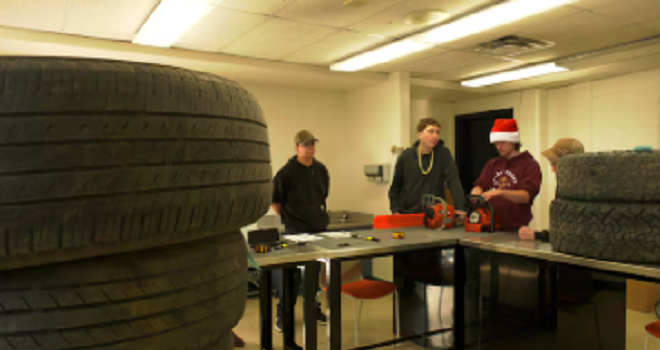
Despite the challenges, students are already taking part in practical projects.
Ryzdyn Shaw, a Grade 9 student who hopes to become a licensed automotive mechanic, developed an interest in the trade when he was young.
“I’ve been working with my dad in our driveway and in our garage since I was, like eight,” he said.
He is currently studying construction at GP Tech and will begin automotive training next semester.
What is a charter school?
Alberta is the only province in Canada with a public charter school system.
Charter schools are publicly funded and independently operated by non-profit organizations rather than traditional school boards. They must follow Alberta’s curriculum but can offer specialized educational approaches, including programs focused on science, technology, arts and alternative learning methods.
There are 36 charter school authorities in Alberta, with dozens of school sites across the province. Most are concentrated in larger urban centres, particularly Calgary and Edmonton.
Unlike private schools, public charter schools do not charge tuition.
Traditional public schools already offer trades-related courses, including construction, mechanics and culinary arts, raising questions about the need for a separate charter school.
Harji says the difference lies in how GP Tech incorporates those skills into everyday learning.
“We are not just focusing on the core subjects as well as the options for skills and trades. We’re looking at it from a completely different lens.”
Harji said students spend about 70 per cent of their time in workshops, developing foundational skills alongside their academic studies.
Recruiting young workforce
The school’s approach comes amid growing concerns about a shortage of skilled trades workers in Canada, with federal officials warning that the country needs to attract more people into the sector.
According to the federal government, Canada will need more than 1.4 million new skilled trades workers by 2033, with an estimated 21 per cent of the existing workforce expected to retire.
Ottawa has announced an $8-billion investment through its Team Canada Strong initiative, aimed at recruiting, training and hiring 80,000 to 100,000 new Red Seal skilled trades workers by 2030–31.
Harji believes exposing students to the trades earlier could help address future workforce needs, particularly as more experienced workers approach retirement.
“This way we are able to fill that gap earlier on, and we’re able to meet that need and be ready for it, rather than waiting for it to come up,” she said.
But while schools like GP Tech aim to introduce more young people to the trades, economist Jim Stanford cautions that demand for those workers can fluctuate significantly.
“Employers often pull their hair out and complain about a shortage of skilled trades, but there is a real boom and bust aspect to this career path, unfortunately,” said Stanford, director of the Centre for Future Work.
He pointed to downturns in home construction and broader economic uncertainty, including U.S. tariffs, as factors affecting employment.
Still, Stanford said Canada’s plans for major investments in housing, mining and resources, and manufacturing could create significant demand for skilled workers.
“If all of those plans came to fruition, then there’s no doubt that the existing need for skilled trades training in Canada, which is already there, would get that much more intense,” he said.
Regardless of how demand evolves, education experts say introducing students to different trades at a younger age can help them explore potential career paths.
Bonnie Watt, a University of Alberta faculty of education professor, says combining practical training with traditional academic subjects can also make learning more meaningful.
“When we can actually have the object or the three-dimensional piece that we’re working with and bring in the physics and the science and the English and the social,” she said, students can better understand how those subjects apply to the work they’re doing.
Watt believes Grade 7 is an opportunity for students to discover what interests them — and what doesn’t — before making decisions about their futures.
“If I can make a decision in grade seven that I don’t like that particular skill set, and I have no attraction to it, but I can move on to another one. , I don’t have to be 20 years old, try it and then decide that I’m not doing it,” she said.
GP Tech has established partnerships with Northwestern Polytechnic in Grande Prairie and SAIT in Calgary, offering potential pathways to further training.
‘A community hub’
But the school’s ambitions extend beyond the classroom.

“The vision for it is to be a community hub, creating it with community partnerships,” Harji said.
Longer-term plans include a student-run café and free automotive services, such as oil changes and tire changes, for community members.
The school also plans to expand its programming.
“We will be offering aviation in the near future,” Harji said.
For Zacharias, who hopes to one day own a construction business, introducing young people to the trades could help meet Canada’s future workforce needs.
“We’ll just have a higher demand more and more. So it’s good that we have schools like this to make kids want to do this more and be more engaged with it,” he said.
And as his father often reminds him, skilled trades workers will always have a role to play.
“My dad always said even a lawyer or a doctor need a roof to live under,” he said.
This article was first reported by CTV News