





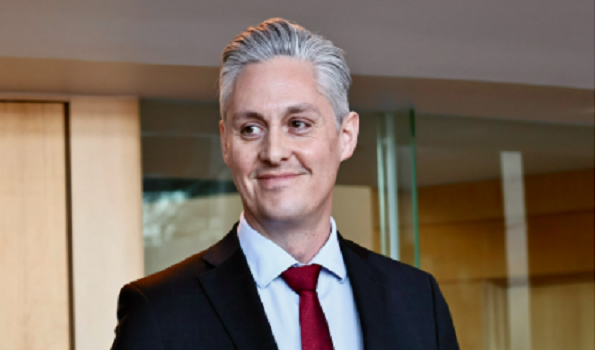
NWT Premier Urges Ottawa to Commit to Mackenzie Valley Highway to Drive Economic Growth
A federal commitment to fund the construction of the Mackenzie Valley Highway is essential to making Canada’s North more attractive to investors and could be the region’s last chance to unlock its economic potential, Northwest Territories Premier R.J. Simpson says.
The proposed highway, first envisioned in the 1950s, would be an 800-kilometre, all-season gravel route that connects a highway system extending to Southern Canada with northern highways leading to the Arctic Ocean, without having to detour through B.C. and Yukon or travel a system of ice roads.
Last week’s federal budget earmarked $187-million to launch a project manager to lead the initiative, and Ottawa has proposed to fully fund the construction of the highway, estimated to cost $3.5-billion, as well as some continuing maintenance.

The route is expected to create a more dependable flow of supplies to remote Northern communities, and allow families to travel by land in and out of the region year-round.
“It’s going to change people’s lives,” Mr. Simpson said in a Tuesday interview at an infrastructure conference in Toronto organized by the Canadian Council for Public-Private Partnerships. “I wouldn’t be surprised if there were tears when people read the federal budget.”
It is also expected to change the equation for investors when they look at resource exploration, mining or infrastructure investments in the Northwest Territories, offering a cheaper, land-based way to access the region without resorting to charter flights and helicopters.
“For investors, one of the big barriers that we’ve had is a lack of infrastructure,” he said. “It just makes everything too expensive.”
But Mr. Simpson said that the territory has to move quickly to capitalize on a generational opportunity to build infrastructure that makes a new set of economic opportunities possible before the current burst of political will wanes.
“There’s a recognition that if we don’t capitalize on this opportunity, it’s probably not coming around again,” he said.
An intensifying focus on Arctic sovereignty and national defence, Canada’s energy security and critical mineral supply chains, as well as tensions with the United States, have spurred increased interest in the North, including among Canadian and European investors.
When top global CEOs visited Toronto for the Canada Investment Summit in September, “it was interesting to hear that the North was on their radar,” Mr. Simpson said.
First, there is work to do to build the necessary “enabling infrastructure” that makes it possible to commit capital to Northern projects.
The Northwest Territories is working to streamline its regulatory system, which is jointly managed by boards with territorial, Indigenous and federal government officials. For a long time, the federal government wasn’t fully engaged or making timely board appointments, Mr. Simpson said.
“All of those little things add two weeks here, three weeks there, six months there to the timelines for development,” he said. Now, federal officials are “paying attention. They’re now focused on it.”

There is also a changing perception of the role Indigenous peoples can play as partners and investors in projects, so that investors understand those communities, when engaged from the start, “aren’t barriers to development,” he said.
Prime Minister Mark Carney’s government has referred three key projects in the Northwest Territories to the Major Projects Office: the Mackenzie Valley Highway, the $3.4-billion Taltson Hydro Expansion and the Arctic Economic and Security Corridor – a proposed 400-kilometre all-season road to the Nunavut border.
Since then, Canadian industry is showing more curiosity about the North. One week after Mr. Carney announced the referrals, mining group Rio Tinto – which has dwindling diamond mining operations in the territory – travelled to the region to explore for mineral deposits. The company has secured prospecting licences to look for copper.
The Taltson project, which Mr. Simpson estimated could be finished by 2033 or 2034, would add 320 kilometres of transmission lines to connect industrial customers and more than 70 per cent of the NWT population in 11 communities through a unified grid.
“We have mines that are ready to go,” he said. “We just need that power.”
And as Ottawa considers lifting its decade-long moratorium on offshore oil and gas exploration in the Western Arctic, there could be further interest from the energy sector.
“The barriers that have traditionally been there that prevented companies from coming in, we’re addressing those,” he said.
“Those are the most basic things you can do, but we haven’t done them,” he added. “We’re doing them now.”
This article was first reported by The Globe and Mail