





Ottawa Looks to Ease Trade Tensions as Carney Heads to Washington
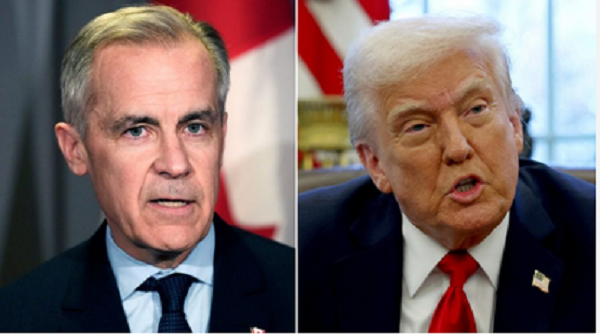
Prime Minister Mark Carney heads to Washington Monday to talk trade and security with U.S. President Donald Trump as Canada seeks to end or reduce mounting U.S. tariffs.
Mr. Carney will meet with Mr. Trump at the White House Tuesday before returning home the next day, the Prime Minister’s Office said in a statement.
This will be the Prime Minister’s second trip to the White House since taking office this year. After his previous meeting with Mr. Trump in May, Mr. Carney emerged without any measurable progress in ending a costly trade war but also avoided any sign of conflict with the mercurial President.
A senior government official, asked about the prospects of any kind of breakthrough at the White House, said only that there will be very live and active conversations between Canadian and U.S. officials right up until the meeting.
The Globe and Mail is not identifying the source because they are not authorized to discuss the matter publicly.

The official also said Canada expects to talk about North American border and perimeter security with Mr. Trump, including Ottawa’s efforts to boost oversight in the Arctic and increase defence spending. The source cited Canada’s decision to buy new submarines that are capable of traversing Arctic waters.
Mr. Carney will be accompanied by Dominic LeBlanc, Minister Responsible for Canada-U.S. Trade, Foreign Affairs Minister Anita Anand and Industry Minister Mélanie Joly.
Canada, Mexico and the U.S. are preparing for a scheduled review of the United States-Mexico-Canada Agreement, with the Trump administration expected to seek more concessions for U.S. industry.
Even as he seeks a trade deal with Mr. Trump, Mr. Carney is trying to fast-track large infrastructure and resource projects within Canada to spur the Canadian economy as it faces strong headwinds from Mr. Trump’s protectionist policies.
The United States is still waiting for a decision from Mr. Carney on whether he plans to scale back Canada’s order of F-35 fighter jets as contemplated in a review announced this spring after Mr. Trump’s tariffs hit. The government has floated the idea of cutting back the 88-jet order to 16. And Canada and the United States are discussing whether Ottawa will join Mr. Trump’s Golden Dome missile-defence project.
Goldy Hyder, president of the Business Council of Canada, a lobby group, said he expects that Mr. Carney is seeking closer ties with Mr. Trump. “The President is a relationship man. He believes in relationships,” he said.
Mr. Hyder disagrees with those who feel it’s risky to be talking to the President because of the unpredictability factor. “Our advice has been: it’s more risky not to be talking to the President. You’re better off being there in the room with him than on the outside as a target.”
The U.S. envoy to Canada, Pete Hoekstra, recently said the Trump administration had hoped to negotiate a grander bargain with Canada than simply a renewal of the USMCA – a deal that would have encompassed a multitude of issues, including defence, energy and autos.

Since returning to office earlier this year, Mr. Trump has hit Canada with a string of tariffs: 50 per cent on steel and aluminum, 25 per cent on autos – with a carve-out for U.S. parts – and 35 per cent on any goods traded outside the USMCA, with the exception of oil, gas and potash, which are subject to 10-per-cent tariffs.
On Sept. 30, Mr. Trump imposed a new 10-per-cent tariff on Canadian softwood-lumber shipments, raising the total levy on softwood from Canada to more than 45 per cent.
The Business Council’s Mr. Hyder said Canada needs to remember the significant waiver it currently receives from U.S. tariffs – where 85 per cent of Canadian exports are exempt from levies imposed by Mr. Trump – could be removed.
“We’re in a good place because the President chose to grant exemptions,” he said. “That also means they can be taken away, so let’s not get too comfortable here.”
He said Canada has to consider joining Mr. Trump’s Golden Dome project.
“I think it’s all just a part of the security umbrella – after all, those missiles will fly over Canada if there ever were to be any,” he said.
Daniel Ujczo, an Ohio-based trade lawyer with clients on both sides of the Canada-U.S. border, said he was skeptical that the two sides are close to any agreement. For one, they want to see how Mr. Trump’s trade deals with the European Union, Japan and South Korea play out before making an agreement of their own, he said.
He said the U.S. also has to figure out how to reconcile Mr. Trump’s desire for long-term tariffs with the USMCA, which stipulates that there be no tariffs on the vast majority of trade between the three countries.
“It would be premature to expect a deal at this point. Until the dust settles, it’s difficult to make an agreement,” he said.
In addition to trade, he said Mr. Carney and Mr. Trump were likely to discuss Russia-Ukraine, security issues and defence procurement.
Mr. Trump earlier this week revived talk of annexing Canada, making public a recent conversation with Canadian officials. In his speech to U.S. generals and admirals at the Marine Corps. base in Quantico, Va., the President reiterated that Ottawa wants to join his proposed Golden Dome missile-defence system.
“Canada called me a couple of weeks ago, they want to be part of it, to which I said, ‘well, why don’t you just join our country, you’d become 51, become the 51st state, and you’d get it for free,’ ” he said in the speech.
Mr. Trump added that his tariffs are hitting the Canadian economy and pushing investment to instead go to the U.S.
“They’re having a hard time up there in Canada now because, as you know, with tariffs, everyone’s coming into our country. We have more investment than we’ve ever had before,” he said. “They’re coming in from Canada, Mexico, from Europe, from all over – AI, auto plants – everybody’s coming back to the United States.”
Brian Clow, who served as deputy chief of staff to former prime minister Justin Trudeau and was among the leading federal officials on Canada-U.S. relations, said he expects the Carney government will play down the prospects of a breakthrough at the meeting.
Mr. Clow said he thinks Mr. Trump likes the sectoral tariffs and the effect they are having. “He thinks he’s winning. He likes the revenue that it’s generating. He likes the reshoring of manufacturing to the United States.”
Meanwhile, Quebec Premier François Legault will play host to Ontario counterpart Doug Ford and representatives from seven U.S. states, including four Democratic governors, early next week at a leadership summit of the Great Lakes St. Lawrence Governors and Premiers.
Mr. Legault and Mr. Ford will meet with New York’s Kathy Hochul, Michigan’s Gretchen Whitmer, Wisconsin’s Tony Evers and Pennsylvania’s Josh Shapiro, along with officials from Ohio, Illinois and Minnesota, and hold a press conference Monday morning. Ohio is the only state in the group led by a Republican governor.
This article was first reported by The Globe and Mail