





Canada’s Fiscal Warnings May Be Overstated, Says Giroux
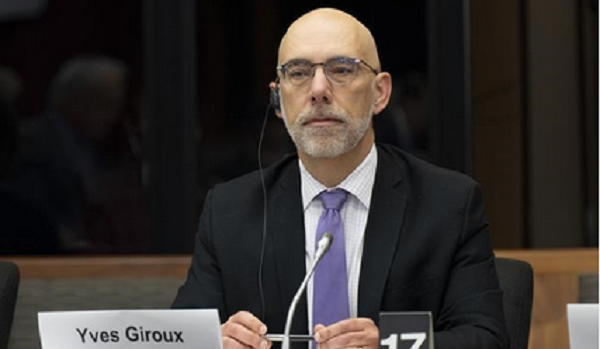
Former parliamentary budget officer (PBO) Yves Giroux says it’s likely too early to tell whether Canada’s fiscal outlook is as precarious as his successor is warning.
“I would probably, personally, wait until we see what’s in the budget before making such a statement,” Giroux said during a panel discussion airing Sunday on CTV Question Period. “I think, for my part, it’s a bit premature.”
Giroux’s successor, the current interim PBO Jason Jacques, said in an interview on CTV Question Period last month that the country’s fiscal outlook has Canada “at the precipice.”
Asked by host Vassy Kapelos at the time what that means in layperson’s terms, Jacques said while Canada hasn’t “gone over the precipice,” it’s “looking out over the cliff.”
His warning comes just weeks before the federal government is set to table its highly anticipated budget on Nov. 4, and following the PBO’s most recent economic outlook that projects the Liberal government will post an annual deficit of $68.5 billion this year, up from $51.7 billion last year.

Giroux told Kapelos that Jacques may have “different information” than he does.
“From what I see and from the information that I’ve been exposed to, I would rather wait until the budget is tabled to see exactly what the fiscal track looks like for the foreseeable future, what types of measures the government wants to implement on the spending, but also on the revenue side,” Giroux told Kapelos.
“That may or may not plug the fiscal gap that we’re expecting to see, so we’ll have a much better idea on that of that on the evening of Nov. 4.”
The long-delayed budget will be Mark Carney’s first as prime minister. He has indicated it will be one of both “austerity” and “investment,” prompting questions about how the federal government can earmark billions of dollars in new spending, while also balancing the operational budget in three years.
Giroux’s comments were part of a panel discussion with former clerk of the Privy Council Michael Wernick, focused on how the federal government might fulfil its fiscal promises.
Will attrition in the federal public service be enough?
As the federal government looks to reduce operational spending, Carney has insisted any cuts to the federal public service would “happen naturally through attrition.”
But other ministers — including Government Transformation, Public Works and Procurement Minister Joël Lightbound — have conceded “there will be adjustments.”
The Liberal election platform pledged to cap and not cut the federal public service, and eliminate $15 billion a year by 2028 to bring revenues in line with operational spending.
Speaking to Kapelos, Wernick said attrition is not the best way forward to reduce the size of personnel.

“Attrition is just relying on a passive pattern of who dies, who gets sick, who takes retirement,” he said. “It’s not going to end up with a public service in the right people in the right places.
“I would work backwards from what kinds of services and functions you want to offer Canadians, and then you make sure the people are in the right place,” he added.
Asked is attrition is a realistic approach to achieve the federal government’s spending targets, Giroux said: “I don’t think that can be achieved through attrition.”
“Even if it was mathematically possible to reduce the size of the public service solely through attrition, it’s not desirable because that leaves gaps where you don’t want gaps, and that leaves parts that may be ripe for reductions relatively untouched or not reduced as much as there should be,” Giroux told Kapelos.
While the federal public service decreased by approximately 10,000 employees in 2025 compared to 2024, federal personnel spending increased by about $1.5 billion, according to an August report from the PBO.
The size of the federal public service has also grown by more than 100,000 workers over the past 10 years, from 257,034 in 2015 to 357,965 in 2025.
This article was first reported by CTV News