






Canadian Defence Firms Express Cautious Confidence in Upcoming Federal Budget
The prime minister’s pledge to prioritize a “Buy Canadian” policy has companies in the defence and national security sectors cautiously optimistic about the upcoming budget.
Speaking at the University of Ottawa last Tuesday, Prime Minister Mark Carney promised “generational investments” for key sectors, including defence.
The CEO of Ventus Respiratory Technologies, Arjun Grewal, says he’s hopeful about what the budget has to offer the Canadian military and companies in the defence sector.
“I’m very optimistic,” Grewal said. “It’s unfortunate that that optimism is being fuelled by the acknowledgement of the threats we’re facing. We are in a position right now as a nation that it’s now or never we need to make these investments.”
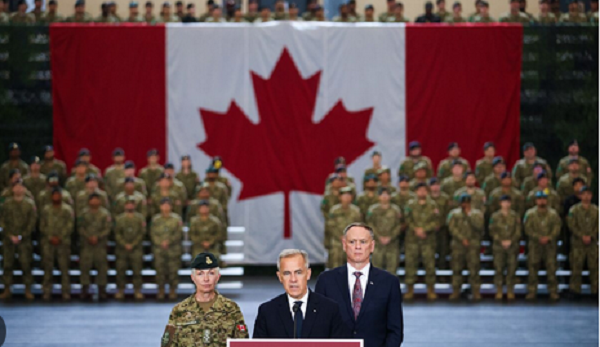
Canada has committed to finally reaching NATO’s two per cent of GDP target. To get there, Carney has pledged an extra $9 billion on defence by the end of March 2026. As part of that push, Canada is expanding the Canadian Coast Guard’s mandate and is transitioning it to the Department of National Defence, spending $2 billion to increase pay and benefits for military members, and pledging to purchase new aircraft, armed vehicles and ammunition.

“We will ensure every dollar is invested wisely, including by prioritizing made-in-Canada manufacturing and supply chains,” Carney announced during a speech at the Munk School in Toronto in June.
Jordan Miller, a defence analyst and Canadian Global Affairs Institute fellow, says DND and the CAF have historically had “challenges” spending all the money allocated to them. The PBO recently estimated last October that annual military spending must reach $81.9 billion by 2032-33 to meet the two per cent target.
“The program that Canada has already committed to in its defence policy would get Canada to that two per cent,” Miller said. “But it’s unrealistic to think that all that money could be spent by March.”
Instead, Miller says it is possible Canada will announce the winners of major procurement projects, like the contract for new submarines, alongside an initial advance or downpayment.
“That would be significant in that it would move Canada closer to two per cent, but it wouldn’t put any floating capability in the water yet,” he said, adding that a prepayment sends a signal to the world that Canada is serious about dealing with its capability challenges.
Procurement a problem?
The new Liberal government has pledged to tackle a procurement system that has often been called slow and problematic by establishing the Defence Investment Agency. The new agency, which is run by Chief Executive Officer Doug Guzman, is supposed to streamline procurement and allow federal funds to be spent faster.
A former JTF2 squadron commander turned venture capitalist, Glenn Cowan, says the promise of major spending increases and changes to speed up along with a streamlined procurement process makes November’s budget “critically important.”
“The talent that we have in Canada is unmatched in some key, main areas: AI, quantum advanced materials and computer visioning,” Cowan said. “Our capital markets are starting to emerge to fund these technologies but the main challenge we have in Canada is that we have traditionally not had a viable customer.”
Cowan, whose company ONE9 provides capital investments for defence and other companies, says that for years Canadian entrepreneurs have had to turn outside Canada, often to the United States, to find buyers for their technology.

“That really comes down to, sort of, a very lethargic, very antiquated and heavily bureaucratic procurement system,” he said.
Cowan believes language encouraging private capital investments would go a long way to helping build up Canadian businesses in the sector. He believes the government could start by create a program that incentivizes Business Development Canada or Export Development Canada to invest in Canada’s national security and defence sectors.
“We would like to see the bridge between the federal government and private capital create a system where the burden of investment is not on the taxpayer, it’s actually on private capital investors to take an onus on building this capability,” he said. “We just need the government to show that this is a safe spot for investors to put their money.”
While encouraged by Carney’s commitments to prioritize local, Cowan and Grewal say they’re maintaining some level of skepticism until the budget and its procurement language is released.
“I’ll believe it when I see it in action,” Grewal said. “Buy Canada is a very aspirational statement, not because we don’t have the capacity. I just haven’t seen the CAF really practice what they preach in some instances.”
Personnel, housing and bases
Former chief of defence staff Tom Lawson says the budget should inject money to the improvement and modernization of bases, training facilities and military housing. Years of budgetary constraints, he says, have created run-down conditions that contribute to the military’s retention and recruitment problems.
“When you’re running a military on a shoestring budget, you have rot out on your bases and your wings and your naval facilities,” he said. “The first, any number of billions, are going to have to go into building out the infrastructure on which we train and prepare ourselves to do all the things that we do in Canada and around the world.”
Lawson admits he was part of the problem by pushing new funding towards equipment and troop readiness.
“When someone would say, do we need to put some into military housing and barracks, I would say, ‘Yeah, we absolutely do,’ and we do not have that money.”

Canada’s Auditor General recently found that the military is falling short on recruiting and retention. Between 2022 and 2025, Karen Hogan found the Canadian Armed Forces (CAF) only recruited around 15,000 of the more than 19,700 members it had intended to sign up.
“If Canada spends billions of dollars on equipment but that equipment doesn’t have sufficient trained personnel to use that equipment, some of that equipment will under deliver on its aspirations,” said Miller.
To increase the readiness of its military, Miller agrees with Lawson that significant investments to improve personnel shortages are urgently needed. The shortage of trained military personnel, he says, is the single greatest limiter to any new defence spending.
“Prime Ministers going back to Mr. Martin and Mr. Harper have all promised to surging the Canadian Armed Forces, that is a necessary goal, but it is an all-volunteer force so there are some limits to that,” he said. “The challenge for any government and any military is that you cannot just buy personnel. It’s not something that you can procure.”
This article was first reported by CTV News