



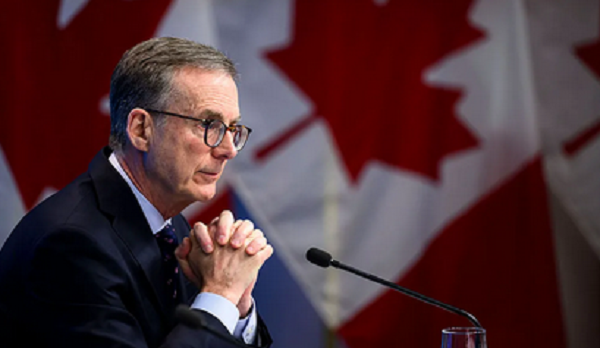
Bank of Canada Governor Charts Course for Regulating Digital Currencies
Bank of Canada Governor Tiff Macklem said he expects Canadian stablecoins will need to be backed by “high-quality, short-term, highly liquid assets,” laying out expectations for the new digital asset class two days after the central bank was tapped to oversee the sector.
The federal budget, released Tuesday, promised a new regulatory regime for stablecoins, a type of cryptocurrency that’s pegged one-to-one to a fiat currency or stable financial asset or commodity. The budget assigned oversight for the sector to the central bank, which already regulates online payments providers.
In a Senate committee hearing on Thursday, Mr. Macklem said that the legislation and regulations for stablecoins have yet to be developed. But he offered some high-level guidance on what would likely be expected.
“It’s very important that it is, in fact, stable. And what that means is that it’s always convertible to money at par. Because as soon as there’s questions about whether that will happen, you will get a run on the stablecoin, and the stablecoin very rapidly becomes unstable,” Mr. Macklem said.
 “As part of our regime, we’re going to need to make sure that if you’ve got a stablecoin, we want to see that you actually have the backing in place in high-quality, liquid assets,” he added. “The other part is we want to make sure that there’s enough operational resilience, so that this thing functions 24/7.”
In a separate appearance on Thursday, Finance Minister François-Philippe Champagne said that stablecoins would likely be regulated as a type of payment, rather than as a security. This distinction is important as securities are regulated at a provincial level, leading to a patchwork of rules across the country.
“I think to put that in the payment system would provide the consistency that you would need to facilitate trade and commerce across provinces,” Mr. Champagne told an audience of bankers and fintech entrepreneurs in Toronto.
The push to regulate stablecoins follows the passage of U.S. legislation earlier this year called the GENIUS Act. This established a framework for regulating stablecoins in the United States, setting out rules around the type of collateral that can back the digital asset and laying out various consumer protection measures.
The passage of the GENIUS Act has spurred a surge in interest in stablecoins, which had, until recently, been used mostly to facilitate transactions between different cryptocurrencies, rather than as a mainstream payment method.
Bank of America and Citigroup are among the U.S. banks considering launching their own stablecoins, and PayPal and Visa now offer stablecoin payment options. Ottawa-based Shopify Inc. now allows merchants to accept U.S. dollar-backed stablecoins, through a partnership with Coinbase and Stripe.

“Canadian stablecoins, that was important to me, and I would say the Prime Minister, because the alternative would be that people would basically use stablecoins denominated in U.S. dollars,” Mr. Champagne said.
The budget also tapped the Bank of Canada to oversee the long-awaited open-banking system, which will allow consumers to transfer financial data more easily between banks and fintech companies. Mr. Champagne said the first phase of open banking would begin next year, after many delays.
The central bank is taking on these additional responsibilities at the same time it’s laying off staff.
Senior deputy governor Carolyn Rogers said Thursday that the bank had received a letter from the Department of Finance several months ago telling it to reduce its expenses by 15 per cent as part of the government-wide push to shrink the civil service. It plans to lay off around 230 employees, out of a total 2,300-strong work force.
At the same time, this week’s budget allocates around $30-million over two years to the Bank of Canada to implement the stablecoin and open-banking regulation. It’s not clear how this funding will affect staffing levels.

When asked how he expects the central bank to handle its new mandates with fewer staff, Mr. Champagne said he had spoken with bank leadership, and “they felt confident that they had the knowledge, expertise and people in order to be able to take on these new responsibilities.”
The Bank of Canada began overseeing the retail payments system in 2024. It now oversees around 1,500 companies that provide online payment services, such as digital wallets.
Ms. Rogers said she expects there will be “fairly large overlap” between retail payment providers and companies looking to launch stablecoins or participate in open banking.
“This is all very new, but one of the conversations we will be having over the coming months is, how do we make sure that we don’t end up having three different registration regimes for those businesses,” she said.
With a file from Stefanie Marotta
This article was first reported by The Globe and Mail