







The Canadian Vanguard Stock Market Report – Weekend, November 21 – 23, 2025 Edition
Markets Rebound Friday, But Weekly Data Remains Weak; Nasdaq falls for Third Consecutive Week
. The Stock Market Report is updated regularly during the weekend
The Toronto Market – Friday, November 21, 2025
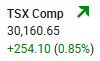
The S&P/TSX Composite Index gained 254.10 points, or 0.85%, to close at 30,160.65. The Toronto market attempted to recover from Thursday’s decline but managed only a partial rebound. The week’s high of 30,632 was reached shortly after the market opened on Thursday—before the session turned into the month’s steepest sell-off. The intraday swing on Thursday was substantial, with a gap of roughly 725 points between the day’s high and low.


Friday’s Toronto Market Statistics
Toronto’s market breadth was firmly positive today, with advancing issues outnumbering decliners by roughly five to two. The TSX recorded 1,527 advancers and 579 decliners, for an advancer-to-decliner ratio of 2.64 to 1, while 125 issues were unchanged.
There were 41 new 52-Week Highs and 64 new 52-Week Lows, compared with yesterday’s 73 new 52-Week Highs and 58 new 52-Week Lows.
Total trading volume reached 470,830,134 shares, up about 0.7% from yesterday’s 467,441,123 shares—essentially unchanged in practical terms.
.
The US Markets – Friday, November 21, 2025
All major North American equity indexes finished higher on Friday. The Dow Jones Industrial Average gained 493.15 points, or 1.08%, closing at 46,245.41. The S&P 500 advanced 64.23 points, or 0.98%, to end at 6,602.99, while the Nasdaq Composite added 195.03 points, or 0.88%, to finish at 22,273.08.
The Russell 2000 outperformed the major benchmarks, jumping 64.48 points, or 2.80%, to close at 2,369.59—an impressive single-day gain of nearly 3%. Despite Friday’s surge, the small-cap index still ended the week in negative territory. This was a particularly volatile and difficult week for the broader markets.

Friday’s U.S. Market Statistics
New York Stock Exchange (NYSE): Advancing issues strongly outpaced decliners on the NYSE. The exchange reported 2,239 advancers, 551 decliners, and 63 unchanged issues. This produced an advancer-to-decliner ratio of 4.06 to 1—roughly four advancers for every decliner.
There were 38 new 52-week highs and 100 new 52-week lows, compared with 93 new 52-week highs and 269 new 52-week lows recorded on Thursday.
Total trading volume reached 6,006,026,455 shares, about 5.5% higher than Thursday’s volume of 5,691,671,027 shares.
NASDAQ: At the NASDAQ, advancing stocks also easily outnumbered decliners, with 3,515 advancers and 1,284 decliners, producing an advancer-to-decliner ratio of 2.73 to 1; another 131 issues were unchanged.
The exchange reported 73 new 52-week highs and 423 new 52-week lows, compared with Thursday’s 119 new 52-week highs and 473 new l52-week lows.
Total NASDAQ trading volume was 10,133,314,818 shares—about 7% lower than Thursday’s 10,900,296,383 shares.
US Market Wrap-Up Report.
U.S. markets staged a strong rebound on Friday, closing out a turbulent week with broad-based gains across major indexes. While the rally offered a clear improvement in short-term sentiment, underlying technical and structural signals suggest the market’s recovery remains incomplete.
Broad-Based Rebound Signals a Short-Term Shift in Sentiment. Buying pressure returned decisively to U.S. equities, with advancing issues dominating decliners across both major exchanges. The NYSE posted, as already indicated above, a 4.06:1 advancer–decliner ratio, while the NASDAQ registered a nearly 3:1 ratio—strong signals that Friday’s rally extended beyond a handful of large-cap names into mid-caps, small caps, and cyclicals.
Such powerful breadth often marks the aftermath of a capitulation-style selloff, where traders shift from aggressive de-risking to opportunistic buying. Friday’s action fits this pattern: widespread participation, strong index gains, and sharp reversals in oversold sectors.
However, this short-term strength does not fully offset the damage inflicted earlier in the week.
Some Evidence of Lingering Structural Weakness are indicated in Friday’s data. Despite broad gains, the distribution of new 52-week highs and lows remains skewed toward weakness:
- NYSE: 38 new highs vs. 100 new lows
- NASDAQ: 73 new highs vs. 423 new lows
The elevated number of new lows—particularly on the NASDAQ—indicates that many stocks remain in established downtrends. This imbalance underscores that Friday’s rally improved sentiment, but has not reversed longer-term price deterioration across large segments of the market.
This divergence between breadth and trend is characteristic of bearish-to-neutral market phases where rebounds are forceful but fragile.
Friday’s Small-Cap Surge indicated renewed appetite for Risk—but only partially. The Russell 2000 surged nearly 3%, significantly outperforming the major benchmarks. This kind of movement is typical when:
- risk appetite improves,
- traders unwind defensive positioning, and
- oversold speculative segments attract short-term buyers.
Even so, the Russell remained negative for the week, reflecting the broader challenge facing small caps: higher financing costs, greater sensitivity to economic slowdowns, and persistent volatility.
Its outperformance on Friday signals risk-on behavior, but its weekly decline reminds us that the medium-term trend is still fragile.
Counter-Trend Bounce
Friday’s rebound was fueled more by Positioning than Fundamentals. While Friday’s action was strong, the underlying macro environment shows no clear evidence of a decisive shift. The market had been pressured earlier in the week by:
- uncertainty around interest-rate expectations,
- valuations of Artificial Intelligence (AI) stocks,
- concerns about economic momentum, and
- heightened risk aversion.
The market’s strong close into the weekend suggests technical oversold conditions and positioning dynamics, rather than changes in fundamental macro drivers, were the primary catalysts. One day of improved breadth does not resolve broader concerns about economic trajectory or financial conditions.
This highlights that Friday’s strength should be interpreted as a counter-trend bounce, not a confirmed trend reversal.
Bottom Line
Friday’s market delivered a powerful and broad relief rally, marked by strong breadth and improved sentiment after a difficult week. However, the persistence of widespread 52-week lows, uneven volume patterns, and a still-negative weekly performance suggests that the market remains in a corrective or fragile phase.
The rebound should be viewed as a short-term realignment of sentiment, not as evidence of a renewed uptrend. Next week’s action—especially whether the market can deliver sustained breadth and stronger high–low readings—will be critical in determining whether Friday’s rally evolves into something more durable.
Commodities, Bonds and Crypto
Oil Markets:
Geopolitical Sensitivity Remains Elevated. U.S. crude prices declined on Sunday, with West Texas Intermediate falling to $58.18 per barrel as of 12:30 a.m. EDT Monday. The drop reflects the market’s rapid reaction to President Trump’s new Ukraine plan, which appears to have introduced fresh geopolitical uncertainty.
This pullback indicates that oil remains highly sensitive to geopolitical policy shifts, and traders are reassessing risk premiums tied to potential supply disruptions and diplomatic realignments. The decline also suggests that speculative long positions may be unwinding following a period of heightened volatility in energy markets.
Precious Metals:
Gold prices fell $32.70 (-0.80%) to $4,046.70, while silver declined $0.29 (-0.59%) to $49.62 per ounce. It is important to note that Gold and Silver are sliding this morning despite global uncertainty.
This weakness in precious metals—traditionally safe-haven assets—suggests one or more of the following dynamics:
- A modest reversal of flight-to-safety flows after last week’s turbulence
- A possible shift toward risk assets ahead of Monday’s trading session
- Anticipation of softer interest-rate expectations, which may be reducing the urgency for defensive hedges
Even so, gold remains at historically elevated levels, indicating that long-term concerns about inflation, policy uncertainty, and geopolitical risks are still priced into the market.
Bitcoin:
High Volatility Persists at Elevated Price Levels. Bitcoin briefly touched $88,000 earlier Sunday before pulling back to $87,016 (-$379.31, or -0.43%) as of the latest update.
The ability to reach new highs—even intraday—demonstrates that risk appetite in crypto remains strong, but the quick pullback also reinforces that BTC is still in a high-volatility regime. Current price behavior suggests: Active profit-taking near all-time peaks, High sensitivity to liquidity conditions, or Ongoing speculative participation amid macro uncertainty.
Bitcoin’s resilience may reflect broader demand for alternative assets during periods of currency and policy fluctuation.
Bond Market:
The 10-Year Yield Falls on Renewed Rate-Cut Expectations. The U.S. 10-year Treasury yield slipped to 4.07% as of 12:30 a.m. EDT Monday, driven by strengthening expectations of a potential Fed rate cut.
The move lower in yields is consistent with last week’s defensive positioning and suggests that bond markets are anticipating slower forward growth, even if equities showed signs of short-term stabilization on Friday.
Futures Market:
U.S. equity futures were higher early Monday: Dow Futures was up 109.00 points (+0.24%). S&P 500 Futures was up 35.25 points (+0.53%) at 6,655.25. Nasdaq 100 Futures was up 183.00 points (+0.75%) at 24,488.50. Futures this morning are showing early strength, but this behavior typically warrants caution.
The overnight tone suggests an attempt at continuation after Friday’s rally. However, recent patterns warrant caution: throughout last week, strong overnight futures readings repeatedly failed to translate into gains during the regular session, often leading instead to intraday sell-offs.
While that pattern may have ended with last week’s turbulence, futures should be interpreted strictly as a snapshot of sentiment—not a predictor of next-day performance. As always, the market will ultimately respond to incoming data, liquidity conditions, and risk flows rather than after-hours optimism.
Important Note:
Market performance during the regular session often bears little or no correlation to futures performance the night before. Readers should view these figures only as data captured at their specific timestamp, not as forward guidance.
.
NOTICE TO READERS
Our readers are strongly advised to conduct their research into individual stocks before making a purchase decision. In addition, investors are advised that past stock performance is no guarantee of future price appreciation. Any recommendation is not a guarantee of any particular stock’s future prices, and The Canadian Vanguard accepts no responsibility or liability for investors’ or readers’ purchases.
The Canadian Vanguard’s Stock Market Reports, https://www.thecanadianvanguard.com/category/stock-markets/ , are composed by senior Financial Industry and Information Technology professionals. We deliberately neither engage nor deploy AI tools to produce data for these reports.
Stocks In The News/ Stocks To Watch and Market Strategy will soon be available only to Paying Subscribers.
(c) This article is published by The Canadian Vanguard on November 22, 2025.