





Alberta–Ottawa Energy Pact Sparks Divided Response Across Sectors
An energy agreement between the Alberta government and Ottawa has reignited discussions about a potential pipeline to Canada’s west coast, drawing cautious hope, deep skepticism and urgent questions about the viability of major energy projects in a rapidly shifting global market.
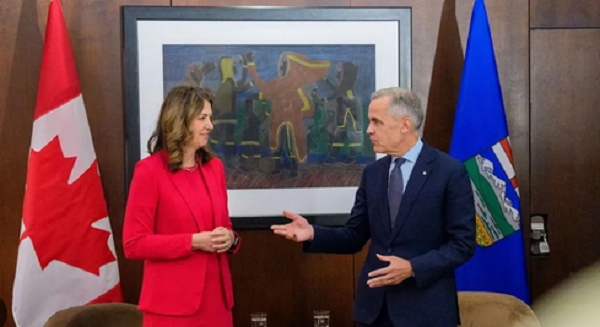
The memorandum of understanding (MOU) signed Thursday by Premier Danielle Smith and Prime Minister Mark Carney signals a renewed willingness from both to collaborate on energy infrastructure development.
It’s a sector that has been mired in regulatory uncertainty and political debate for more than a decade.
While the MOU is not a guarantee of any project, it signals the feds’ willingness to revisit long-standing prohibitions and regulatory bottlenecks.
For energy sector leaders and analysts, that alone marks a dramatic shift.
Industry sees long-awaited opportunity
Among Canada’s energy industry, the MOU is being interpreted as a significant step toward revitalizing investment confidence.
Enbridge, one of the country’s largest energy infrastructure companies, issued a statement calling the agreement “a positive step toward realizing Canada’s potential as a global energy superpower.”
The company noted the MOU acknowledges the importance of oil production growth in the national interest, emphasizes Indigenous participation in infrastructure projects and represents “significant progress toward a policy framework that will attract investment and unlock growth in the energy sector.”

Enbridge said it looks forward to seeing how the MOU is codified into the necessary legislative and regulatory changes.
Trans Mountain, which operates the existing Trans Mountain Pipeline and is pursuing an expansion project, said its optimization efforts to increase capacity by 360,000 barrels per day are independent of the MOU.
“Utilization for Q3 was 87 per cent based on the current capacity of 890,000 barrels per day,” the company said.
“For October and November, utilization has been in the 90 per cent or higher range.”
The expansion, achieved through drag-reducing agents and other pipeline optimization projects, is expected to increase total capacity to approximately 1,250,000 barrels per day over the next four to five years.
Heather Exner-Pirot—director of energy, natural resources and environment at the Macdonald-Laurier Institute—said the MOU provides “a ton of optimism” for Alberta’s energy sector.
She said the agreement ends a period where the industry “felt like you were getting punched in the face for 10 years.”
She noted the importance of diversifying Canadian energy exports, particularly targeting Asian markets.
“Alberta has the world’s fourth-largest reserves of oil,” she said.
Exner-Pirot also noted several Canadian companies, including Enbridge and Trans Mountain, have been involved in technical advisory committees to explore potential projects, while private sector proponents are closely watching the regulatory and economic conditions.
“There’s been no private proponent saying this is a dumb idea,” she said.

“They’re saying the conditions have to be right for us to go to our boards and shareholders and secure the kind of funding required to build a pipeline in Canada.”
Impact on Canadian manufacturing
The MOU could have ripple effects across Canadian manufacturing and construction industries.
Dennis Darby—president of Canadian Manufacturers and Exporters—described the agreement as “very positive.”
“Energy exports are one of the largest components of Canadian exports, followed by manufactured goods,” he said.
“If the MOU leads to building major projects, whether carbon capture or pipeline infrastructure, that translates into thousands of jobs and millions of dollars in business for the manufacturing sector.”
Darby said manufacturers across Canada produce components critical to energy projects, from steel pipes to pumps, valves and pressure vessels.
“Whenever Canada builds projects, the impact is felt nationwide,” he said.
“We have 1.8 million Canadians working in manufacturing, and when investments like this happen, everyone benefits. The success of Alberta’s energy projects really does help the entire country.”
Analysts cautiously optimistic
Industry and policy analysts have underscored that while the MOU is an important first step, challenges remain, particularly on the regulatory and political fronts.
Gurpreet Lail—CEO of Enserva—described the announcement as a “signal for good things to come” after a decade of uncertainty for the energy sector.
“We’ve been handcuffed for so long by federal policy,” Lail said.
“This MOU shows a willingness to move forward, review outdated regulations and restore investment confidence.
“Signing the MOU is a great first step, but there’s still a lot of detail to be worked out, (such as) regulatory frameworks, approvals and private sector investment pathways.”
Exner-Pirot said the MOU represents an opportunity for more constructive dialogue with Indigenous communities and other stakeholders.
“For First Nations, they’ve gone through this rigmarole in British Columbia a few times. They will be weighing their options,” she said.
Environmental concerns, opposition
Not everyone is celebrating the MOU.
Environmental groups and some Indigenous communities have voiced strong opposition, citing potential risks to land, water and climate progress.
Keith Brooks—programs director at Environmental Defence Canada—called the agreement “a bad deal for Canadians” and warned it could undermine climate policy.
“The MOU sets back climate progress significantly,” he said.
“It pits province against province and goes against the wishes of coastal First Nations, who have been very clear in their opposition.
“The prime minister’s offer to support a pipeline in exchange for loosening existing climate policies is deeply concerning.”

Earlier this week, 41 civil society organizations released a statement in opposition of a northwest coast pipeline and tankers.
Brooks noted ongoing environmental and Indigenous concerns, including tailings pond pollution in Alberta’s oilsands, and potential risks along the proposed pipeline route through rugged terrain, including hundreds of rivers and streams.
He also questioned the timing of the project in light of a recent International Energy Agency (IEA) report predicting global oil demand could peak by 2030.
“People are effectively doubling down on a product for which demand is expected to taper off,” he said.
Exner-Pirot said demand is stronger than ever.
“Just this year, they (IEA) did a reverse, as many people have done, to see that the energy transition probably isn’t happening as fast as we may have wanted and that there’ll be at least this amount of demand for a couple of decades, and more demand in Asia,” she said.
“India is now the fastest-growing consumer of oil, and so there is an expectation, and you’ve seen it in Canadian oil and gas stocks in recent months. American shale is also peaking, and so that will reduce supply in the coming years.
“We do expect that there will be global demand for oil for a lot longer.”
Brooks said environmental pushback won’t stop.
He noted Thursday’s resignation of Steven Guilbeault as environment minister as an indicator of the deal’s controversy, calling it a “principled stand” but a setback for climate advocates.
Private sector, investment considerations
The MOU envisions a private-sector proponent for the pipeline, but companies have been cautious.
Enbridge and Trans Mountain did not specify whether they would invest.
CTV News also requested comment from SouthBow Corp, but the company declined.
Industry analysts said investment will hinge on regulatory clarity, risk mitigation and market conditions.
“Private sector participants will only step up if conditions are right,” Exner-Pirot said.
“It’s not that anyone thinks this is a bad idea—investors simply need confidence that the project can proceed safely, legally and profitably.”
Analysts at CIBC Capital Markets, however, don’t expect the private sector to take the lead on a new Pacific coast pipeline, given opposition from the British Columbia government and First Nations.
“The requirement to consult with B.C. and Indigenous groups is necessary and logical,” they wrote in a Friday report.
“The MOU does not contain anything resembling judicial reform and therefore seems to rely on the Building Canada Act and the pre-existing duty to consult Indigenous Peoples to avoid endless legal challenges.
“Before any company on our coverage list gets financially involved in a pipeline project as politically charged as this one, we would at least like to see some alignment among Alberta, B.C. and Indigenous groups.
“Recognizing this is unlikely, we would expect some financial incentives to shield any project proponent from legal costs and cost overruns.”
Challenges and next steps
While the MOU represents a milestone, experts caution regulatory, environmental and financial hurdles remain.
Approvals must be secured from multiple levels of government, Indigenous consultations must be conducted and market conditions must remain favourable for private investment.
The provincial and federal governments will appoint an “implementation committee” to deliver on the measures within the MOU.
This includes putting in place, on or before April 1, 2026, a carbon pricing equivalency agreement, a methane equivalency agreement, a trilateral agreement with the Pathways companies and a co-operation agreement on impact assessments.
Then, on or before July 1, 2026, the parties must come to an agreement on how Alberta can submit its pipeline application to the MPO as the proponent, and the federal government must provide feedback on Alberta’s policy framework for AI data centres.

Lastly, by Jan. 1, 2027, Alberta must finalize its nuclear power generation strategy.
The timeline for construction remains uncertain as well, with some projections suggesting the pipeline could come online around 2038.
According to senior provincial and federal officials who briefed reporters early Thursday, the MOU is underpinned by a shared commitment to achieve net-zero greenhouse gas emissions by 2050 and create hundreds of thousands of high-paying jobs.
The federal and provincial governments are also committing to consult with and, “where appropriate,” accommodate Indigenous Peoples and rights.
The MOU focuses on plans to advance four specific projects:
Constructing “one or more” pipelines, financed by the private sector with Indigenous co-ownership, moving at least one million barrels a day of “low-emission Alberta bitumen” on a route prioritizing Asian markets, in addition to the Trans Mountain pipeline expansion;
Constructing and financing Pathways, the world’s largest proposed carbon capture, utilization and storage project—a piece of this deal framed as necessary and a prerequisite to offset emissions;
Constructing thousands of megawatts of AI computing power, with a “large portion” dedicated to sovereign cloud; and
Constructing large transmission interties with British Columbia and Saskatchewan to improve Western provinces’ ability to supply low-carbon power.
With files from Rachel Aiello
This article was first reported by CTV News