






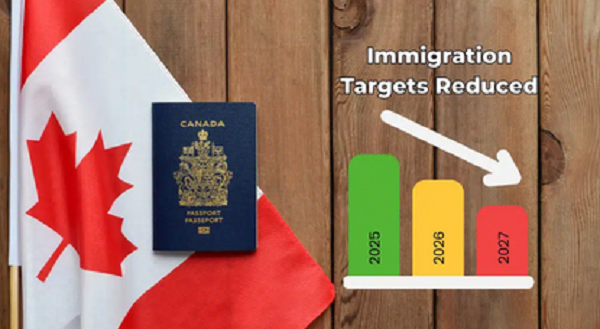
Major Immigration Reductions Ahead as Canada Resets Targets for 2026
Canada is set to tighten immigration rules and accept fewer new residents, students and temporary workers in 2026.
The ongoing cuts are a major shift for the country, which had been boosting immigration levels for years. First introduced in late 2024 and updated again in November, the new caps and lower targets are meant to reduce Canada’s unemployment rate, address housing affordability and ease pressures on public services like healthcare.
While Canada will continue slashing the number of new permanent and temporary residents it admits in 2026, new priorities could also give an edge to skilled workers, applicants who speak French and those who have Canadian experience.
“These caps and tighter eligibility rules are impactful because they ensure that those who do come, particularly students and workers, are better positioned to contribute productively to the Canadian economy,” Calgary-based immigration consultant Mandeep Lidher told CTVNews.ca. “Overall, Canada’s immigration policy is moving toward a smaller but more selective system, focused on qualified applicants, genuine labour shortages and the long-term sustainability of communities nationwide.”
If you’re looking to study, work or live in Canada, here’s what you need to know about changes to the country’s immigration rules in 2026.
Fewer permanent residents
In the latest immigration plan that was released on Nov. 5, Canada made it clear that it would continue with cuts that were first introduced in 2024.
The 2026 target of 380,000 new permanent residents is a slight drop from the 395,000 accepted in 2025 and a major shift from 2024, when more than 483,000 were welcomed. The number of new permanent residents is set to remain at 380,000 through 2028.

“It means applicants with stronger educational and professional backgrounds will be entering Canada,” Lidher said. “This is a structural correction after years of rapid intake growth from 2021 to 2024 and signals a major recalibration of Canada’s immigration system.”
Permanent residents are non-citizens who are authorized to live and work in the country for an extended period of time. They pay taxes and are eligible for services such as health care, but unlike citizens they cannot vote in Canada. Permanent residency pathways include family sponsorship, refugee status and applying as a skilled worker.
The current immigration plan prioritizes economic immigrants like skilled workers, with a target of 239,800 admissions in these categories in 2026 and 244,700 in both 2027 and 2028. Skilled workers are admitted for their potential economic impact on Canada and are evaluated based on factors like work history and education. To meet labour shortages and government priorities, those with experience in healthcare, social services, trade occupations, agriculture, education and STEM (science, technology, engineering and math) occupations will also be prioritized for permanent residency through what’s known as the Express Entry system.
“Of all the changes, the most significant is the reduction in permanent resident admissions,” Al Parsai, a Toronto-based immigration consultant and adjunct professor at Queen’s University, told CTVNews.ca. “The system is becoming more competitive and selective.”
Caps on temporary workers
As part of its immigration cuts, Canada has announced that it wants to reduce the number of temporary residents to less than five per cent of its total population by the end of 2027. Only 230,000 new temporary workers will be admitted in 2026, down significantly from the target of 367,750 in 2025. The target for new temporary workers will then decrease slightly to 220,000 in both 2026 and 2027.
“Ottawa has shifted from growth to control, focusing on sustainability, integrity and alignment with real labour market needs,” Lidher said. “Previously, temporary inflows were subject to minimal regulation.”
In 2024 Canada also created new caps for employers that decrease the number of low-wage temporary foreign workers they can hire. According to the most recent Statistics Canada data, the country currently has more than three million non-permanent residents.
International student cap slashed
Ottawa recently announced that it was slashing international student admissions by more than half. Canada plans to issue only 155,000 new student visas in 2026 and 150,000 in both 2027 and 2028. That’s down significantly from previous caps of 360,000 in 2024 and 437,000 in 2025. New international student admissions peaked at more than 650,000 in 2023.
New international students also need to prove that they have enough money to live in Canada by providing documents like bank statements. On Sept. 1, 2025, the minimum required amount was increased by more than $2,000 to a total of $22,895 per year for single applicants. That amount grows by approximately $6,000 per year for each accompanying family member.
Emphasis on Canadian experience
As part of its plan to reduce the temporary resident population, Canada’s immigration department says it is prioritizing permanent residency applications from those who already have experience in the country. To that end, it will accelerate the transition of up to 33,000 temporary workers to permanent residency in 2026 and 2027. By focusing on applicants with Canadian experience, Ottawa says it can address labour shortages without adding pressures on public services.
“Canada is shifting from expansion toward selectivity: admissions are large, but the criteria and mix are changing,” Parsai added. “Applicants must now demonstrate Canadian experience, language strength and adaptability.”
Stricter rules for family members
Canada is cutting the number of new immigrants admitted under family reunification streams to 84,000 in 2026, down by about 4,000 compared to previous plans. That target drops slightly to 81,000 in both 2027 and 2028.
In early 2025 Canada also began restricting work permit eligibility for family members of international students and temporary foreign workers.
Previously, open work permits were available to spouses and common-law partners of international students, and the spouses, common-law partners and dependent children of foreign workers.
Under stricter new rules, work permits are only available to spouses of international students who are enrolled in a doctoral program, a master’s programs that is 16 months or longer, or select professional programs such as nursing, pharmacy, law or engineering.

Work permits are also now only available to spouses of foreign workers who are employed in management positions or roles that typically require a university degree, such as a financial adviser or software engineer. Other sectors facing labour shortages or linked to government priorities – such as construction, health care and education – may also be eligible. Workers must have at least 16 months remaining on their permit at the time their spouse applies. Dependent children of foreign workers no longer qualify for work permits.
More francophone immigration
While Canada cuts overall immigration numbers, it wants a larger share of newcomers to be proficient in French. The 2026 target for new francophone permanent residents is nine per cent, up from 8.5 per cent in 2025. That target grows to 9.5 per cent in 2027 and 10.5 per cent in 2028.
Tighter asylum rules and targets
The target for refugees, protected persons and those admitted on humanitarian grounds is set at 56,200 people in 2026, which is down nearly 12,000 from an earlier target. That number is expected to drop again to 54,300 in both 2027 and will remain at that number in 2028.
Canada is also proposing new rules that would make asylum claims ineligible if they are submitted more than one year after arriving in Canada or more than 14 days after crossing a land border from the U.S. The new rules are part of Bill C-2, which is known as the Strong Borders Act. While it has not been passed yet, Bill C-2 could also give authorities the power to immediately cancel immigration documents and applications.
“We are seeing a massive reduction in government-assisted refugees,” Carleton University international affairs Prof. Fen Hampson recently told CTV News. “These are queer refugees, war-torn refugees, refugees in third countries that Canada has an obligation with the UNHCR to bring to Canada, and those numbers have been scrapped.”
Ukrainian nationals fleeing the ongoing war in Ukraine arrive at Trudeau Airport in Montreal, Sunday, May 29, 2022. (THE CANADIAN PRESS/Graham Hughes)
With files from CTV National News Senior Correspondent Judy Trinh.
This article was first reported by CTV News