



As Chinese EVs Arrive in Canada, Experts Weigh Cost, Quality, and Risk
Last month, Prime Minister Mark Carney announced that Canada will allow up to 49,000 Chinese electric vehicles (EVs) into the market annually, with more than half of these vehicles priced at less than $35,000 within five years.
So can Canadians expect to be driving a $30,000 Chinese EV off the lot soon? Will parts be easy to source, and repairs affordable? How well will they handle our Canadian winters? Experts weigh in on what Canadians can expect when these vehicles start arriving, likely this year.
How much will Chinese EVs cost?
Compact and subcompact SUVs make up nearly half of the EV market in Canada, says Robert Karwel, automotive industry expert at J.D. Power, which means Canadians can likely expect to see those kinds of models imported from China first. He estimates prices will be around 10 to 15 per cent lower than average in Canada. Last year, he says, the average subcompact EV cost $42,000 — so Canadians may end up paying closer to somewhere between $35,700 and $37,800 for those models.
“Alternatively, they might export a nicer, more expensive vehicle because it’s generally a little bit more in line with Western tastes,” Karwel says. Since Chinese automakers can only sell so many EVs here, he adds, they may choose to elevate prices to be closer to the current Canadian marketplace. “If the Chinese can only supply a relatively low amount of their domestic brands to Canada, why would they export the base cheapest vehicles to our marketplace?”
Should you buy or lease?
Chinese EVs will likely allow for lower financing and leasing payments, Karwel says, because the capital cost of the vehicle is a little less to begin with.
READ MORE ON OUR DAILY STOCK MARKET REPORTS – Sustained Tech Rotation Sparks Broad Market Selloff
Daniel Ross, senior manager of industry insights and residual value strategy at Canadian Black Book, typically recommends consumers lease before purchasing when there’s uncertainty in the market. In that case, they would have a guaranteed value at the end of the lease contract. However, it’s not yet known if Chinese manufacturers are going to offer leasing programs.
Karwel agrees that leasing is the easiest way to acquire a new vehicle, but says it may not be the way to go with Chinese EVs. “If the residual value isn’t great, it means your payment is going to be higher at the end,” he says. Residual value is the estimated worth of the vehicle at the end of its lease term; if at the end of term the residual value is higher than the market value, you’d be paying more than the car is worth.
After one to three years, Chinese EVs won’t have as much retained value as their competitors at the same price points, Ross says, partly because of the low price of entry and the risk involved with their longevity in the markets.
Can Chinese EVs stand up to Canadian winters?
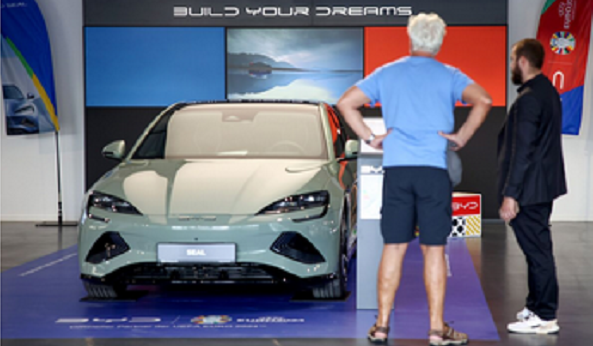
In December, 67 EVs were tested by experts for Autohome, China’s largest automotive media outlet. They looked at safety, range, charging performance, driveability on icy surfaces and acceleration in temperatures as low as -30 degrees. While most cars lost around half of their normal range due to the extreme cold, eight Chinese EVs — including the BYD Seal 06 sedan — ranked in the top 10 performers.
However, there’s a big difference in how EV ranges are tested here. The China Light-Duty Vehicle Test Cycle (CLTC) uses lower average speeds than the North American standard Environmental Protection Agency (EPA) testing. That translates to about 20 per cent less range in Canada than in China. Canada’s highways are higher speed and stretch for longer distances, and that eats away EV range quite quickly, Ross adds.
Mark Whinton of Brant, Ont., a former automotive insurance forensic investigator who now runs the YouTube channel Carquestions, says he compared the BYD Atto3 with the Chevy Bolt and says the BYD’s range was about 30 kilometres shorter, which he says is “not a deal breaker.”
Overall, Whinton says EVs are typically more reliable than cars powered by internal combustion engines. “EVs don’t have an engine, they don’t have a transmission, they don’t need oil changes, they don’t have fan belts … Generally, the maintenance costs are way lower,” he says.
Many of the common parts that wear out and need replacement (tires, wiper blades, brake parts) are already made in China, Whinton says, and are commonly used for other makes, so getting access to those parts for repairs shouldn’t be a problem. “When any new car brand comes to Canada, there will need to be a warehouse (or two or three) set up for parts. Hopefully, BYD has a plan for this to match a vehicle launch — if they don’t, I wouldn’t want to be the first BYD owner with a cracked windshield,” Whinton says.
How much will insurance cost?
It will likely take a few years to see how these vehicles actually perform and what they’re like in terms of repair and injury claims, says Daniel Ivans, Rates.ca insurance expert and licensed insurance broker.
However, that doesn’t mean early adopters of Chinese EVs should expect to pay higher premiums, Ivans says. Insurance companies look to similar vehicles when deciding rates. They’ll start with the assumption that they’re going to perform like other vehicles. If they perform better, we could see premium decreases; if the claims or loss ratios are much higher, we could anticipate increases.
One thing to be aware of around insurance costs is the availability of mechanics. “If it’s difficult to find a specialty mechanic, that means delays and those delays typically translate to longer rental periods,” Ivans says. For anyone purchasing an EV, he recommends making sure the limits on rental vehicles are robust in the event of a claim.
Will Chinese EV manufacturers offer warranties?
Mississauga resident and IT project manager Brian Galvis owns a Tesla, but recently drove a BYD Yuan Up subcompact SUV while visiting Colombia. “My first experience was that it felt like a cheap Tesla,” he says.
While the BYD didn’t have some of the fancier features of a Tesla, like regenerative braking and remote climate control, he did appreciate BYD’s rotating screen that switches between landscape and portrait with the press of a button. “That was a selling point,” he says. “I wish my Tesla had that.”
Overall, Galvis says the BYD Yuan Up is a great car for the price point.
His one piece of advice for prospective buyers: get it under warranty. He recently had to have his Tesla’s air conditioning system replaced, which would have cost him $6,000 to $7,000 if it wasn’t under warranty.
Whinton says that if Chinese EV sales go well, he expects to see an established network of parts distribution within two to three years, before owners’ warranties run out.
With some questions still up in the air, it’s up to the consumer to find out what kind of support will be offered once they purchase a Chinese EV. “Take your time and make an educated decision,” Ross says.
This article was first reported by The Star