



Canada, Mexico Forge Strategic Pact Amid U.S. Trade Tensions
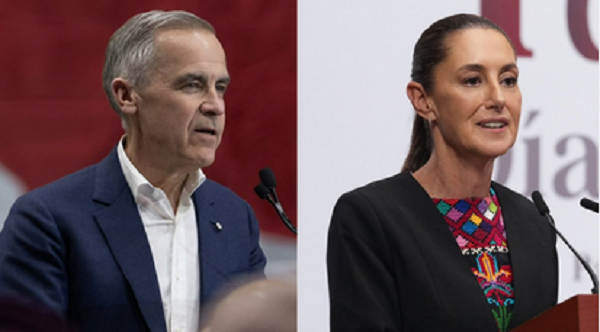
Prime Minister Mark Carney and his Mexican counterpart, President Claudia Sheinbaum, vowed closer ties Thursday against the backdrop of rising U.S. protectionism and the likelihood Donald Trump will soon make major demands to renegotiate the trilateral United States-Mexico-Canada Agreement.
Mr. Carney, at Mexico’s National Palace for a one-day official visit focused on trade and security, signed what he and Ms. Sheinbaum call a “strategic comprehensive partnership” pact aimed at deepening two-way trade and investment. The document is also intended to signal the era of indifference in the Canada-Mexico relationship is over.
They said they would prioritize the development of trade infrastructure including ports, rail and energy corridors and invest and trade more in areas including energy, critical minerals and agriculture.
The two leaders made a show of unity when asked whether they would fight efforts by the Trump administration to divide Canada and Mexico in coming USCMA negotiations.
They offered mild commitments of solidarity when asked whether they could rule out betraying each other in trade talks with Washington. After the last round of trade negotiations with Mr. Trump that ended in 2018, the head of a delegation of Canadian parliamentarians accused Mexico of throwing Canada “under the bus” in talks with the United States.


“Of course, we are going to co-operate directly, as we always have,” Mr. Carney said at a news conference after a meeting between the two leaders. “Canada is absolutely committed to work with both our partners,” he said of Mexico and the United States. “Is that unequivocal enough for you?”
Ms. Sheinbaum replied that a “trade agreement for all three countries is the best thing for all three countries.” She added: “That’s the best answer we can give you.”
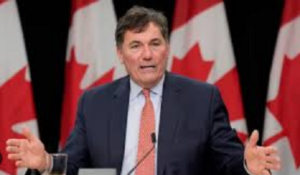
Mr. Carney said Dominic LeBlanc, minister responsible for Canada-U.S. trade, would soon lead a trade mission to Mexico and give nearly $10-million to United Nations-led projects to support migrant integration initiatives in Mexico and combat the illicit production and trafficking of fentanyl. Mr. Trump has blamed both Canada and Mexico for opioids smuggling into U.S. territory even though data show very little appears to be coming from inside Canadian borders.
Mr. Carney was also asked about statements this week by U.S. Ambassador Pete Hoekstra, who said the Trump administration had hoped to negotiate a grander bargain with Canada than simply a renewal of the USMCA. The envoy said this bigger deal Washington had hoped for would have encompassed a multitude of issues including defence, energy and autos.
The Prime Minister acknowledged a more expansive agreement was not under consideration right now.
“That bigger deal that’s in the interests, not just of the United States, but in the interest of the Canadian people, is not on the table − but it’s still possible,” Mr. Carney said.
He said Canada hopes to reach bilateral agreements on matters with the U.S. even as all three countries are conducting the scheduled review of the USMCA.
“We’re having bilateral discussions with the United States, so you may see improvements along the way,” the Prime Minister said.
“We have the ambition, but a deal is a deal, and a deal has to go for both sides, and Canada will agree to a deal that’s in the best interest of Canadians,” he said.
“This should not surprise anyone, including the U.S. ambassador, who’s doing a very good job for America.”
It’s been nearly eight years since a Canadian prime minister visited Mexico outside of a trilateral meeting with the United States. Former Mexican president Andrés Manuel López Obrador did not visit Canada during his six-year tenure that ended in 2024.
The two leaders exchanged gifts: Mr. Carney giving Ms. Sheinbaum a black FIFA sweater to celebrate the coming FIFA World Cup in North America and art made from birch bark. The Mexican leader gave him a lacquered wood box and a brightly coloured Alebrije jaguar sculpture.
Graeme Clark, the former Canadian ambassador to Mexico, said he considers it unlikely that such a meeting between Canada and Mexico would have taken place with the same “pressing urgency” if Mr. Trump had not regained the White House in 2024.
He said indifference on both sides has for many years hindered Canada’s relationship with Mexico, which ranks among this country’s top five export markets.
“Canadians think Mexico is just tequila and the beach and fiesta. Mexico is the 14 or 15th largest economy in the world,” Mr. Clark said.
The former envoy said what’s vital for Canada is to broaden channels of communication with Mexico as the Trump administration prepares for the scheduled 2026 review of the USMCA.
Mexicans were upset in 2024 when Canadian politicians including Ontario Premier Doug Ford suggested abandoning Mexico and striking a bilateral trade deal with the Trump White House.
Mr. Clark said it’s entirely possible Mexico could pursue a different course with Washington during coming negotiations.
He said what’s really important is that Mr. Carney made the trip. “This is a big deal for Mexicans. The fact that he’s spending 24 hours just on Mexico. That means something,” the former envoy said.
He said Mr. Carney needs to understand Mexico’s priorities for the USMCA negotiations.
“We need to keep them close. Because just as people like Doug Ford were inclined to throw Mexico under the bus, the Mexicans are equally able, I’d say, to put our needs aside” in the negotiations, Mr. Clark said.


“So even if it’s not a great love between the two countries, it can be a complementary relationship.”
Business leaders lauded the Carney-Sheinbaum meeting, saying neither country can afford to take each other for granted. “We’re addressing a long-standing issue where we haven’t done enough together: we’ve ignored each other,” Business Council of Canada president Goldy Hyder said. He and a contingent of Canadian corporate leaders accompanied Mr. Carney on his trip.
The sizable business delegation included Bank of Nova Scotia chief executive officer Scott Thomson, CPKC CEO Keith Creel, TC Energy CEO François Poirier, Martinrea International executive chairman Rob Wildeboer and ATCO CEO Nancy Southern.
Since returning to office earlier this year, Mr. Trump has hit Canada with a string of tariffs: 50 per cent on steel and aluminum, 25 per cent on autos and 35 per cent on any goods traded outside the USMCA, with the exception of oil, gas and potash at 10 per cent. His administration has also significantly hiked duties on Canadian softwood.
This article was first reported by The Globe and Mail