



Canada Sets Decade-Long Plan to Double Military Exports and Supercharge Employment
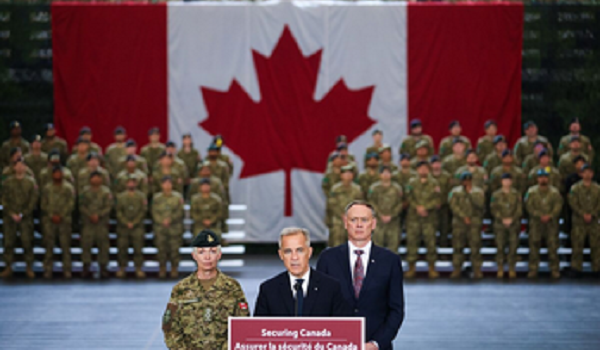
Ottawa is promising to buy Canadian, cut down bureaucratic barriers and rearm the country in its new Defence Industrial Strategy, under which the federal government also plans to select companies to be strategic partners from the vast number vying for a piece of the country’s ballooning defence budget.
Over the next 10 years, the government says it plans to double Canada’s defence exports, create 125,000 new jobs and increase the share of defence-related acquisitions awarded to Canadian companies to 70 per cent. To this point, a similar share of the country’s defence expenditures have been directed to the U.S.
In addition, the government plans to grow defence revenues for small- to medium-sized businesses by more than $5.1-billion annually.
In its 2025 fall budget, Ottawa set aside $81.8-billion for defence over five years, $6.6-billion of which was allocated to the Defence Industrial Strategy, the blueprint for how the government says Canada will build out its defence industry and safeguard its sovereignty.
The strategy, which was supposed to be released last week but was delayed after the mass shooting in Tumbler Ridge, B.C., follows a series of announcements by Ottawa about its intention to boost Canada’s economy through increased defence spending. The government has yet to announce the strategy, but on Sunday media reports revealed the details. The Globe and Mail and other media had received advance copies of a document outlining the strategy.
Without the strategy to clarify where these dollars were to be spent, Canadian businesses have been left to wonder whether their expansion into the sector will pay off, and whether it will increase their chances of selling at home.
By 2035, the government intends to boost defence spending to 5 per cent of Canada’s gross domestic product. This will mean spending $180-billion on defence procurement, $290-billion on defence-related infrastructure and $125-billion on downstream economic activity, according to the government.

In the strategy document’s introduction, Defence Minister David McGuinty, Industry Minister Mélanie Joly and Secretary of State for defence procurement Stephen Fuhr reference Russia’s invasion of Ukraine and the COVID-19 pandemic as turning points for how Canada thinks about supply chain vulnerability. This, plus the “ruptured” world order that Prime Minister Mark Carney spoke of during his recent speech in Davos, is the setting in which Canada’s industrial strategy is being unveiled.
“In this uncertain world, it is more important than ever that Canada possess the capacity to sustain its own defence and safeguard its own sovereignty,” the strategy document says.
Past estimates have reported that Canada’s defence sector is made up of nearly 600 companies, which contribute more than $9.6-billion to the country’s GDP and 81,200 jobs. These numbers are likely higher today as more companies across the country race to join the sector. Through its new strategy, the federal government is promising to create about one and a half times as many jobs as currently exist.
Eliot Pence, founder of Ottawa-based defence tech company Dominion Dynamics, said the scale of growth that the government is promising will likely require multiple contract awards annually in excess of $500-million, as well as hundreds of contracts between $5-million and $50-million. This could mean about 300 defence-related contracts annually, he said.
“Historical precedent shows that this scale of transformation is possible, but only with sustained political support from the Prime Minister’s Office,” he said in a statement, pointing to Canada’s National Shipbuilding Strategy as an example of long-term procurement rebuilding industrial capacity.
Ottawa’s new defence strategy makes it clear where those contracts are likely to be focused. It names 10 key sovereign capabilities: aerospace, ammunition, digital systems (such as artificial intelligence, quantum computing, secure cloud and communications equipment), maintenance support, personnel protection, sensors, space, specialized manufacturing, training and simulation, and uncrewed autonomous systems.
Nitrocellulose, or the compound used to make explosives, is also singled out as a capability that Canada aims to control domestically. Production is scheduled to start in 2029, the strategy document says.
From within these sectors will likely come Canada’s defence “champions,” which the federal government says it intends to identify no later than the summer. According to the strategy document, Ottawa will publish “a framework for the identification and onboarding of select Canadian defence firms as key strategic partners.”
Mr. Pence said this is a good move. It gives companies – and investors – certainty when it comes to putting their money into the sector.
Central to much of the work that this strategy lays out, the document says, is Ottawa’s newly formed Defence Investment Agency (DIA). Initially housed within Public Services and Procurement Canada, the defence strategy says this agency will turn into its own entity through legislation to be introduced in the spring.
The DIA will also spearhead a new Defence Advisory Forum, co-chaired by the federal ministers of defence and industry, as well as the secretary of state for defence procurement. The purpose of the forum will be to bring industry in for direct engagement on procurement, potential war games and other government-military meetings, according to the strategy.
At the heart of the DIA’s work moving forward will also be Ottawa’s new mandate for defence procurement, which includes new procurement being directed to Canadian companies first.
When Canada can’t build it at home it will seek allies to work alongside it in a way that still brings industrial benefits to the country. Europe, Britain and Indo-Pacific countries are highlighted as ideal partners. And when none of the previous options are possible, Canada will buy from its allies in a way that maintains sovereign control, the strategy says.
Matthew Lombardi, founder of Canadian defence innovation network The Icebreaker, said the emphasis on building first “is a huge shift and shows the government is listening to Canadian defence companies.”
However, he added that he would have liked to see more specific changes to procurement pathways for small- and medium-sized businesses. For example, he said, the government could push procurement authority down from other agencies to the Canadian Forces at times, or create a fast lane for procuring small systems, like what are known as attritable, or expendable, drones.

A definition of what constitutes a Canadian company in the context of the strategy is also missing. Industry has criticized the federal government’s Buy Canadian policy, which it implemented in December, for not clearly stating whether multinational companies with Canadian subsidiaries were included.
Other initiatives that the federal government is putting forth in its new strategy include accelerating security clearance for industry personnel, holding industry days to bring the Canadian Forces and companies together, and altering its Industrial and Technological Benefits Policy, which industry has criticized for its inefficiencies. Changes to the policy will be published in early 2026.
Mr. Lombardi said the strategy’s wording around scaling Canadian small- and medium-sized businesses is promising and is recognition of the fact that many of them are already selling abroad while struggling to enter the domestic market.
To support the research and development being done by these companies, the strategy says, a plan to establish a Bureau of Research, Engineering and Advanced Leadership in Innovation and Science will be published, with the first round of projects selected by late 2026.
The bureau is being called Canada’s response to the U.S.’s Defence Advanced Research Projects Agency, which is credited with the creation of GPS and the internet.
Canada’s steel and aluminum sectors may also receive a boost from Ottawa through its Strategic Response Fund as part of the strategy, to help them pivot to manufacturing for defence.
And Ottawa is looking even further down the supply chain to its own domestic talent, promising to implement a program to increase the supply of skilled labour in the country.
This article was first reported by The Globe and Mail