



Canadian LNG Exports to Asia Surge as Energy Markets Tighten
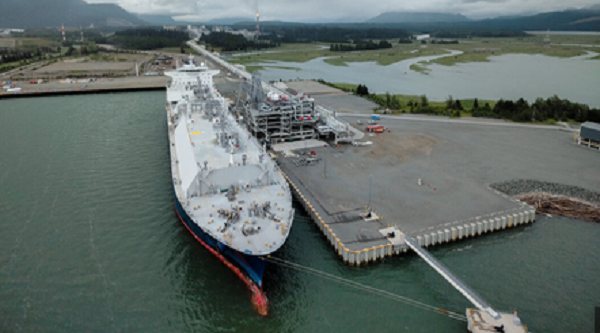
LNG Canada has been sharply boosting exports this month to Asia, coinciding with reduced global supplies for liquefied natural gas after the virtual shutdown of the Strait of Hormuz.
During the first 17 days of this month, the Shell PLC-led project in Kitimat, B.C., had eight ships wait their turn to dock and begin the journey of exporting LNG, according to data from Kpler, a provider of real-time analytics.
On Tuesday, the vessel Puteri Mahsuri departed with LNG Canada’s 60th cargo to Asia since export operations began in mid-2025.
After only four vessels departed from Kitimat in December, Canada’s first LNG export terminal has been ramping up, with 10 ships starting to transport the fuel across the Pacific Ocean in January and another 11 vessels in February, Kpler statistics show.
Before the United States and Israel launched attacks on Iran on Feb. 28, about one-fifth of the world’s oil and LNG supplies passed through the Strait of Hormuz.
Qatar, the world’s second-largest LNG exporter, halted its production after Iran attacked Qatari facilities and the strait effectively closed to marine traffic. LNG shipments from the United Arab Emirates also have been suspended.

The Kitimat terminal went through a slow startup phase for six months after the first vessel, the Gas
Last year, LNG Canada operated far below its exporting goals because its production schedule meant it had to gradually launch two “trains,” or processing units for supercooling natural gas.
In what the industry calls nameplate capacity, LNG Canada’s Phase 1 has the ability to export at a rate of 14 million tonnes a year. The project, however, could increase output to 15 million tonnes annually through operating efficiencies, or 1.25 million tonnes a month.
“The facility has yet to produce at close to maximum utilization due to operational issues,” JP Lacouture, a principal insight analyst at Kpler, said in a statement on Tuesday.
LNG Canada has been disrupted by BC Hydro-related power outages in the past.
But even after a recent production delay, the export volume so far in March of 550,280 tonnes puts LNG Canada on pace to reach almost 85 per cent of its full capacity in early spring.
Mr. Lacouture said there are now at least six vessels waiting their turn to load up later this month in Kitimat.
In a community notice to Kitimat residents last week, LNG Canada said unscheduled flaring would occur from the combustion of natural gas. The notice was the latest in a series of messages for planned and unplanned flaring over the past nine months, cautioning local residents about increased noise and smoke.
Climate activists say the focus on fossil fuels such as LNG ends up delaying the global transition to renewables such as wind and solar.
For the first three months of this year alone, LNG Canada will easily surpass the export volume from the initial six months of running last year.
“LNG Canada continues to safely and responsibly advance its early operations. Bringing any LNG facility into operations is a managed and sequenced process,” LNG Canada spokesperson Paul Hagel said in a statement.

Clark Williams-Derry, an analyst at the Institute for Energy Economics and Financial Analysis, estimates that the United States shipped a record 108.6 million tonnes of LNG in 2025 as the top exporting country.
Based on data from Kpler, his analysis placed Qatar second at 81 million tonnes of LNG exported last year, followed by Australia at 77.7 million tonnes.
LNG Canada’s shipments last year of more than 2.2 million tonnes put this country in 19th place out of 24 LNG exporting nations.
“As the Middle East conflict continues to escalate and the Strait of Hormuz remains effectively closed, base-case assumptions have shifted significantly, as the crisis risks leaving lasting scars on energy markets,” Rystad Energy said in research note this week.
It takes roughly 10 days for a ship to sail from Kitimat to North Asia, compared with 20 days from the U.S. Gulf Coast, via the Panama Canal.
Prime Minister Mark Carney, as part of his quest to make Canada an energy superpower and reduce economic dependence on the U.S., announced in September that LNG Canada’s Phase 2 expansion plan made the list of major projects of national interest to be considered for fast-tracking.
In November, Mr. Carney said Nisga’a Nation-backed Ksi Lisims LNG in northwest B.C. has been added by Ottawa to the growing roster of plans submitted to the Major Projects Office, which is seeking to expedite a wide range of developments in sectors such as energy, mining and infrastructure across Canada.
If LNG Canada forges ahead with its Phase 2 expansion plan, it would double the Kitimat terminal’s capacity by the early 2030s.
RBC Capital Markets analyst Michael Harvey estimates that LNG Canada exported about 4.6 million tonnes of LNG to Asia between last June and mid-March of this year.
“The project is nearing full ramp,” he said in a research note. “At full export capacity, the facility will require roughly 15 export tanker vessels per month.”

Mr. Harvey said that of the cargo sailings that have delivered to their destinations, there were 30 trips to South Korea, 14 to Japan, seven to China and five to Taiwan.
LNG Canada’s liquefaction facility is located on the Haisla Nation’s traditional territory.
The Diamond Gas Crystal, named after former Haisla chief councillor Crystal Smith, has loaded up with LNG on three occasions at the Kitimat site. It made its first appearance at LNG Canada last October, and it has filled up twice so far this year.
LNG Canada is this country’s first export terminal for natural gas in liquid form. Two smaller B.C. projects – Woodfibre LNG near Squamish and Cedar LNG in Kitimat – are under construction.
The contentious Coastal GasLink pipeline, operated by TC Energy Corp., is supplying natural gas from northeast B.C. to LNG Canada and will be used for Cedar.
Benchmark LNG spot prices for Asia-Pacific markets have surged 80 per cent in March.
But LNG Canada is primarily linked to long-term pricing contracts.
London-based Shell has the largest stake in the Kitimat terminal at 40 per cent, followed by Malaysia’s state-owned Petronas (25 per cent), Japan-based Mitsubishi (15 per cent), PetroChina (15 per cent) and South Korea’s Kogas (5 per cent).
Each joint venture participant is responsible for “offtake” – long-term buyers of LNG in Asia – in proportion to their ownership stakes.
This article was first reported by The Globe and Mail