



Carney and Modi Commit to Reviving Paused Canada-India Trade Negotiations
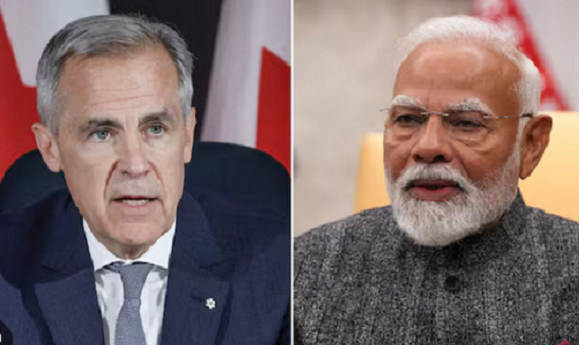
Prime Minister Mark Carney and Indian Prime Minister Narendra Modi have agreed to pursue what they are calling a comprehensive economic partnership, restarting trade talks that have been frozen for the past two years.
The development comes after the two leaders met on the sidelines of the G20 summit in Johannesburg on Sunday. It is the latest evidence of a thaw in relations between the two countries, which broke down following the killing of Canadian Sikh activist Hardeep Singh Nijjar in British Columbia in 2023.
Canada and India have pursued a free-trade agreement in fits and starts since 2010. The latest effort began in 2022 but was called off the next year amid the diplomatic row that followed Mr. Nijjar’s assassination. Canadian law enforcement officials have blamed the killing on the Indian government.
The Sunday announcement is part of a broader reorientation of Canadian foreign policy. Since becoming Prime Minister, Mr. Carney has sought to mend economic ties with China and India – two countries with which Ottawa has had major security concerns in recent years.
He has also taken a more hard-nosed approach to pursuing foreign trade and investment deals, including with non-democratic countries with poor human-rights records.

On his way to the G20 meeting, Mr. Carney stopped in the United Arab Emirates to drum up investment from large sovereign wealth funds – leaving with a pledge from the UAE to invest around $70-billion in Canada.
“Certainly it’s not the case – this is an important point – when we engage with a country … that we’re endorsing everything that country does,” Mr. Carney said at a news conference on Sunday before his meeting with Mr. Modi.
This policy shift comes in response to the sharp protectionist turn by U.S. President Donald Trump, which has called into question Canada’s access to its main export market.
Ottawa has pledged to double non-U.S. exports to $600-billion from $300-billion over the next decade, and it has committed billions to improving trade infrastructure to move Canadian products to the coasts and onto ships bound for overseas markets.
Canada and India have agreed to pursue “an ambitious Comprehensive Economic Partnership Agreement encompassing goods, services, investment, agriculture and agri-food, digital trade, mobility, and sustainable development,” the Prime Minister’s Office said Sunday. It said the goal is to double two-way trade to $70-billion by 2030.
On the weekend, India and Canada also struck a trilateral “technology and innovation partnership,” with Australia as the third member, aimed at boosting co-operation in sectors like nuclear energy and artificial intelligence.
Trade between the two countries remains relatively limited. In 2024, Canada exported $5.3-billion worth of goods to India and imported $8-billion worth of goods, according to Statistics Canada. That’s compared to almost $600-billion in goods exported to the U.S. and around $30-billion in merchandise exports to China.
Canadian services exports to India have increased significantly in recent years, hitting $16.1-billion in 2024. However, this growth was driven almost entirely by Indian foreign students spending money in Canada (which is classified as a tourism services export), and Canada has dramatically reduced its foreign student intake over the past year.
Canada also has significant foreign direct investment in India, mostly by Canadian pension funds and large institutional investors in Indian infrastructure.
In an interview on Friday, Canada’s International Trade Minister, Maninder Sidhu, who was in India earlier this month to meet his counterpart, said he sees significant opportunity to boost Canadian energy exports to India, particularly of liquefied natural gas.
“The economy is growing 7 or 8 per cent year-over-year. It’s the fifth-largest economy in the world, destined to be the third. They need 70 per cent more energy. Where is the energy going to come from? Hopefully from Canada,” Mr. Sidhu said.
“India has an ambitious agenda to get cleaner, get off coal quicker. And so it’s LNG, it’s conventional energy, conventional oil, but it’s also nuclear,” he said.
Canada already has 15 trade deals covering 51 countries, but it is actively seeking more. Ottawa inked an agreement with Indonesia in September and is working toward deals with the Southeast Asian ASEAN bloc and the South American Mercosur bloc.
No other market comes close to the United States in terms of importance to Canada, and Ottawa’s overarching priority is to secure tariff relief from the U.S. and a successful renewal of the United States-Mexico-Canada free-trade agreement next year. However, Mr. Carney bristled when asked on Sunday when he had last spoken with Mr. Trump, who broke off the latest round of Canada-U.S. trade talks last month in anger over an Ontario government TV ad.
“Who cares? I mean, it’s a detail. I spoke to him. I’ll speak to him again when it matters,” Mr. Carney said, noting that both he and the President had been busy.
Ottawa and New Delhi have tried to strike a trade deal multiple times over the past two decades without success. India tends to be highly protectionist and has frequently been a stumbling block to trade liberalization efforts at the World Trade Organization.

Just this month, India imposed a 30-per-cent tariff on yellow peas, which has hit Canadian farmers.
However, New Delhi has started to change its approach to trade as a result of shifts in both domestic politics and geopolitics, said Jeff Nankivell, president and CEO of the Asia Pacific Foundation of Canada.
Mr. Trump has imposed a 50-per-cent tariff on Indian goods, leading New Delhi – like Ottawa – to look for new export markets. In July, India struck a free-trade agreement with Britain and it is in trade talks the European Union.
“This is a change in their trade policy, and I think they recognize that it’s time for an opening up of the Indian economy. Not an easy thing to do with domestic politics in India, but that’s a change,” Mr. Nankivell said.
Ottawa and New Delhi have spent months manoeuvring toward the Sunday announcement. Mr. Modi came to Canada at Mr. Carney’s invitation in June for the G7 summit in Kananaskis, Alta. Since then, the two countries have reinstated their high commissioners, who were mutually expelled in 2024, and resumed co-operation on security and law enforcement issues.
The relationship could still come under pressure as the trial of the four men accused of killing Mr. Nijjar gets under way in British Columbia. However, Mr. Nankivell, a former Canadian diplomat, said that the two countries would not be re-engaging at this level unless they were confident they’d be able to manage through any revelations that come from the trial.
Mr. Carney will visit India in early 2026, the PMO said.
This article was first reported by The Globe and Mail