



Carney Expects Tariff Relief Following Talks with Trump
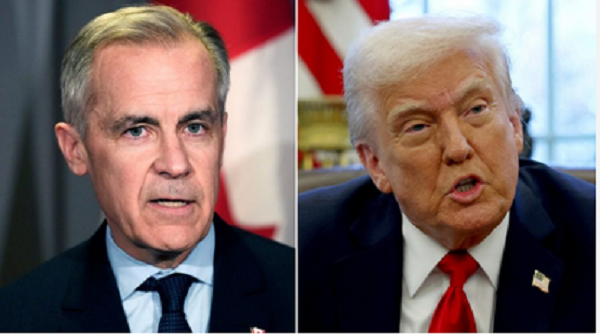
Prime Minister Mark Carney said he spoke at length with President Donald Trump earlier this week and that he is expecting to secure some relief for strategic sectors battered by U.S. tariffs, but he stressed there is no certainty that this will happen.
Mr. Carney, who said he talked to Mr. Trump on Monday evening, added that Michael Sabia, Clerk of the Privy Council, is in Washington for talks with U.S. administration officials this week.
“We are expecting agreements, small agreements, in some of the strategic sectors. We will see. It’s not a guarantee,” Mr. Carney said in French on Wednesday, referring to the automotive, steel and aluminum sectors.
He made the comments in response to questions from reporters on the way into a two-day gathering of his cabinet and outside experts.
Mr. Carney’s conversation with Mr. Trump was the second in recent weeks after efforts to reach a broad trade deal with the U.S. by a Trump-imposed Aug. 1 deadline collapsed.


Mr. Carney said the Toronto meeting is taking place against the backdrop of a U.S.-led transformation of the global economy. His government is facing increasing pressure to find ways of solving the trade disputes while also fulfilling campaign promises to Canadians on housing, affordability and crime.
The Prime Minister said the cabinet meeting would include discussions on the groundwork for the renegotiation of the United States-Mexico-Canada Agreement, or USMCA, scheduled for next year, and supports for Canadian sectors pummelled by tariffs.
Cabinet ministers will also receive external perspectives on the economy, technology, the mood among Canadians and business leaders, as well as guidance on navigating the Canada-U.S. relationship.
Part of that outside panel will include Kevin Roberts, the president of the Heritage Foundation, a right-wing think tank with significant ties to the Trump administration. Mr. Trump recently chose its chief economist to lead the Bureau of Labor Statistics, after he fired the previous leader.
The Heritage Foundation was also behind an effort known as Project 2025, a controversial proposal for an overhaul of the U.S. government.
The Prime Minister’s Office said Mr. Roberts was invited to the meeting on Thursday to offer insight into the Trump administration’s trade priorities ahead of the USMCA review next year, and that the discussion will focus solely on trade.
Mr. Carney said Wednesday that his conversation with Mr. Trump earlier in the week was constructive.
“We spoke at length on a wide range of issues, including on trade, geopolitical, other issues, labour issues, etc.,” he said. “It was a good conversation.”
The discussion had not previously been disclosed by the PMO. Calls between the Prime Minister and other world leaders are typically followed by a formal public summary.
In a statement, Mr. Carney’s office did not explain why there was no such “readout” this time.
“The Prime Minister has always been clear that he and the President are in close and frequent communication, and that is in the interest of workers, business, and all Canadians,” his office said.
Parliament resumes in two weeks and part of the talks with cabinet in Toronto are the next steps forward for major campaign promises, including getting natural resources and infrastructure projects built faster, building more homes, addressing crime and reining in spending.
Conservative Leader Pierre Poilievre accused Mr. Carney of already breaking promises to Canadians in failing to get a deal with Mr. Trump.
“He promised ‘elbows up,’ ” Mr. Poilievre told reporters after an announcement in Mississauga Wednesday morning. “He’s been elbows down.”
The Prime Minister announced on Aug. 22 that Canada was dropping its retaliatory tariffs on some U.S. products in a bid to reset trade discussions with the White House that had stalled.
Canada retained its countertariffs on steel, aluminum and autos, industries that have all been hammered by U.S. sectoral duties, known as Section 232 tariffs.
Ottawa has made efforts to try to secure a deal with Mr. Trump, including increasing spending on military and border security and scrapping the digital services tax that hit U.S. tech companies.
Earlier this year, Canada imposed three rounds of countertariffs covering nearly $100-billion worth of U.S. goods.
However, it soon started adjusting the measures, offering carve-outs for U.S. goods used in Canadian manufacturing, and exemptions for U.S. auto companies that continue making cars in Canada.
Brian Clow, who served as deputy chief of staff to former prime minister Justin Trudeau, said he thinks the Trump administration has little incentive to make a deal that would remove or reduce U.S. tariffs.
“There’s no imminent deal, mainly because the Trump administration is largely happy with the current tariffs on Canada,” Mr. Clow said.
“When it comes to tariffs on steel, aluminum and cars, I don’t see relief any time soon unless Canada were to make major concessions.”


Pollster Jean-Marc Léger, president and CEO of market-research company Leger, gave a presentation to cabinet Wednesday.
He told reporters afterward that a year ago, tariffs were the most important issue in Canada and that’s one of the reasons why the Carney government was elected.
But now, he said, tariffs rank only fourth in a list of priorities, with most Canadians concerned about the state of the economy.
Sébastien Dallaire, executive vice-president at Leger, said Canadians are still giving the government the benefit of the doubt on its dealings with the U.S. but are hesitant about the prospect of a deal with the Trump administration.
Mr. Dallaire said most people view the government as meeting their expectations, although Mr. Léger added that about half don’t believe Mr. Carney will succeed in striking a deal with the Americans.
“The expectations are, it will be difficult for the next few months, and people understand that,” Mr. Léger said.
With a report from Steve Chase
This article was first reported by The Globe and Mail