




China Links Future Commercial Growth to Stable Canada Relations
During his high-stakes visit to Ottawa, Beijing’s top diplomat on Friday dangled the prospect of Canada doubling its exports to China by 2030, if relations stay positive.
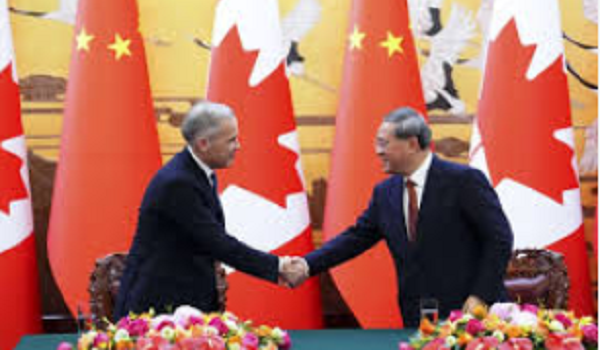
Wang Yi, whose trip spans three days ending Saturday, laid out expectations for Canada-China relations in remarks shortly before a meeting with Foreign Affairs Minister Anita Anand.
One of the conditions was “strategic independence,” a term China often uses to signal its interest in seeing Canada stop moving in lockstep with the United States. It is the first trip here by a Chinese Foreign Minister in 10 years.
“The ups and downs in China-Canada relations over these years have brought us many important lessons,” he said in remarks translated by the Asia Pacific Foundation of Canada.

“We need to uphold mutual respect, seek common ground while reserving differences, maintain strategic independence, and pursue mutual benefit and win-win outcomes,” Mr. Wang said.
“I believe that no matter how the international situation changes, we should adhere to these beneficial experiences.”
Ms. Anand said Canada wants to boost trade with China by 50 per cent in the next four years while protecting its national-security interests, as she welcomed her Chinese counterpart to Ottawa.
She made no mention on Friday of the fact that a Canadian warship transited the Taiwan Strait days before Mr. Wang’s visit, which began Thursday. This transit took place in defiance of an earlier warning from Beijing to stay away from the disputed waterway, which China claims as its own.
“We are committed to growing this relationship responsibly with a goal of increasing exports to China by 50 per cent by 2030, while safeguarding Canada’s economic and national-security interests and values over decades,” Ms. Anand said as reporters covered the start of her meeting with Mr. Wang.
The Chinese Foreign Minister said in reply that he was even more bullish than Ms. Anand about the growth of Canadian exports to China. But he attached conditions.
“I think that if our bilateral relationship maintains a momentum of development, and if both sides’ policies maintain stability and positive expectations, then I believe it can completely exceed 50 per cent, and it may even grow by 100 per cent without any problem,” Mr. Wang said. “This is because China will very soon become the world’s largest market, and China’s market is willing to open itself to Canada.”
Canadian merchandise exports to China were valued at $34.1-billion in 2025, according to the federal government.
Mr. Wang is in Ottawa as both countries work to cement a “strategic partnership” struck in January after a bitter trade war and years of strained relations.
Ms. Anand plans to take Mr. Wang hiking on Saturday, an outing that suggests a deeper, more cordial relationship normally reserved for close allies.

HMCS Charlottetown passed through the Taiwan Strait – which is located between China and Taiwan – on May 22 and 23, the Department of National Defence said Thursday.
In Beijing on Friday, the Chinese government, responding to the Canadian warship’s actions, said it firmly opposes any attempt by any country to undermine its sovereignty and security “under the pretext of freedom of navigation.”
The transit took place just weeks after a warning delivered by Wang Di, China’s ambassador to Canada, in an interview with The Globe last month. The envoy said the new partnership between the two countries would be harmed if Ottawa sends more military vessels through the Taiwan Strait or if Canadian parliamentarians keep travelling to Taiwan to meet with its government.
The ambassador appeared to be laying out expectations for Canada’s behaviour as the two countries attempt to build on their truce reached earlier this year.
Prime Minister Mark Carney played down this new partnership with China during a meeting in New York Thursday, calling it a “very basic reset of the relationship.”
U.S. President Donald Trump has criticized the deal struck between Mr. Carney and Chinese President Xi Jinping. In January, Canada broke with the United States, agreeing to lower the tariffs on Chinese-made electric vehicles from the 100-per-cent levy Ottawa had imposed in tandem with the Biden administration in 2024.
The deal with Beijing allows China to send 49,000 electric vehicles in 2026, a number that will rise in future years. Beijing, in turn, agreed to cut retaliatory tariffs on items, such as canola and seafood and other products.
As part of this budding relationship, Mr. Carney has set out “guardrails” for areas of Canada’s economy that are off limits to Chinese investment, such as artificial intelligence, critical minerals and defence.
In a readout Friday, both Ms. Anand and Mr. Wang committed to “regularizing annual foreign ministers’ meetings” as part of this new relationship. They said Canada and China are re-establishing a “National Security and Rule of Law Dialogue” to discuss issues of mutual interest and concerns. They said a Law Enforcement Working Group meeting to discuss matters such as counternarcotics would take place in Beijing June 8-12.

They said Canada has accepted China’s invitation to be “a country of honour” at the 9th China International Import Expo to be held in Shanghai in early November.
The pair said they look forward to the next meeting of the high-level Canada-China Economic and Financial Strategic Dialogue, which will be co-chaired by Canada’s Minister of Finance and National Revenue, François-Philippe Champagne, Canada’s Minister of International Trade, Maninder Sidhu, and Vice-Premier of the People’s Republic of China, He Lifeng.
Vina Nadjibulla, vice-president of research and strategy at the Asia Pacific Foundation, cautioned about the risk that China would weaponize closer trade relations that make Canada more dependent on Chinese companies.
More exports, particularly when concentrated in a single product or sector, can give Beijing leverage, she said. It could use the threat of future export boycotts to force Canada to align with its policies whether on Taiwan, the South China Sea, the United States or other matters.
With reports from Reuters
This article was first reported by The Globe and Mail