




CUSMA Seen as Key Catalyst for Expanding Japanese Auto Production in Canada
As the Canadian government prepares to review the Canada-U.S.-Mexico Agreement (CUSMA) this summer — a deal the U.S. president is signalling he’s prepared to abandon — Japan’s ambassador is reminding Canada just how high the stakes are for a key component of Ontario’s economy.
Japanese Ambassador to Canada Kanji Yamanouchi says continued access to the U.S. market, as provided for under CUSMA, is essential for current and potential increased Japanese investment in auto manufacturing in Canada.
“That is the critical condition,” Yamanouchi said in an interview airing Sunday on CTV Question Period . “Canada is, of course, a G7 country. Your GDP is one of the top ten countries — $2.5 trillion. But you know the size of the U.S. market? $30 trillion.”
“All those cars made in Canada, of course sold in Canada, but at the same time, exported to the U.S market,” added Yamanouchi. “(For) private companies, that means they have to calculate to increase profit. So CUSMA is a very important part of the calculation.”
Last year, U.S. President Donald Turmp imposed a 25 per cent tariff on Canadian-made automobiles, with a complicated carveout for the U.S. content in imported vehicles. Trump has also repeatedly stated that the U.S. doesn’t need cars made in Canada or Mexico and that he wants to bring back auto manufacturing positions to the United States.

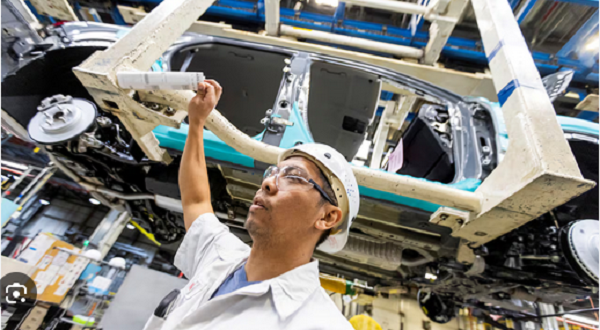
Japanese auto makers, meanwhile, are a critical source of automotive production and employment in Ontario.
Honda and Toyota have manufactured vehicles in Canada for decades, and while overall auto production in Canada has declined in the last ten years, these two companies are now consistently outproducing their American rivals.
In 2024 and 2025, Honda and Toyota each assembled more vehicles in Canada than Ford, General Motors and Stellantis combined, according to a report published this month by the Trillium Network for Advanced Manufacturing.
Employment trends are also following production trends, with Japanese automakers employing more than 60 per cent of all automotive assembly workers in Ontario in 2024 versus just 38 per cent by American companies.
Japan wants more Canadian LNG: Ambassador
Prime Minister Mark Carney is scheduled to visit Japan later this week as part of his nine-day, three-country tour of the Indo-Pacific, aimed at drumming up increased trade and investment opportunities for Canada.
Energy security, specifically access to liquefied natural gas (LNG), is of particular importance to Japan.
Yamanouchi said the opening of LNG Canada’s export terminal last year was a “very, very important historical event,” as it opened markets in Asia, including Japan.

he Japanese ambassador said there is more appetite for Canadian LNG in his country, and he pointed to the yet-to-be approved Phase 2 of LNG Canada — which would double the export terminal’s export capacity — as an important future project.
“That (expansion) would make LNG Canada facility the second largest in the world and Asian countries, especially Japan, are very much interested,” Yamanouchi said, pointing to the 10-day shipping time and relative geopolitical safety of the marine route.
“This is a very, very important project for us.”
The federal government referred LNG Canada Phase 2 to its Major Projects Office (MPO) for consideration in September of last year. If the MPO designates the terminal expansion as a project in the national interest, the new federal body is mandated to fast-track regulatory approval and development.
The consortium of companies behind LNG Canada have not, however, made a final investment decision about proceeding with the second phase of the project.
This article was first reported by CTV News