






Experts Debunk Social Media Calls for Welland Canal Blockade
The Strait of Hormuz, it isn’t.
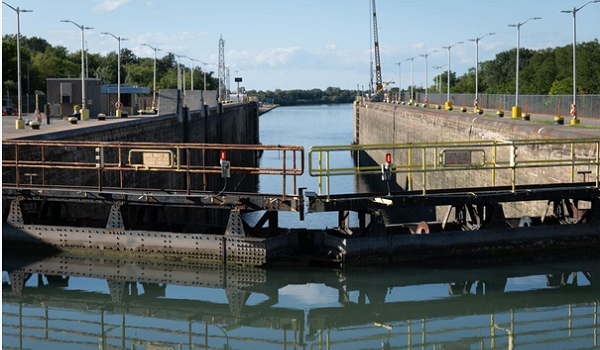
But could Canada block American ships from passing through the Welland Canal as retaliation for tariffs imposed by U.S. President Donald Trump? After all, the canal’s eight locks are all right here in Ontario.
While social media has been abuzz with suggestions that the key passage from the Great Lakes to the St. Lawrence River could become part of the trade war, it wouldn’t be very smart — or practical — to try to block it, supply chain and trade experts say.

For one thing, the canal is overseen by two separate Canadian and U.S. organizations, pointed out veteran international trade lawyer John Boscariol.
“If push came to shove, could Canada override whatever agreements it has about the canal? Maybe. But it would be cutting off our nose to spite our face,” said Boscariol, head of the trade law group at McCarthy Tétrault.
The Great Lakes St. Lawrence Seaway Development Corporation administers the seaway on the American side as a federal agency within the U.S. Department of Transportation.
In Canada, the federal government owns the Canadian portion but its management is overseen by the non-profit St. Lawrence Seaway Management Corporation.
Odds are that the U.S. would see the move as a dramatic escalation of the trade war and strike back, Boscariol said. Supply chains are so well integrated on both sides of the border that things which hurt U.S. companies could easily side-swipe Canada’s economy too, he added.
“There are products moving through there that Canadian companies rely on,” said Boscariol. “I understand the temptation of lashing out under these circumstances, but it’s complicated enough for the Canadian government to figure out ways they can use counter-tariffs without hurting Canadian companies. This would be even more complicated.”
Yes, blocking American access to the canal would disrupt a key U.S. trade route, acknowledged Fraser Johnson, a professor at Western University’s Ivey School of Business, and one of Canada’s top supply chain experts.

“It connects the Midwest of the U.S. to markets in the Great Lakes and to export markets. There’s a lot of volume that goes through the Great Lakes,” said Johnson. “The Welland Canal is the key passageway from the Great Lakes to the St. Lawrence.”
Grain producers in the U.S. Midwest, steel makers in the American rust belt, and other companies would need to find alternative routes to get their products to customers in Europe or South America. And that’s not fast or cheap, Johnson said. The Welland Canal sees roughly 3,000 ships a year, carrying 40 to 50 million tonnes of freight.
“Marine transport is the most cost-efficient way to transport bulk cargo. As a cost issue, it’s not even close,” said Johnson. “Trucking would be anywhere from five to eight times more expensive. The best option would be rail. But it’s still roughly twice the cost of marine shipping.”
Disrupting a trade route that’s been used for over a century isn’t something that happens overnight, Johnson warned.
“There are always workarounds, but you’ve got supply chains set up for decades and are running like a precision instrument,” said Johnson. “It would be a hassle and it would be more expensive.”
And those increased costs would be passed along to customers for the U.S. goods, plenty of whom are in Canada, Johnson said.
“Do we really want to get into a dispute that disrupts the raw material and finished product flowing through the Great Lakes? I don’t think that’s a very good idea,” said Johnson.
He also scoffed at the notion of Canadian and U.S. naval ships squaring off at the entrance to the Welland Canal.

“I’d like to see them say they’re sending an aircraft carrier into Lake America,” Johnson chuckled.
The U.S. could also respond in tit-for-tat fashion by blocking Canadian ships from passing through locks further east along the St. Lawrence Seaway in New York state, Johnson added.
“About two-thirds of the goods going through the St. Lawrence Seaway are Canadian,” said Johnson.
With files from The Canadian Press
This article was first reported by The Canadian Press