



Federal Budget Seeks to Spur Private Investment but Sidesteps Major Tax Reforms
Prime Minister Mark Carney used his first budget to make a pitch for more private investment in the country, but stopped short of the kind of game-changing tax and regulatory changes many businesses and investors had been hoping to see as the Canadian economy reels from U.S. protectionism.
The budget followed through on Mr. Carney’s pledge to trim government operational spending so it could put more money toward capital projects – both infrastructure and other measures aimed at encouraging private-sector investment. And it hinted at possible regulatory changes that would be well-received on Bay Street and in many boardrooms across Canada.
But the moves designed to boost business investment and improve the country’s long-standing productivity problems were more incremental than transformational.
In their spring election platform, the Liberals had promised to launch an “expert review” of the corporate tax system, raising the possibility of a broad cut to the baseline corporate tax rate. The budget made no mention of a review.
Instead, efforts to improve tax competitiveness, and respond to the latest round of U.S. corporate tax cuts, focused on what the budget called a “productivity super-deduction.” This is a cluster of tax incentives that allow companies to write off a range of investments in machinery, equipment and buildings more rapidly, most of which had been previously announced in 2024.

“It looked a lot like what we’ve seen in the past, a lot of rehashing things,” Randall Bartlett, senior director of economics at Desjardins, said of the government’s tax-competitiveness efforts.
“They could have been more aggressive in moving forward, and more ambitious in cutting the effective tax rate” for investment.
Meanwhile, the budget announced $32.5-billion in new capital investments – a somewhat loosely defined category that includes infrastructure and tax incentives – over the next five years.
That’s “definitely not chump change,” said Rebekah Young, head of inclusion and resilience economics at Bank of Nova Scotia. But this was mostly in line with Bay Street expectations and probably won’t move the dial much on the country’s near-term economic outlook, she said.
Expectations were high heading into the budget, given Mr. Carney’s rhetoric about the need for economic transformation and given what’s at stake.
U.S. President Donald Trump’s tariffs have upended continental trade, cratering Canadian exports, freezing business investment and calling into question the viability of key Canadian industries. This has compounded concerns about weak productivity and underinvestment by Canadian businesses.
The budget sets out a lofty goal: Bringing in about $500-billion in private-sector investment over the next five years, with the aim of enabling $1-trillion in total investment, both public and private, in the country.
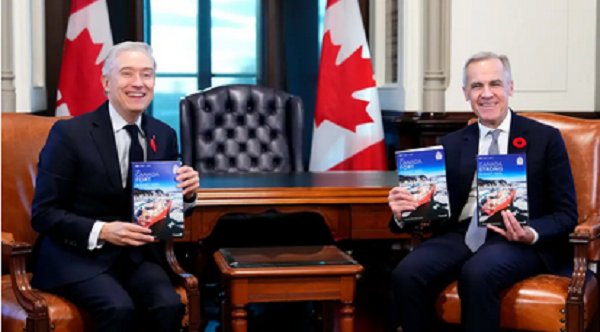
To get there, Mr. Carney and Finance Minister François-Philippe Champagne offered a smattering of new programs, tax incentives and promises to use government expenditures on things such as defence to boost private-sector opportunities.

This includes an enhancement to the Scientific Research and Experimental Development tax-incentive program, a new $2-billion “Critical Minerals Sovereign Fund,” and $1-billion to support investments in artificial intelligence, much of which was repurposed.
Ottawa is also investing $6-billion in trade-related infrastructure, including ports, roads and digital infrastructure, with $1-billion of this earmarked for an “Arctic Infrastructure Fund.”
The real heart of Mr. Carney’s growth agenda, however, appears to focus on using the various levers of government finance – including the Canada Infrastructure Bank, the Canada Growth Fund and the Canada Indigenous Loan Guarantee Corporation – to drive forward large resource and infrastructure projects under the guidance of the new Major Projects Office.
The budget said the MPO, which was launched over the summer to speed up the regulatory process for “nation-building” projects, will “co-ordinate financing from the private sector, provincial and territorial partners, and the federal government.”
The Canada Infrastructure Bank was given an additional $10-billion in capital and had its mandate expanded to allow it to invest in “any nation-building projects that have been referred to the Major Projects Office, regardless of sector or asset class.” That opens the door to investments in pipelines or other projects previously out of bounds for the Crown corporation.
“I think the really big investment opportunities are going to be in the non-fiscal stuff. So, increasing the capitalization of the infrastructure bank, mandating the MPO to co-ordinate and structure financing for major projects, seeding the landscape for this next round of infrastructure projects,” said Ms. Young of Scotiabank.
The budget also dangled some policy changes that could have a meaningful impact on private investment, without actually committing to anything. This included a suggestion that the government will look at privatizing airports, and could scrap the oil and gas emissions cap if the country can successfully establish carbon credit markets and deploy carbon capture, utilization and storage technology.
While Mr. Carney and Mr. Champagne may have pursued a less-aggressive growth agenda than some had hoped to see, they also delivered less red ink than some had feared.
The deficit is forecast to come in at $78.3-billion this fiscal year. That’s almost twice the deficit that had been forecast in the 2024 fall economic statement, but in the mid-range of recent Bay Street estimates.
And against expectations, the budget projects a downward path for the deficit-to-GDP ratio over the next five years – although with no route back to balance. The budget said this downward slope, combined with the goal of balancing day-to-day operating spending with revenues, would be the government’s two fiscal anchors going forward.

“I think markets are generally going to be pretty sanguine on this,” said Mr. Bartlett of Desjardins.
“Debt-to-GDP is not on the right track, and I think the risks are tilted to the downside of their outlook. But when you put Canada up against other G7 economies and other major economies globally, Canada is among the cleanest dirty shirts in the fiscal laundry basket,” he said.
Ultimately, the federal government is trying to walk and chew gum at the same time, helping tariff-battered industries that are struggling to survive while persuading investors and companies to bet long term on Canada.
Dennis Darby, chief executive of Canadian Manufacturers & Exporters, said in a statement that the budget is a move in the right direction, pairing the billions already announced to support the steel, aluminum, auto and forestry companies, with a package of more forward-looking measures.
“However, deeper tax reform, substantial red-tape reduction are needed to shift Canada from managing risk to driving growth,” he said.
This article was first reported by The Globe and Mail