




Ottawa Commits $200 Million to Nova Scotia Spaceport for Domestic Satellite Launch Capability
Ottawa is spending $200-million at a Canadian-owned spaceport to enable sovereign satellite launches and has selected three companies to receive funding from its launch grant program as part of its effort to boost Canada’s space and defence capabilities and encourage new investment in the industry.
Ottawa will lease a dedicated space-launch pad at Spaceport Nova Scotia, a facility near Canso, N.S., being built by Halifax-based Maritime Launch Services MAXQ-NE .
The Department of National Defence will pay $20-million per year over 10 years, with 90 per cent of gross rental payments being spent in Canada to support the domestic space agency.
Read More On Our Daily Stock Market Reports – Markets Rally As Oil Prices Retreat
MLS is planning to build four launch pads that other companies would use to send their rockets into orbit. One pad is currently operational and was used to host the company’s first commercial launch last November. The dedicated DND pad is expected to be ready for launch by the end of 2026.

Meanwhile, three companies – Canada Rocket Co., Reaction Dynamics and NordSpace – will each receive a $8.3-million non-repayable grant to develop space-launch vehicles and technologies.
The grants are being delivered through Launch the North, a three-year, $105-million contest operated by the Department of National Defence and the Canadian Armed Forces. Last year’s federal budget included $182.6-million to establish sovereign launch capability over the next three years.
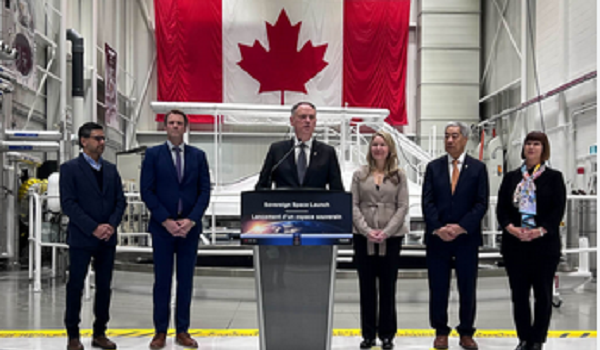
The funding and partnership were announced by Defence Minister David McGuinty in Ottawa Monday morning.
“With this step, we are not only advancing our capabilities here on Earth – we are reaffirming our place among the spacefaring nations shaping the future beyond it,” Mr. McGuinty said in a news release.
As Prime Minister Mark Carney looks to increase Canada’s defence spending to 5 per cent of gross domestic product by 2035, sovereign control of space launch, satellites and other related space technologies is being prioritized as a high-value sector.
Canada is the only G7 nation without a domestic space-launch capability. With space considered a likely first frontier for Canada in any impending conflict, Ottawa has said developing this technology will help reduce Canada’s dependence on other nations while growing a new commercial industry.
Launch capabilities will allow the Canadian government, including the military, and a wide range of companies to put their satellites into orbit without relying on foreign entities. These satellites could serve a number of functions including Arctic and border monitoring, earth observation for climate change and natural disasters, mining and industrial purposes, and telecommunications services. Canadian launch companies will also be able to sell access to orbit to global governments and private businesses.
This first Launch the North stream of grants is focused on light launches, with the goal of developing initial launch capabilities for satellites with payloads of 200 kilograms or less by the end of 2028. Two of the three first-round companies will be selected for the second stage, and only one company will be selected for the third stage.
The program will be followed by a medium-weight competition in future years.
Maritime Launch has had two launches so far, but neither successfully reached outer space.

Canada’s last suborbital launch that reached the Kármán line, widely considered the boundary between Earth’s atmosphere and outer space, took place in Churchill, Man., in 1998. No Canadian launch has ever reached orbit.
Mr. McGuinty also announced Canada’s participation in the NATO Starlift initiative. As a member, Canada’s space-launch capabilities will become part of a greater network shared across the alliance as part of an effort to make members’ capabilities more cost-effective, resilient and available on short notice, especially during crisis or conflict.
Canada Rocket co-founder and chief executive officer Hugh Kolias said the grant will help the company fund the construction of its new 7,600 square-foot engine development facility in Toronto, commission test space and double its team to 20 by June.
The company ultimately plans to design and manufacture a rocket that can send up to 6,500 kilograms to orbit, a weight class that Mr. Kolias said is in demand globally and for which there are few commercial launch options.
The company will start trying out components in the coming months, buying products off the shelf when possible to attain launch capabilities as quickly as possible, he said. He estimates the company will have a fully assembled engine ready for testing in about a year and a half.
Already, the government’s push to support satellite companies has helped the company attract $6.2-million in private seed capital, Mr. Kolias said.
Reaction Dynamics CEO and chief technical officer Bachar Elzein said the company would use its grant to continue building toward its late-2028 liftoff target.
The Longueuil, Que.-based company is aiming for a suborbital launch this October, which will help it test deliverables such as in-flight engine ignition, engine performance and separation of its rocket in flight.
Most importantly, the test will demonstrate the company’s containerized approach to launch. Whereas most rockets require fuelling at the launch site, Reaction Dynamics’ rocket fuel can be shipped inside of its combustion chamber, minimizing logistics at the launch site, Mr. Elzein said.

“When you can launch your satellite from a forest without requiring massive infrastructure, that means you have better resilience of your space assets. And in the current situation, geopolitically, it’s something that is more relevant,” he said.
NordSpace, a Markham, Ont.,-based startup founded by York University PhD candidate Rahul Goel, will receive the third grant to develop its multifuel orbital launch vehicle, Tundra.
Mr. Goel said the company plans to use the funding to continue building its team and developing its advanced manufacturing capabilities, including 3D metal printing.
“The initiative reflects Canada’s recognition that access to space is as strategically critical as the payloads that reach it,” the company said in a news release.
NordSpace is aiming to vertically integrate the launch process. In addition to designing and manufacturing engines and flying its own satellites, the company is building its own spaceport in Newfoundland and Labrador.
This article was first reported by The Globe and Mail