




Regulators Flag Growing Wave of Market Manipulation in Canada
Cases of market manipulation that were in the single digits are on the rise in Canada are on the rise in Canada, according to national data, as regulators chase an evolving tactic that observers say is increasingly carried out at scale by rapidly acting algorithms.
But even as Canadian regulators step up, an advocacy group says punishments remain far lower than some eye-popping penalties levied in the United States — something it says must change to take the profit out of tricking the market.
“What we need is our systems to send messages out there to say, ‘Hey, we need to stop this. You need to be punished, and we need to get reform,’” said Terry Lynch, the founder of the group Save Canadian Markets.
Lynch, who is also the CEO of Power Metallic Mines, said he’s seen multiple cases where Canadian stocks drop drastically in value – something he attributes to the combined efforts of millions of trades driven by computer programs.
Many of those automated trades could be “spoofing” the stock, he said. That’s a type of market manipulation where a trader makes large buy or sell orders they never intend to complete, creating false market signals to other investors.

Lynch suspects unscrupulous traders are using algorithms, or “algos” as he calls them, to make money as these stocks fall by short selling them – essentially a bet the stock will drop in value.
“They have algos making a thousand bucks here and five hundred bucks there, and it adds up to real money over time. But it just trashes the stocks,” he said.
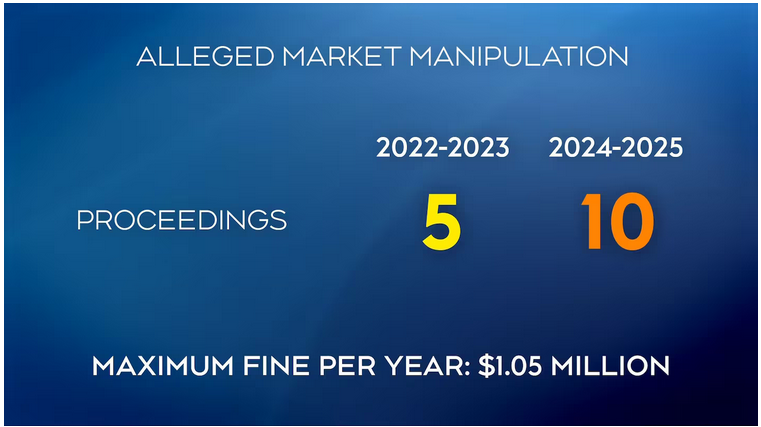
According to data from the Canadian Securities Administrators (CSA), an umbrella group of provincial securities regulators across the country, the number of proceedings started against alleged market manipulators has doubled from five in 2022-2023 to 10 in 2024-2025.
The number of investor warning letters is up too, from 758 to 1011 in the same period. Investor warnings can be about market manipulation but can also include other cautions about individuals and companies “acting in harmful ways.”
But annual fines for market manipulation haven’t gone much over $1 million in that time, the data show. In 2022-2023, they added up to $100,000, then crested at $1,055,000 in 2023-2024 before dropping again to $93,000 in 2024-2025.
The agency doesn’t break out its data by type of market manipulation, but spokesperson Ilana Kelemen said its member provincial securities commissions are watching for all types.
“CSA members are actively monitoring and investing spoofing cases,” Kelemen wrote in an e-mail.
Canadians targeted by U.S. authorities
Canadians accused of spoofing can also find themselves in the sights of U.S. authorities. In one case, Ontario’s Aleksandr Milrud was accused of operating a “sophisticated, international, groundbreaking market manipulation scheme” with “artificial trade orders executed at high speeds.”
Milrud pleaded guilty to a criminal charge, was sentenced to five years of probation and ordered to forfeit $285,000, according to a news release by the United States Securities and Exchange Commission in 2022.
TD Bank paid more than $20 million to resolve charges relating to a former trader’s alleged spoofing scheme last year. The largest spoofing settlement so far is at JP Morgan Chase, which paid $920 million in 2020 to settle allegations of hundreds of thousands of fake orders.
It was Canadian data that led Toronto-based Quantum BioPharma to levy allegations of complicity in an alleged stock spoofing scheme to major Canadian banks CIBC and RBC, saying some 16 million orders for their stock were fictitious.
The allegations form the basis of a $700 million lawsuit in filed in the United States District Court for the Southern District of New York in 2024. The banks have denied these allegations in court filings, saying Quantum BioPharma’s own actions are to blame for its stock’s slide in value.
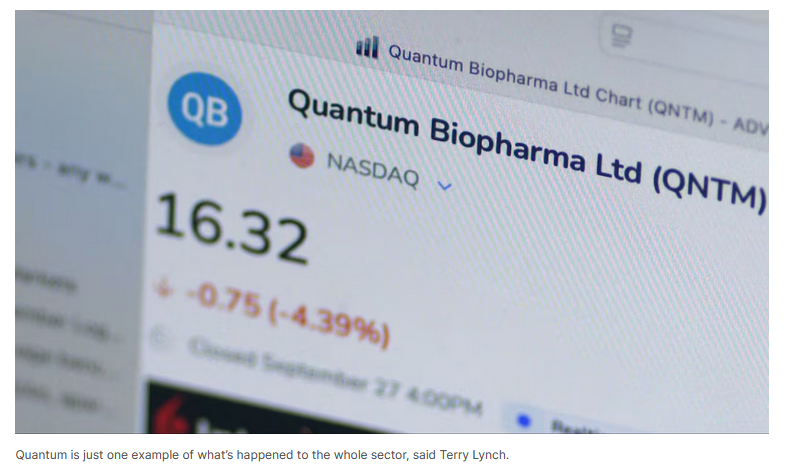
“Quantum is just one example of what’s happened to the whole sector,” said Lynch, who was elected to Quantum BioPharma’s board in 2025. He has been pushing for rules against certain kinds of short selling to take the profit out of using a spoofing tactic to drive a stock’s price down.
A report for the Ontario government by the Capital Markets Modernization Taskforce recommended some short selling restrictions in 2020 and proposed new rules in June 2025.
W5 caught up with Ontario’s finance minister, Peter Bethenfalvy, asking him what Ontario’s government is doing to protect investors in light of the Quantum BioPharma lawsuit.

“We expect all market participants to follow the rules,” Bethenfalvy said. “We have enforcement. I’m not going to comment on anything in front of tribunals or courts right now. But make no mistake, we are always there to protect the good actors and go after the bad actors,” he said.
Over in B.C., retiree Randy Manzardo invested tens of thousands of dollars in Quantum Biopharma, believing their drug for multiple sclerosis showed great promise in mice.
But his stock dropped in value profoundly in the face of what the company alleges was a spoofing campaign.
“It’s disheartening. And it’s made me angry,” he said.
Manzardo said he appreciates the increased focus on market manipulation techniques by the regulators. But he’s not sure he can invest safely with the threat of certain tactics.
“It’s such an uneven playing field for an average guy like me,” he said.
Provincial responses
W5 reached out to provincial regulators to find out more details about their stock spoofing enforcement efforts.
In Ontario, an Ontario Securities Commission spokesperson said there’s been one proceeding in the last five years that included stock spoofing allegations.
In B.C., a spokesperson for the B.C. Securities Commission said there’s been no administrative litigation, but the agency uses caution letters to warn potential market manipulators, and gatekeeper notice letters to raise potential red flags with trading firms about their clients’ activities.
Since 2024, the BCSC has issued three caution letters and two gatekeeper notice letters about “spoofing or similar activity,” the agency said.
In Alberta, the Alberta Securities Commission described two cases in the last five years where respondents were found liable and sanctioned. One respondent paid a $50,000 administrative penalty, and in the other case, the respondents paid a total of $792,400 in penalties and costs, they said.
In Nova Scotia, there was one case involving stock spoofing by a company headquartered in Halifax, though many of its traders were based in China. The respondent paid an administrative penalty for $110,000, court documents say.
In Saskatchewan, a spokesperson confirmed there were no cases in the last five years, and other securities commissions or provincial spokespeople didn’t respond to W5 inquiries.
This article was first reported by CTV News