





Temporary resident departures push Canadian population growth to standstill
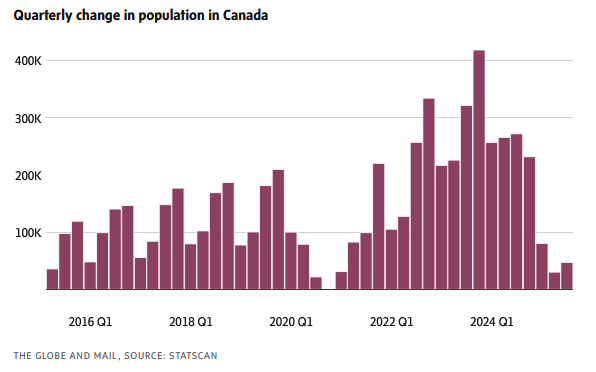
Canada’s population barely grew in the second quarter this year, continuing a trend of near-zero growth after Ottawa’s moves last year to curb immigration.
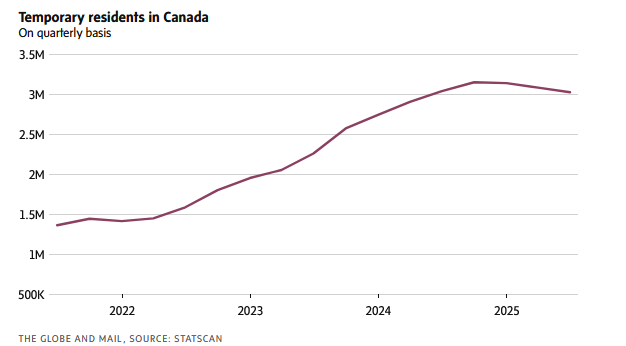
The slow growth was driven by outflows of non-permanent residents. The number of temporary residents fell by nearly 60,000 between April 1 and July 1 of this year, according to Statistics Canada’s latest population estimates.
This outflow represents the largest number of temporary residents leaving the country, outside of the height of the pandemic − a number only comparable to the third quarter of 1971.
As a result, the overall population of Canada grew by a mere 0.1 per cent in the second quarter of the year, or 47,098 people, the same level of growth the country experienced between January and March of 2025.


Canada’s population currently stands at 41.65 million people. On a year-over-year basis, the country’s population grew by 0.9 per cent, the smallest increase since 2016, excluding 2020, the year the World Health Organization declared a pandemic.
Canada’s population had soared between 2021 and 2024, growing by a quarterly average of 215,000 people in that four-year time period. This growth was driven primarily by international students and temporary foreign workers.
The abrupt increase in migration led to concerns over housing and the overall cost of living, putting pressure on the federal government to limit the non-permanent resident intake. A series of policy changes were implemented through 2024 that aimed to cap the number of temporary residents at 5 per cent of the overall population by the end of 2026.
The measures have been working, albeit slowly. The number of temporary residents peaked at 7.6 per cent of the total population in October, 2024, but has since dropped to 7.3 per cent, or just over three million people. Since the start of the year, the number of non-permanent residents has fallen by roughly 114,000.
In particular, the number of study-permit holders sharply declined between April and July, with 32,025 fewer international students in the country. In the past year alone, the number has fallen by almost 18 per cent. But an increase in the number of asylum claimants (up 25 per cent since July, 2024) has mitigated the decline in the overall temporary resident population.
Statscan data also showed that Canada welcomed 103,157 immigrants in the second quarter, roughly the same as the intake in the first three months of 2025 – albeit lower than the second quarters in the previous three years.
The federal government lowered its permanent resident admissions target to 395,000 newcomers in 2025, 380,000 in 2026 and 365,000 in 2027. Ottawa had previously targeted admitting 500,000 permanent residents annually in 2025 and 2026.
Mikal Skuterud, a labour economist at the University of Waterloo, noted that the decline in the temporary resident population will not happen in a linear fashion. “I expect that the pace of decline will accelerate over the next few quarters, as study permits and work permits expire, and fewer of these permits are issued.”
Student-permit approvals plummeted by 70 per cent in the first half of 2025, compared with the first half of 2024, with 90,000 fewer international student visas being issued, according to data from Immigration, Refugees and Citizenship Canada.
Prof. Skuterud is, however, doubtful that Ottawa will hit its 5-per-cent temporary resident population target by the end of 2026. “I don’t think they anticipated the challenge with a backlog in asylum claims. That number is rising, so it is probably going to take a longer time for the government to hit its target.”
Meanwhile, Canada’s population continues to age, more so because of the decline in younger immigrants. The Canadian median age has increased from 40.3 years to 40.6 years over the past year. The upward trend was temporarily halted between 2021 and 2024 because of the large wave of young newcomers into Canada.
A research note from Kari Norman, an economist with Desjardins, stated that continued declines in the non-permanent resident population will allow Canada’s housing supply and public services to “catch up.”
“It should also ultimately help to lift Canada’s real GDP per capita, which has been trending lower over the last three years,” Ms. Norman said.
This article was first reported by The Globe and Mail