





Indexes Rise as Taiwan Semiconductor Lifts Chip Stocks and Revives AI Momentum
The Canadian Vanguard Stock Market Report – Thursday January 15, 2026 Edition.
.
The Toronto Market
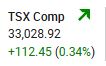
The S&P/TSX Composite Index rose 112.45 points, or 0.34%, to close at 33,028.92, extending its recent upward momentum. The index recorded a second straight day of gains, with today’s advance coming in at roughly double yesterday’s increase—an encouraging sign of strengthening buying interest. The TSX has now closed higher in five of the last six trading sessions, suggesting improving short-term sentiment. Gains were led by the banking sector, which continues to provide stability and support for the broader index as investors favor large-cap, dividend-paying stocks amid ongoing economic uncertainty.

Today’s TSX Market Statistics
Market breadth was solidly positive, with advancing stocks outpacing decliners across the TSX. A total of 1,381 stocks advanced compared with 797 that declined, resulting in an advancer-to-decliner ratio of 1.73 to 1. This indicates broad participation in today’s market gains, although 140 stocks finished unchanged.
Momentum remained positive but showed some moderation. The TSX recorded 358 new 52-week highs and 23 new 52-week lows. While the number of new highs remains elevated, it was lower than yesterday’s reading of 538 highs, suggesting that upside momentum may be stabilizing rather than accelerating.
Trading activity cooled slightly, with total volume reaching 423.1 million shares—about 20% lower than the prior session’s 525.2 million shares. The lighter volume suggests today’s gains were driven more by steady buying than aggressive accumulation, a typical pattern during a maturing short-term rally.
Toronto Market Wrap-Up Report
Sector leadership rotated today, a common feature of a healthy but maturing rally. Energy—yesterday’s top performer—pulled back and was the weakest sector on the day. Industrials led the market, gaining 1.15%, followed by Financials, up 0.55%, as investors continued to favor economically sensitive and defensive large-cap names. Technology (-0.48%) and Energy (-0.58%) were the laggards.
Precious metals stocks posted modest gains, but strength was limited, with the Basic Materials sector rising just 0.21%. While gold prices are unlikely to fall sharply this year and may continue trending higher—albeit at a slower pace—the muted sector response suggests investors are currently prioritizing growth and income over safe-haven exposure. Retail stocks ended the session slightly lower, though declines were relatively mild, indicating no broad risk-off move.
Bombardier Inc. (TSX: BBD.B) was one of the most notable stocks in focus today. The company announced plans to expand its footprint in Dorval, Quebec, with a new 126,000-square-foot manufacturing facility expected to be operational by late 2027. The approximately $100 million project will be partly financed through a $35 million repayable loan from Quebec’s ESSOR program and is aimed at increasing production capacity. Shares of Bombardier more than doubled last year, supported by growing demand for defense-related aerospace products. The expansion reinforces the company’s long-term growth strategy and is expected to generate hundreds of skilled jobs. The stock remains worth monitoring closely.
Bombardier shares rose 7.17%, or $17.82, to close at $266.20 on volume of 520,000 shares.
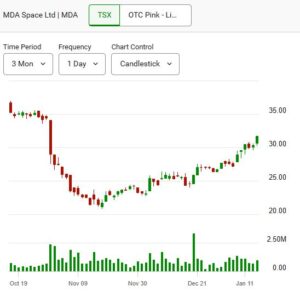
Market leadership today was broad-based, with strong performers across multiple sectors. Increased investor interest in space-related travel, research, and defense applications continues to support select names in the industry. One such company is MDA Space Ltd. (TSX: MDA). Technically, MDA’s chart appears to be completing the right side of a cup formation, often viewed as a constructive setup by technical traders. As a small-cap stock, MDA carries higher risk, but it remains a name worth keeping on a watchlist. MDA shares gained 4.55%, or $1.38, to close at $31.69 on volume of 944,000 shares.
Market Takeaway: Bullish vs. Cautious View
Bullish Signals:
- The rally remains broad, with leadership rotating rather than narrowing—typically a sign of underlying market strength.
- Financials and Industrials leading suggests confidence in economic resilience rather than fear-driven positioning.
- Strong participation from individual stocks, such as Bombardier and MDA, indicates continued investor appetite for both large-cap and selective growth opportunities.
Cautious Signals:
- Energy’s pullback after leading the prior session points to short-term profit-taking.
- Fewer aggressive moves in defensive sectors like gold miners suggest enthusiasm is steady but not accelerating.
- Sector rotation and lighter conviction in some areas are consistent with a rally that may be entering a more mature phase.
Market Stage Assessment
The TSX appears to be transitioning from an early-stage rally into a mid-to-late-stage advance. Momentum remains positive, but leadership is rotating and gains are becoming more selective. For retail investors, this environment favors:
Staying invested but avoiding excessive chasing
Focusing on quality, sector leaders, and companies with visible growth drivers
Watching for signs of narrowing breadth or rising volatility as potential early warnings
.
The US Markets
U.S. equity markets closed higher across the board, though underlying trading action suggested growing selectivity beneath the surface. The Dow Jones Industrial Average gained 292.81 points, or 0.60%, to finish at 49,442.44, outperforming broader benchmarks as investors favored large-cap, value-oriented stocks.
The S&P 500 added 17.87 points, or 0.25%, ending the session at 6,944.47, while the Nasdaq Composite rose 58.27 points, or 0.26%, to close at 23,530.02. Despite the positive close, the Nasdaq showed signs of intraday weakness. After opening with strong gains, the index reversed course in the afternoon, falling roughly 120 points from around 2:00 p.m. through the close. The sharp, near-vertical decline suggests profit-taking and a lack of strong buying support at higher levels rather than a broad shift to bearish sentiment.
Small-cap stocks outperformed, with the Russell 2000 advancing 22.92 points, or 0.86%, to close at 2,674.56. Strength in small caps often reflects improving risk appetite and expectations for domestic economic resilience.
Market Insight for Retail Investors:
The divergence between the Dow’s strength and the Nasdaq’s late-day pullback points to ongoing sector rotation rather than outright risk aversion. Investors appear comfortable holding equities but are becoming more selective, favoring value, financials, and smaller companies over extended growth and technology names. Continued late-session selling in the Nasdaq could signal short-term consolidation ahead, but as long as broader indexes remain supported, the overall trend remains constructive.

Today’s U.S. Market Statistics
New York Stock Exchange (NYSE): Market breadth was firmly positive, with advancing stocks clearly outpacing decliners. The NYSE recorded 2,920 advancers versus 1,522 decliners, with 371 issues unchanged. This produced an advancer-to-decliner ratio of 1.92 to 1, or roughly two advancers for every decliner, indicating broad participation in today’s market strength.
Momentum improved meaningfully, as the exchange posted 759 new 52-week highs against just 55 new 52-week lows. This compares favorably with yesterday’s 518 new highs and 69 new lows, suggesting expanding upside leadership and improving internal market health.
Total NYSE trading volume reached 5.19 billion shares, which was about 7% lower than yesterday’s 5.59 billion shares. The lighter volume implies steady accumulation rather than aggressive buying—often seen during sustained but maturing advances.
NASDAQ: Breadth on the NASDAQ was positive but less robust than on the NYSE. Advancing issues numbered 2,689 compared with 2,139 decliners, resulting in an advancer-to-decliner ratio of 1.26 to 1, or roughly seven advancers for every five decliners, with 158 stocks unchanged.
The NASDAQ recorded 445 new 52-week highs and 110 new 52-week lows, an improvement from yesterday’s 277 highs and 131 lows. This points to strengthening participation among growth stocks, though new lows remain elevated relative to the NYSE.
Total NASDAQ trading volume came in at 10.05 billion shares, down 21% from yesterday’s 12.62 billion shares. The sharp drop in volume, combined with late-day selling pressure in the Nasdaq Composite, suggests increased selectivity and profit-taking rather than broad-based risk aversion.
Retail Investor Takeaway
Overall market internals remain constructive, particularly on the NYSE, where breadth and new highs support the case for a continued uptrend. However, softer volume and mixed signals on the NASDAQ indicate the market may be entering a mid-to-late-stage rally, where gains persist but become more uneven. This environment typically rewards patience, disciplined entries, and a focus on quality leadership rather than chasing extended momentum.
U.S. Market Wrap-Up Report
U.S. equity markets continued to show clear signs of sector rotation, with defensive and value-oriented areas leading the session. Utilities gained 0.89%, Industrials rose 0.85%, and Financials advanced 0.84%, making them the top-performing sectors of the day. Technology posted a modest gain of just 0.36%, while Energy and Healthcare were the weakest performers.
The ongoing rotation out of large-cap Technology stocks remained evident. While major banks provided some underlying support, it was not enough to prevent the NASDAQ from fading during the final two hours of trading. This late-session weakness reinforces the idea that investors are becoming more selective, locking in profits in extended growth names while reallocating capital elsewhere.
Small-cap stocks continued to outperform, with the Russell 2000 emerging as the strongest major index. This trend has been in place since the fourth quarter of last year, when small-cap stocks began to gain traction as the Dow Jones Industrial Average started to experience repeated sessions of decline. Strength in small caps typically reflects improved confidence in domestic economic conditions and a willingness among investors to take on measured risk.
Among individual stocks, Goldman Sachs Group (GS) and Morgan Stanley (MS) posted solid gains. However, their strength had limited impact on the Dow, as both stocks opened in negative territory and struggled to build sustained upside momentum despite finishing higher. Even so, both banks remain worth considering for addition to a watchlist, particularly if financial sector leadership continues.
Investor Takeaway: Bullish vs. Cautious Outlook
Bullish Factors:
- Leadership from Utilities, Industrials, and Financials suggests a healthy rotation rather than a broad market breakdown.
- Continued strength in the Russell 2000 points to improving risk appetite and confidence in U.S. economic growth.
- Market breadth and rising new 52-week highs support the view that the underlying trend remains constructive.
Caution Flags:
- Persistent weakness and late-day selling in the NASDAQ signal profit-taking in extended Technology stocks.
- Technology’s inability to lead meaningfully suggests the market may be moving into a more selective phase.
- Financial stocks are advancing, but the lack of follow-through in the Dow highlights fading momentum in some large-cap leaders.
Market Stage Assessment
The U.S. market appears to be in a mid-stage to early late-stage rally, characterized by rotation, uneven leadership, and increasing divergence between sectors and indexes. For retail investors, this environment favors:
- Maintaining exposure but managing risk carefully
- Focusing on sectors showing consistent leadership rather than chasing former high-flyers
- Using pullbacks to build positions in quality names rather than buying strength late in the day
NOTICE TO READERS
The Canadian Vanguard Stock Market is about empowering you to build and manage wealth by yourself. There is certainly no magic in managing finances or wealth but one needs to know what to do and commit to doing what is needed. When you are ready to start the journey to Put Your Destiny In Your Own Hands, read The Canadian Vanguard every market day. If you wish to exchange ideas, need more information or for sophisticated market data analysis, please click Contact Us
Our readers are strongly advised to conduct their own research into individual stocks before making a purchase decision. In addition, investors are advised that past stock performance is no guarantee of future price appreciation. Any recommendation is not a guarantee of any particular stock’s future prices, and The Canadian Vanguard accepts no responsibility or liability for investors’ or readers’ purchases.
Stocks In The News/ Stocks To Watch and Market Strategy will soon be available but only to Paying Subscribers.
(c) This article is published by The Canadian Vanguard on January 15, 2026