





Markets Retreat, but Small Caps Shine Amid Broad Declines
The Canadian Vanguard Stock Market Report – Thursday January 29, 2026 Edition.
.
The Toronto Market
The Toronto Market Index
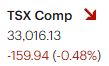
The S&P/TSX Composite Index fell 159.94 points, or 0.48%, to close at 33,016.13. The index opened higher but turned negative within the first thirty minutes of trading and continued to decline for the remainder of the session, staying in the red throughout the day. Despite the weakness, it finished roughly 250 points above the session low. Gold prices were higher at the open but trended lower as the session progressed. Profit-taking likely contributed to the market’s downward performance.
Thursday’s TSX Market Statistics
Market breadth on the TSX was negative, with decliners outpacing advancers by a ratio of 1.44 to 1, as 1,309 stocks declined versus 908 advancing issues, while 129 stocks were unchanged. This skew toward declining issues suggests broad-based selling pressure rather than weakness concentrated in a few sectors.
Despite the negative breadth, leadership remained evident, with 274 stocks recording new 52-week highs compared with 89 new 52-week lows. While new highs increased from the prior session, the rise in new lows—up from 51—signals growing dispersion beneath the index surface and warrants monitoring for potential trend fatigue.
Trading activity strengthened meaningfully, with TSX volume rising 12% to 715.1 million shares. The increase in volume alongside a declining market points to active portfolio repositioning and profit-taking, reinforcing the view that investors are becoming more selective amid elevated index levels.
Toronto Market Wrap-Up Report
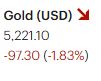
Gold prices have continued their steady advance, a trend that has broadly supported the TSX through strength in precious and industrial metals. However, the absence of gold miners among the top twenty TSX performers signals waning investor conviction toward the sector at current price levels. Instead, profit-taking dominated today’s session, weighing on index performance. Ongoing trade tensions between Canada and the United States further dampened sentiment, reinforcing a cautious tone across the market. While gold typically attracts safe-haven inflows during periods of geopolitical and trade uncertainty, today’s price action suggests investors are selectively locking in gains rather than increasing exposure.
Sector performance reflected this mixed backdrop. Energy, Telecommunications Services, and Technology led the market, indicating continued interest in defensive yield and growth-oriented themes. In contrast, Industrials fell 1.44% and Basic Materials declined 2.98%, underperforming as cyclical exposure was reduced. Financials managed to close modestly higher, providing some index support, while Healthcare lagged and finished in negative territory.
Despite strength in underlying metal prices, gold and industrial metals miners broadly declined. Agnico Eagle Mines (TSX: AEM), Franco-Nevada Corp. (TSX: FNV), First Majestic Silver Corp (TSX: AG). (down 4.06%), and Wheaton Precious Metals Corp. (TSX: WPM) (down 2.92%) all closed lower, underscoring the divergence between commodity prices and equity performance. Energy was the top-performing sector overall, though stock-specific volatility remained elevated. Energy Fuels Inc. dropped 10.55%, while Ero Copper Corp. gained 4.66%, highlighting selective capital rotation within the resource space.
In Technology, Shopify Inc. advanced 2.63% ($4.94) to close at $193.53 on heavy volume of 29 million shares, reflecting continued investor confidence in large-cap growth names. Conversely, Celestica Inc. experienced a sharp sell-off following its earnings release, falling 13.54% ($62.23) to $403.89 on 1.6 million shares traded, as the market reassessed forward expectations.
Overall, today’s market action points to heightened selectivity, profit-taking near highs, and increasing sensitivity to macro and earnings-driven catalysts.
.
The US Markets
U.S. Market Indexes
U.S. equity markets delivered a mixed performance, with defensive leadership and late-session buying helping limit downside pressure. The Dow Jones Industrial Average gained 55.96 points, or 0.11%, to close at 49,071.56, outperforming other major benchmarks. The S&P 500 slipped 9.02 points, or 0.13%, to end at 6,969.01, remaining within close range of the psychologically important 7,000 level. Meanwhile, the Nasdaq Composite declined 172.33 points, or 0.72%, to finish at 23,685.12, reflecting continued pressure on growth and technology-heavy names.
The Russell 2000 advanced 1.23 points, or 0.05%, to close at 2,654.78, positioning small-cap stocks as the second-best-performing segment after the Dow. The Dow spent most of the session in negative territory but staged a late rebound to close well above its intraday lows, signaling resilient demand for blue-chip stocks.
All major indexes traded sharply lower earlier in the session, with the Nasdaq at one point down nearly 600 points before recovering meaningfully into the close. The ability of the indexes to finish significantly above their session lows suggests underlying buying interest and dip-buying activity, despite ongoing volatility. While the broader trend remains mixed, this late-session stabilization provides a modestly constructive signal for near-term market sentiment.

Thursday’s U.S. Market Statistics
New York Stock Exchange (NYSE)
Market breadth on the NYSE was modestly positive, with advancing issues outpacing decliners by a ratio of 1.19 to 1. A total of 2,428 stocks advanced versus 2,037 decliners, while 399 issues were unchanged. The positive breadth suggests underlying support for large-cap and value-oriented stocks, consistent with the Dow’s relative outperformance.
Leadership strength remained intact, as the exchange recorded 610 new 52-week highs against 176 new 52-week lows. While new highs increased from the prior session, the sharp rise in new lows—from 97—signals growing internal volatility and selective risk-off behavior beneath the surface.
Trading activity accelerated meaningfully, with NYSE volume climbing 24% to nearly 7.0 billion shares. Higher volume alongside mixed index performance points to active portfolio rebalancing rather than indiscriminate selling.
NASDAQ
In contrast, NASDAQ breadth was negative, with decliners outnumbering advancers by a ratio of 1.33 to 1. There were 2,746 declining issues versus 2,067 advancers, with 266 stocks unchanged, underscoring continued pressure on growth- and technology-oriented names.
Market internals weakened further as new 52-week lows (295) slightly exceeded new highs (285), a notable deterioration from the prior session when new highs significantly outpaced new lows. This shift highlights rising downside momentum within the growth complex.
NASDAQ trading volume rose 7% to 9.08 billion shares, reinforcing the view that investors remain highly engaged but increasingly selective. The combination of higher volume, negative breadth, and expanding new lows suggests ongoing consolidation and elevated sensitivity to earnings and macro catalysts.
Market Statistics — Portfolio Positioning Perspective For Traders
NYSE: Defensive Rotation and Capital Preservation
Breadth on the NYSE was modestly positive, with advancers exceeding decliners by a 1.19-to-1 ratio. The underlying support for large-cap and value-oriented stocks aligns with recent strength in the Dow and suggests continued investor preference for stability and cash-flow durability.
The rise in new 52-week highs to 610 reflects ongoing leadership in select defensive and dividend-paying names. However, the simultaneous increase in new lows to 176 signals growing dispersion, reinforcing the case for disciplined stock selection rather than broad index exposure.
NYSE trading volume surged 24%, if it persists, points to active reallocation rather than passive buying. From a positioning standpoint, this favors maintaining exposure to high-quality, liquid names while trimming positions that have run ahead of fundamentals.
NASDAQ: De-Risking Within Growth Allocations
NASDAQ breadth remained negative, with decliners outnumbering advancers by 1.33 to 1, indicating continued pressure on growth and higher-beta stocks. The near parity between new 52-week highs (285) and lows (295) marks a meaningful deterioration in internal momentum and suggests that investors are reassessing risk within technology and innovation-heavy portfolios.
Rising NASDAQ volume reinforces the view that the pullback is being driven by deliberate de-risking rather than lack of participation. For portfolio positioning, this environment argues for tightening exposure to speculative growth, emphasizing earnings visibility, and favoring companies with strong balance sheets and pricing power.
Portfolio Implications
Overall, the divergence between NYSE and NASDAQ internals points to a barbell-style market. Investors appear to be rotating toward defensive large caps and selectively maintaining growth exposure while reducing risk at the margin. In this setting, balanced portfolios may benefit from a bias toward quality, active risk management, and tactical flexibility until internal breadth stabilizes.
U.S. Market Wrap-Up Report
U.S. equities ended the session lower overall despite mixed sector performance, reflecting selective risk appetite rather than broad-based buying. Telecommunications Services, Energy, and Financials were the top-performing sectors, pointing to a blend of defensive positioning and continued interest in cash-flow-generating cyclicals. In contrast, Basic Materials declined 0.49% and Technology fell 0.91%, weighing on the broader market. Although six of the eleven major sectors finished higher, weakness in heavyweight growth names kept overall market tone negative.
Meta Platforms (META) stood out as one of the session’s clear outperformers. Shares surged 10.40% ($69.58) to close at $738.31 on robust volume of 59.8 million shares, following a well-received earnings report. The strong price advance accompanied by elevated volume suggests institutional participation and raises the possibility of a technical breakout, contingent on follow-through in coming sessions.
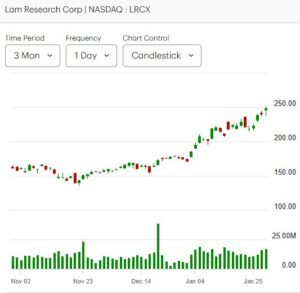
Lam Research Corp. (LRCX) also delivered a solid performance, rising 3.5% ($8.59) to $248.17 on 16 million shares traded. The move reflects renewed investor interest in selective semiconductor equipment names despite broader technology sector weakness.
After the close, Apple Inc. (AAPL) shares rose a modest 0.55% ($1.42) in after-hours trading after the company reported earnings that exceeded expectations. Management highlighted its “best-ever quarter” for iPhone revenue, offering near-term support for the stock and potentially stabilizing sentiment toward mega-cap technology despite ongoing sector headwinds.
Portfolio Positioning Takeaways
For Institutional Investors:
- Maintain a barbell approach: overweight defensive sectors such as Telecommunications, Energy, and Financials while tactically increasing exposure to earnings-driven growth stocks like META and LRCX.
- Focus on liquidity and volume-confirmed moves to ensure positions can be scaled without market impact.
- Use selective hedging to manage macro and sector rotation risk, particularly given technology sector vulnerability despite positive earnings from mega-caps.
- Evaluate short-term momentum alongside long-term fundamentals to identify stocks with breakout potential, and incorporate them into disciplined risk-managed allocation strategies.
For Retail Investors:
- Stick with quality and sector diversification: defensive sectors continue to provide stability, while individual growth winners offer selective upside.
- Monitor earnings and volume trends to confirm whether a stock’s move is sustainable before adding exposure.
- Avoid chasing broad technology exposure; focus instead on companies showing strong fundamentals and positive market reception.
- Consider using smaller, incremental positions in volatile growth stocks like META or LRCX rather than full allocation, balancing risk with stable defensive holdings.
NOTICE TO READERS
The Canadian Vanguard Stock Market is about empowering you to build and manage wealth by yourself. There is certainly no magic in managing finances or wealth but one needs to know what to do and commit to doing what is needed. When you are ready to start the journey to Put Your Destiny In Your Own Hands, read The Canadian Vanguard every market day. If you need more information please Contact Us
Our readers are strongly advised to conduct their own research into individual stocks before making a purchase decision. In addition, investors are advised that past stock performance is no guarantee of future price appreciation. Any recommendation is not a guarantee of any particular stock’s future prices, and The Canadian Vanguard accepts no responsibility or liability for investors’ or readers’ purchases.
Stocks In The News/ Stocks To Watch and Market Strategy will soon be available but only to Paying Subscribers.
(c) This article is published by The Canadian Vanguard on January 29, 2026