





Rotation Away from Technology Pressure Markets, Nasdaq and Small Caps Slide
The Canadian Vanguard Stock Market Report – Wednesday February 4, 2026 Edition.
.
The Toronto Market
The Toronto Market Index
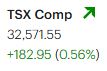
The S&P/TSX Composite Index rose 182.95 points, or 0.56%, to close at 32,571.55, marking its third consecutive gain following Friday’s sharp sell-off. Trading was volatile throughout the session, with the index repeatedly swinging above and below the previous close. It spent roughly one-third of the day in negative territory before surging by about 250 points after 2 p.m., then consolidating and pushing higher into the close.
Wednesday’s TSX Market Statistics
Advancing issues outnumbered declining issues on the TSX, with 1,253 advancers and 941 decliners. This resulted in an advancer-to-decliner ratio of 1.33 to 1, or roughly six advancers for every five decliners, while 147 issues were unchanged.
The market recorded 274 new 52-week highs and 109 new 52-week lows, compared with 172 new highs and 128 new lows in the previous session.
Toronto Market Wrap-Up Report
The TSX finished higher on Wednesday in a broadly positive session, with eight of eleven sectors posting gains. Strength was led by the Consumer Discretionary and Energy sectors, while Technology and Basic Materials underperformed. Consumer Discretionary Goods & Services advanced 2.58%, reflecting renewed risk appetite in select cyclical names.
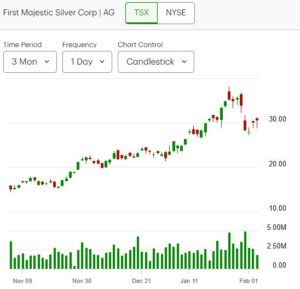
Precious metals equities delivered mixed performance. A limited number of gold and silver producers and streaming companies posted gains, suggesting selective investor positioning rather than broad sector strength. Agnico Eagle Mines Ltd. (TSX: AEM) rose 3.14% on 1.9 million shares traded, while Wheaton Precious Metals Corp. (TSX: WPM) gained 2.60% on 1.0 million shares. Franco-Nevada Corp. (TSX: FNV) was marginally higher, up 0.12%, and First Majestic Silver Corp. (TSX: AG) advanced 1.76%. All four companies maintain exposure to both gold and silver, with Wheaton also providing diversified exposure through metal streaming agreements.
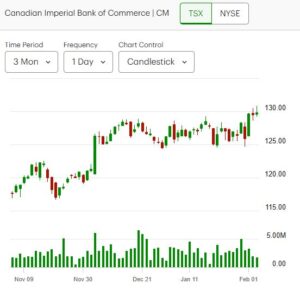
Within Financials, several of Canada’s major banks continue to trade near 52-week highs, reflecting sustained investor demand for income-oriented equities. Bank of Montreal (TSX: BMO) closed approximately 0.3% below its 52-week high of C$193.08, while both BMO and Canadian Imperial Bank of Commerce (TSX: CM) recorded new 52-week highs earlier in the week. Current valuation levels may limit near-term upside, particularly for investors focused on capital appreciation, though dividend stability remains supportive for income-focused portfolios.
Technology shares weighed on broader gains. Shopify Inc. declined 3.96% on 3.2 million shares traded, while Celestica Inc. (TSX: CLS) extended recent losses, falling 7.16% on 791,000 shares. The sector’s weakness reflects continued volatility in high-beta and growth-oriented names.
Elsewhere, several recent outperformers continued to attract buying interest. Nutrien Ltd. (TSX: NTR) rose 1.71% to $97.62 on 2.7 million shares traded, while Bombardier Inc. Class B advanced 0.87% on lighter volume.
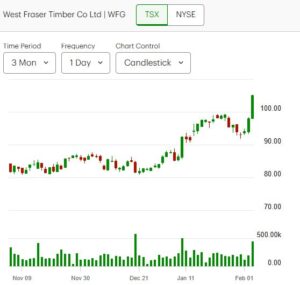
Shares of ATS Corp. (TSX: ATS) drew investor attention following a stronger-than-expected third-quarter earnings report. The automation and technology solutions provider reported revenue of C$760.7 million, representing 17% year-over-year growth and exceeding both company guidance and analyst expectations. The results were supported by improved bookings, suggesting stabilization in demand conditions. The stock traded as much as 8.3% higher during the session, indicating a positive near-term reassessment of growth visibility.
.
The US Markets
U.S. Market Indexes
U.S. equity markets closed mixed, with performance diverging sharply across major indexes. The Dow Jones Industrial Average advanced 260.31 points, or 0.53%, to 49,501.30, outperforming broader benchmarks. In contrast, the S&P 500 declined 35.09 points, or 0.51%, to 6,882.72, while the Nasdaq Composite fell 350.61 points, or 1.51%, to close at 22,904.58.
Small-cap stocks also underperformed, with the Russell 2000 Index dropping 23.95 points, or 0.90%, to 2,624.55. The session reflected a continued rotation away from growth and technology-oriented equities toward more defensive and value-tilted components of the Dow.
Technology shares weighed heavily on the Nasdaq, which remained in negative territory throughout the session. Although the index recovered from its intraday low, where losses approached 600 points in early afternoon trading, selling pressure persisted into the close, reinforcing the Nasdaq as the day’s weakest major index.

Wednesday’s U.S. Market Statistics
New York Stock Exchange (NYSE)
Market breadth on the NYSE was modestly positive, with advancing issues slightly outnumbering decliners. The exchange recorded 2,360 advancers and 2,125 decliners, while 394 issues finished unchanged, producing an advancer-to-decliner ratio of 1.11 to 1. Overall breadth was broadly in line with the previous session.
The NYSE posted a notable increase in new 52-week highs, with 595 stocks reaching new highs compared with 226 recording new lows. This marked a substantial expansion in highs relative to the prior session, which saw 165 new highs and 73 new lows, suggesting continued strength among select large-cap, value, and income-oriented names.
Total NYSE trading volume reached 7.59 billion shares, up 6.5% from the prior session, indicating increased participation alongside modestly positive breadth.
NASDAQ
Breadth on the NASDAQ remained negative for the third consecutive session, with declining issues outpacing advancers by a wide margin. There were 2,985 decliners versus 1,803 advancers, with 291 issues unchanged, resulting in a decliner-to-advancer ratio of approximately 1.65 to 1. Persistent weakness continues to be concentrated in growth and technology-oriented equities.
The NASDAQ recorded 345 new 52-week highs and 449 new 52-week lows, compared with 310 highs and 429 lows in the previous session. The excess of new lows over highs indicates ongoing downside pressure and dispersion within the broader technology complex.
NASDAQ trading volume totaled 11.06 billion shares, up 4.6% from the prior day, reflecting elevated activity amid continued sector-level volatility.
U.S. Market Wrap-Up Report
U.S. equity markets reflected a continued rotation away from technology and high-beta growth stocks, with sector performance and market breadth underscoring a clear divergence in investor positioning. Energy, Telecommunication Services, and Healthcare were the top-performing sectors. Telecommunication Services, in particular, benefited from its defensive characteristics, as investors favored lower-volatility, cash-flow-oriented exposures amid heightened market uncertainty.
Among sectors that finished higher, Financials gained 0.51% and Basic Materials rose 0.11%, though both underperformed the broader group of advancers. Utilities declined 0.93%, while Technology was the weakest sector, falling 1.97%, reinforcing the ongoing pullback from growth-oriented equities.
The rotation was especially pronounced in semiconductor and hardware-related stocks. Advanced Micro Devices (AMD) declined sharply, falling 17.31% ($41.92) on heavy volume of 107.2 million shares, before rebounding modestly in after-hours trading. Storage-related names also saw significant pressure, with SanDisk Corporation down 15.95% ($110.96), Western Digital (WDC) lower by 7.18% ($20.83), and Seagate Technology (STX) down 5.81% ($25.82). The magnitude and volume of these declines point to institutional de-risking rather than isolated profit-taking.
Earnings-related developments drove notable after-hours activity. Alphabet Inc. reported results after the close, with shares modestly lower in extended trading following a 1.96% decline during the regular session. Management highlighted a substantial increase in artificial intelligence-related capital expenditures, projecting spending of approximately $185 billion. While near-term margin concerns weighed on Alphabet shares, the scale of planned investment was viewed positively for AI infrastructure providers. NVIDIA (NVDA) and Broadcom (AVGO) rose 6.22% after hours, reflecting expectations of sustained demand for data center and AI-related hardware. The guidance also challenged prevailing concerns around an imminent AI investment slowdown.
Several AI-adjacent component suppliers experienced elevated volatility. Lumentum Holdings (LITE) gained 7.0% on 12.1 million shares, while Amphenol Corp. (APH), a key supplier of connectors and cabling used in data centers, declined 11.6% during the regular session before recovering 2.31% after hours. Price action in these “picks-and-shovels” names suggests continued investor differentiation between near-term valuation pressure and longer-term demand visibility tied to AI infrastructure buildouts.
In index-related news, Ciena Corp. (CIEN) was announced as a replacement for Dayforce Inc. in the S&P MidCap 400 following Dayforce’s acquisition by a private investment firm. CIEN shares rose 3.25% in after-hours trading, reflecting expected passive fund inflows.
From a market structure perspective, internal breadth continued to diverge between exchanges. NYSE breadth remained modestly positive, supported by expanding new 52-week highs and increased volume—consistent with ongoing strength in large-cap, value, and income-oriented stocks. In contrast, NASDAQ breadth stayed negative for a third consecutive session, with declining issues and new 52-week lows outpacing advancers, highlighting sustained pressure within technology and growth segments.
Overall, the session reinforced a rotational environment rather than broad-based market weakness. Capital continues to favor defensive, value, and cash-flow-generating sectors, while higher-beta growth and technology stocks remain vulnerable to volatility, positioning adjustments, and earnings sensitivity. For traders, dispersion and elevated volume suggest continued opportunity in relative-value and sector-rotation strategies, while longer-term investors may view the divergence as a test of leadership rather than a signal of systemic market deterioration
NOTICE TO READERS
The Canadian Vanguard Stock Market is about empowering you to build and manage wealth by yourself. There is certainly no magic in managing finances or wealth but one needs to know what to do and commit to doing what is needed. When you are ready to start the journey to Put Your Destiny In Your Own Hands, read The Canadian Vanguard every market day. If you need more information please Contact Us
Our readers are strongly advised to conduct their own research into individual stocks before making a purchase decision. In addition, investors are advised that past stock performance is no guarantee of future price appreciation. Any recommendation is not a guarantee of any particular stock’s future prices, and The Canadian Vanguard accepts no responsibility or liability for investors’ or readers’ purchases.
Stocks In The News/ Stocks To Watch and Market Strategy will soon be available but only to Paying Subscribers.
(c) This article is published by The Canadian Vanguard on February 4, 2026