





Global Tensions Drive Oil Prices Up and Stock Markets Down
The Canadian Vanguard Stock Market Report – Wednesday March 17, 2026 Edition.
.
The Toronto Market
The Toronto Market Index
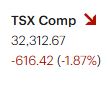
The S&P/TSX Composite Index in Toronto fell by 616.42 points (1.87%) to close at 32,312.67. The index opened 200 points below the previous day’s close and remained subdued for most of the afternoon. However, in line with other major North American indices, losses accelerated shortly after U.S. Federal Reserve Chair Jerome Powell began his press conference.
Today’s TSX Market Statistics
Market breadth on the S&P/TSX Composite Index was notably negative, with declining issues significantly outpacing advancing ones. A total of 1,728 securities declined, compared with 422 that advanced, resulting in an advancers-to-decliners ratio of approximately 1:4.09. An additional 125 securities remained unchanged, underscoring the broadly weak market participation.
Despite the negative breadth, the exchange recorded 98 new 52-week highs and 23 new 52-week lows, compared with 64 new highs and 22 new lows in the previous session. This divergence suggests that while overall sentiment was risk-averse, select securities continued to exhibit upward momentum.
Total trading volume reached 443,074,038 shares, representing a 10% increase from the prior session’s 403,690,474 shares. The rise in volume alongside declining prices may indicate heightened selling pressure and increased conviction among market participants.
Today’s Toronto Market Wrap-Up
The S&P/TSX Composite Index experienced a broad-based and risk-driven sell-off, as escalating geopolitical tensions tied to the developing U.S.–Iran conflict weighed heavily on investor sentiment. The session remained under pressure throughout the day, with downside momentum accelerating in the afternoon in tandem with other major North American equity markets.
Selling intensified shortly after remarks by Jerome Powell, as market participants reassessed the near-term monetary policy outlook. The combination of geopolitical uncertainty and a cautious Federal Reserve tone contributed to a sharp deterioration in risk appetite, triggering programmatic and momentum-driven selling into the close.
Sector Performance
All ten major sectors within the TSX closed in negative territory, underscoring the breadth of the decline. Notably, no sector managed to post even marginal gains.
Defensive segments offered only limited relative outperformance, with Energy (-0.18%) and Utilities (-0.31%) leading on a relative basis. In contrast, cyclical and growth-sensitive sectors bore the brunt of the sell-off, with Information Technology (-2.11%) and Materials (-5.30%) emerging as the primary laggards.
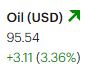
Market weakness intensified around mid-afternoon following reports of potential escalation in the Middle East, including threats to critical energy infrastructure. These developments, combined with central bank signaling, amplified volatility and reinforced a risk-off environment.
Company Highlights
Selective stock performance reflected divergence within sectors:
- CF Industries Holdings (TSX: CF) advanced 2.81% to close at $126.75 on elevated volume (12.6M shares), supported by expectations of sustained strength in global fertilizer demand amid rising energy prices.
- Cameco Corporation (TSX: CCO) declined 1.65% to $150.23, indicating that nuclear-related equities did not participate in the relative resilience observed in broader energy markets.
- Suncor Energy Inc. (TSX: SU) extended its recent gains, continuing to benefit from upward pressure on crude oil prices linked to geopolitical supply risks.
Importantly, current market dynamics highlight that gains within the energy complex are not uniform. Companies with direct exposure to crude oil production and refining, as well as energy-linked inputs such as fertilizers, appear better positioned to benefit from supply disruptions associated with tensions in key transit routes such as the Strait of Hormuz.
Monetary Policy and Macro Outlook
The Bank of Canada maintained its benchmark interest rate at 2.25%, extending the current pause in policy adjustments. Governor Tiff Macklem emphasized the growing macroeconomic risks associated with prolonged geopolitical conflict.
While inflation has remained close to the Bank’s 2% target over the past year, rising oil prices driven by Middle East tensions are expected to exert upward pressure on the Consumer Price Index in the coming months. Elevated energy costs are likely to feed through into broader production and transportation expenses, increasing the risk of renewed inflationary pressures.
At the same time, the growth outlook remains fragile. The Canadian economy continues to adjust to external headwinds, including evolving U.S. trade policies and persistent geopolitical uncertainty. According to the Bank’s assessment, risks to economic growth are tilted to the downside, while risks to inflation are skewed to the upside—creating a challenging policy environment.
Investor Takeaways
For investors and traders, today’s session reinforces several key themes:
- Geopolitical risk is re-emerging as a primary market driver, particularly through its impact on energy markets.
- Monetary policy sensitivity remains elevated, with markets reacting sharply to central bank communication.
- Sector dispersion is increasing, requiring more selective positioning within industries.
- Inflation risks may reaccelerate if energy price pressures persist, complicating the rate outlook.
Overall, the near-term market environment is likely to remain volatile, with direction increasingly dependent on geopolitical developments and central bank responses.
Technical Levels & Trade Ideas
From a technical perspective, the S&P/TSX Composite Index has broken below near-term support, confirming a short-term bearish bias. Immediate support is now seen in the 32,000–31,800 range; a sustained break below this zone could open the door to a deeper retracement toward the 31,200 level. On the upside, former support near 32,800–33,000 now acts as initial resistance, with stronger resistance around 33,500.
Momentum indicators are trending lower, and rising volume on down days suggests continued distribution. Traders may consider maintaining a defensive posture in the near term, with a bias toward selling rallies rather than buying dips until stabilization signals emerge.
From a sector and tactical standpoint:
- Energy-linked equities remain relatively resilient; pullbacks in names such as Suncor Energy Inc. may present short-term trading opportunities if crude prices remain elevated.
- Materials stocks remain under pressure; caution is warranted until base metals stabilize.
- Fertilizer and agriculture-linked names, including CF Industries Holdings, may continue to outperform amid rising input costs tied to energy markets.
Given elevated geopolitical and macro uncertainty, traders should prioritize risk management, tighter stop-loss levels, and shorter time horizons.
.
The US Markets
U.S. Market Indexes
U.S. equities experienced a broad-based and pronounced decline, with all major indices closing lower by more than 1%, reflecting a significant deterioration in risk sentiment.
The Dow Jones Industrial Average fell 768.11 points, or 1.63%, to close at 46,225.15, remaining under consistent selling pressure throughout the session and finishing as the weakest of the major indices. The S&P 500 declined 91.39 points, or 1.36%, to 6,624.70, while the Nasdaq Composite dropped 327.11 points, or 1.46%, to settle at 22,152.42.
The uniformity and magnitude of the declines across indices signal a coordinated risk-off move, typically indicative of macro-driven selling rather than sector-specific weakness. Persistent downward pressure from the opening bell through the close—particularly in the Dow—suggests institutional participation in the sell-off.
The Russell 2000 Index declined 41.35 points, or 1.64%, to close at 2,478.64. Notably, small-cap stocks initially showed resilience, recovering earlier losses by mid-afternoon. However, sentiment reversed sharply following the Federal Reserve’s post-meeting press conference, triggering a steep late-session decline and leaving the index well off its intraday highs.
Small-cap equities, which are typically more sensitive to interest rate expectations, reacted negatively despite the Federal Reserve holding rates steady. Market participants appeared to recalibrate expectations for future monetary easing in light of persistent inflationary pressures and escalating geopolitical risks in the Middle East.

Today’s U.S. Market Statistics
Market internals across U.S. exchanges reflected pronounced weakness, reinforcing the broad-based sell-off observed in the major indices.
New York Stock Exchange (NYSE): Market breadth on the New York Stock Exchange was decisively negative, with declining issues significantly outnumbering advancers. A total of 3,649 securities declined compared to 876 that advanced, while 323 issues remained unchanged. This resulted in a decliner-to-advancer ratio of approximately 4.16:1, underscoring widespread selling pressure across listed equities.
The exchange recorded 103 new 52-week highs and 173 new 52-week lows, a notable deterioration compared to the previous session (136 highs vs. 85 lows). The expansion in new lows signals increasing downside momentum and weakening price structures across a broader set of securities.
Total trading volume reached 5.38 billion shares, representing a 4% increase from the prior session. Rising volume alongside declining prices suggests heightened distribution and increased conviction among sellers.
NASDAQ: Similarly, market breadth on the NASDAQ remained firmly negative. Declining issues totaled 3,807, compared to 988 advancing stocks, with 304 unchanged. This translates to a decliner-to-advancer ratio of approximately 3.85:1, confirming broad participation in the sell-off, particularly within growth-oriented and technology sectors.
The exchange posted 61 new 52-week highs and 272 new 52-week lows, a marked shift from the previous session’s 73 highs and 156 lows. The sharp increase in new lows highlights accelerating weakness in high-beta and momentum-driven equities.
Total trading volume on the NASDAQ rose to 9.43 billion shares, up 7.5% from the prior session. As with the NYSE, the combination of elevated volume and declining prices points to sustained institutional selling pressure.
Today’s U.S. Market Wrap-Up
U.S. equities came under significant selling pressure, with a sharp late-session decline driven by a combination of stronger-than-expected inflation data and heightened policy uncertainty following remarks by Jerome Powell.
Earlier in the day, the February Producer Price Index (PPI) rose 0.7% month-over-month, exceeding expectations and signaling persistent upstream inflationary pressures. While markets initially showed resilience, sentiment deteriorated markedly during the Federal Reserve’s post-meeting press conference. Chairman Powell emphasized the uncertainties stemming from escalating geopolitical tensions, including the evolving U.S.–Iran conflict, and warned that rising oil prices could further elevate inflation expectations while weighing on economic growth.
Markets interpreted these signals as reducing the likelihood of near-term monetary easing. The shift toward a “higher-for-longer” rate outlook—rather than the policy decision itself—was a key catalyst for the sell-off, with equities closing near session lows as risk appetite deteriorated sharply.
Sector Performance
Sector performance reflected a pronounced risk-off environment. The Energy sector was the sole gainer, rising a modest 0.28%, supported by strength in crude oil prices. All other major sectors closed in negative territory.
- Defensive and rate-sensitive sectors experienced varying degrees of weakness:
- Financials declined 0.92%
- Information Technology fell 1.24%
- Consumer Discretionary segments (including both discretionary and durable goods) dropped approximately 2.0%
- Materials led the downside, falling 2.59%, reflecting pressure on cyclical and commodity-linked equities
The breadth and magnitude of sector declines underscore the broad-based nature of the sell-off.
Company Highlights
Despite the negative macro backdrop, select equities exhibited relative strength:
- Bright Spring Health Services rose 2.30% to close at $43.07, supported by continued investor interest following recent strong performance.
- Solaris Energy Infrastructure advanced 8.49% to $68.56, extending gains amid strength in energy-related infrastructure plays.
Within the technology space, semiconductor and storage-related names initially outperformed:
- SanDisk Corporation gained 4.65%, reflecting continued demand for memory and storage solutions.
- Micron Technology Inc. traded higher for most of the session but reversed sharply into the close, finishing nearly flat (+0.01%) as broader market weakness intensified ahead of its earnings release.
The late-session reversal in technology stocks highlights the market’s sensitivity to macro drivers, with even fundamentally strong segments unable to sustain gains amid rising rates and geopolitical uncertainty.
Market Interpretation
Today’s session reinforces a critical shift in market dynamics. The combination of firm inflation data and geopolitical instability has materially reduced expectations for interest rate cuts later in the year. As a result:
- Equity valuations, particularly in growth and rate-sensitive sectors, are facing renewed pressure
- Energy-linked assets are benefiting from supply-side risks and rising oil prices
- Volatility is increasing as macroeconomic and geopolitical factors dominate market direction
Overall, the market response suggests that investors are recalibrating positioning in anticipation of a more prolonged restrictive monetary policy environment, with downside risks to growth and upside risks to inflation becoming more pronounced.
Technical Levels & Trade Ideas
The S&P 500 has shifted into a short-term corrective phase, with price action breaking below near-term support and closing near session lows. Immediate support is now seen in the 6,550–6,500 range, with a deeper downside target near 6,400 if selling pressure persists. On the upside, initial resistance is expected around 6,700–6,750, with stronger resistance near 6,850.
Momentum indicators have turned negative, and the sharp increase in selling volume suggests active institutional distribution. The late-session sell-off following the Federal Reserve commentary reinforces the importance of monitoring macro-driven catalysts, particularly inflation data and central bank communication.
Day Traders
- Focus on intraday momentum and volatility-driven setups
- Look for short opportunities on failed rallies near resistance levels
- Breakdowns below key psychological levels (e.g., round numbers) may offer short-term continuation trades
- Tight stop-loss discipline is essential given elevated volatility tied to macro headlines
Swing Traders
- Maintain a cautious, slightly bearish bias in the near term
- Consider scaling into short positions on relief rallies rather than chasing downside
- Watch for oversold conditions that could trigger sharp but temporary rebounds
- Sector rotation may offer relative opportunities, particularly in energy-linked equities
Position Traders / Investors
- Prioritize capital preservation and risk management
- Reduce exposure to high-duration, rate-sensitive sectors such as technology and discretionary
- Maintain selective exposure to energy and inflation-linked sectors, which may benefit from persistent macro pressures
- Monitor earnings and forward guidance closely, as macro uncertainty may increasingly influence corporate outlooks
Overall, market conditions remain fragile, with direction likely to be dictated by incoming inflation data, central bank communication, and geopolitical developments. Elevated volatility and weaker breadth suggest a continued emphasis on disciplined positioning and risk control.
NOTICE TO READERS
The Canadian Vanguard Stock Market is about empowering you to build and manage your wealth by yourself. There is certainly no magic in managing finances or wealth but one needs to know what to do and commit to doing what is needed. When you are ready to start the journey to Put Your Destiny In Your Own Hands, read The Canadian Vanguard every market day. If you need more information please Contact Us
Our readers are strongly advised to conduct their own research into individual stocks before making a purchase decision. In addition, investors are advised that past stock performance is no guarantee of future price appreciation. Any recommendation is not a guarantee of any particular stock’s future prices, and The Canadian Vanguard accepts no responsibility or liability for investors’ or readers’ purchases.
Stocks In The News/ Stocks To Watch and Market Strategy will soon be available but only to Paying Subscribers.
(c) This article is published by The Canadian Vanguard on March 18, 2026