






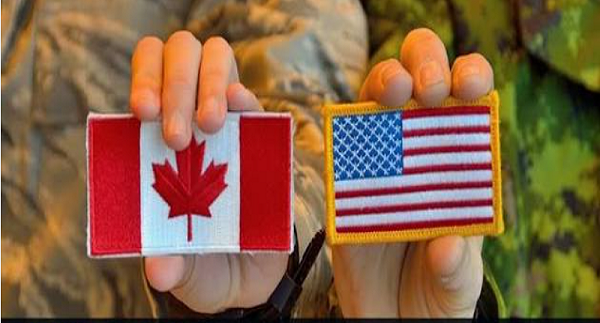
U.S.-Canada Military Ties Endure Amid Political Friction
Canada’s military relationship with the United States remains unchanged despite the collapse of trade talks and escalating tension at a political level, the country’s top soldier says.
At a conference of the chiefs of defence for the Indo-Pacific held in Victoria, B.C., this week, General Jennie Carignan said Canada’s military collaboration with the U.S. remains strong, ensuring the two countries can continue to work together to defend key regions, including the Indo-Pacific. Her comments were echoed by her U.S. counterparts.
“The chiefs of defence, our job is to translate political objectives into military effects. We both do this with our government, and we constantly meet to align our work and collaborate,” Gen. Carignan, who has served as Canada’s Chief of the Defence Staff for two years, told The Globe and Mail in an interview on Monday.

She added that Canada’s fighter jet contract with American company Lockheed Martin and Canada’s role in the U.S.’s Golden Dome missile defence system are a “different conversation” than the one the country is having with the Trump administration about trade, despite media reports saying U.S. officials pressed Canada on these topics as part of negotiations.
The conference in Victoria is being held over three days, ending Wednesday, with 29 countries in attendance. It’s an annual event that rotates locations across the Indo-Pacific and was last held in Canada in 2017. Back then, the discussion centred around countering violent extremism and peacekeeping operations.
As a U.S. Pacific Command event, the country is always one of two co-hosts. This year, its organizing partner is Canada.
It’s a timely collaboration given that the relationship between Canada and the U.S. at a political level is on thin ice, with barbs being thrown back and forth by politicians on both sides since trade negotiations broke down last month. Most recently, U.S. Transportation Secretary Sean Duffy claimed Canada has no military, U.S. Secretary of the Treasury Scott Bessent cracked a joke about the country’s ability to respond to threats and U.S. Defense Secretary Pete Hegseth posted a controversial remark about the Canadian cadet program to social media.
While speaking to reporters at a press conference on Tuesday, Defence Minister David McGuinty called Mr. Hegseth’s post, which mocked two cadets, “below the dignity of the office.”
Yet, in the military-to-military conversations happening in Victoria this week, it was impossible to count on ten fingers the number of times words such as “collaboration,” “partner,” or “interoperability” have been uttered by Canadian and American senior military officials in their public remarks.
Gen. Carignan’s friendly tone when speaking about her U.S. counterparts was matched by General Dan Caine, chairman of the U.S. Joint Chiefs of Staff, and Admiral Samuel Paparo, commander of the U.S. Pacific Command, while addressing the sea of uniforms in attendance at the conference.
Gen. Caine called for a “round of applause for Canada” before going on to emphasize the importance of interoperability between each country’s militaries and for the Indo-Pacific nations in the room to build up their own military might.
Pentagon defends Hegseth’s controversial post about Canadian cadet program
“We owe it to our citizens to invest in our own capabilities to protect our sovereignty and our interests as they intersect around the globe,” he said. “That type of strength is built on interoperability and integration, and yielded through great partnerships. Our forces must be interoperable.”
Adm. Paparo thanked his Canadian counterparts for their leadership and hospitality, before speaking about the importance of operating together to “compound” deterrence.
Gen. Carignan and Adm. Paparo are scheduled to hold a joint press conference with reporters Wednesday morning, on the last day of the conference. The U.S. delegation declined individual interview requests with reporters attending the conference.
The two co-host delegations were seated side by side in the conference’s main ballroom inside the Fairmont Empress hotel on Tuesday, presenting a united front before the other delegates. Mr. McGuinty sat among them before his own opening remarks, which he began by acknowledging his U.S. counterparts, adding to the abundance of pleasantries.
Gen. Carignan told the crowd on Tuesday that Canada and the U.S. have “a lot in common” in terms of their activities and posture in the Indo-Pacific.
“Canada, as a maritime nation, is surrounded on three sides by ocean and has the longest coastline in the world. And on the fourth side of our border, we share with our longtime ally, the United States,” she said.
For now, Canada’s operational and strategic relationship with the U.S. seems distant from that of its faltering political relationship.
Mr. McGuinty told reporters he thinks Canadians “understand the difference between the performative nature of an administration in the United States and the importance of the military-to-military co-operation, which continues.”
This article was first reported by The Globe and Mail