



‘Unlawful, unjustified and illogical’: Carney faces pressure to retaliate against Trump’s steel, aluminum tariffs
Prime Minister Mark Carney is facing increasing pressure from premiers, industry, labour and business organizations to retaliate against U.S. President Donald Trump’s doubling of steel and aluminum tariffs.
But even as he called the tariffs “unlawful, unjustified and illogical,” Mr. Carney said Canada will take its time responding, citing broader talks with the U.S. that he said are progressing.
Mr. Trump initially imposed tariffs of 25 per cent on the metals in March but doubled them to 50 per cent as of Wednesday. The tariffs apply to all foreign suppliers, but they will disproportionately hit Canada, which is the largest supplier of steel and aluminum to the U.S.
Ottawa imposed retaliatory tariffs in March, but Mr. Carney lifted many of those in April over concerns that they would drive up prices for Canadian consumers.
Mr. Carney, who won the spring election on a campaign to fight against U.S. tariffs, including through retaliation, said Canada wouldn’t hit back against the increased tariffs just yet.
“We are in intensive negotiations with the Americans and in parallel, preparing reprisals if those negotiations do not succeed,” Mr. Carney said during Question Period on Wednesday.


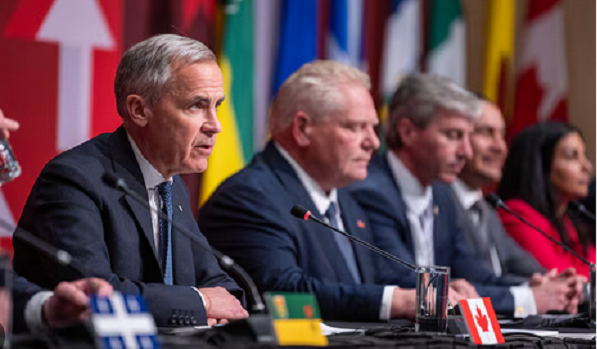
Ontario Premier Doug Ford urged immediate retaliation. He told reporters he had spoken with Intergovernmental Affairs Minister Dominic LeBlanc, who is leading the U.S.-Canada file, to make the case.
The Canadian Labour Congress, the Canadian Chamber of Commerce and the Federation of Canadian Municipalities joined together to demand government action.
The three groups rarely share a stage, but did so Wednesday to make a point, said Bea Bruske, president of the Canadian Labour Congress.
“This is an all-hands-on-deck moment. We need to defend our jobs. We need to invest in our industries, and we need to protect our communities that built this country, labour, business, municipalities and government.”
She urged reprisal, but said she also wants the government to take other steps, including reforms to employment insurance to assist affected workers and legislated commitments to use Canadian steel in national projects.
Ms. Bruske said there are 23,000 steel industry jobs in the country that could be affected “within the next couple of days,” plus 9,500 aluminum jobs, and then all the spin-off jobs created by both industries.
The Prime Minister’s hesitation on retaliation is a contrast with the approach of then-prime minister Justin Trudeau, who immediately imposed tariffs on the U.S., both earlier this year and in 2018, during Mr. Trump’s previous trade war with Canada.
In March, Mr. Ford also moved quickly to levy a 25-per-cent surcharge on electricity that Ontario sends to 1.5 million homes in three U.S. states. He cancelled the measure within a day after Mr. Trump threatened to double steel and aluminum tariffs in response.
But Mr. Ford said his understanding is that a Canada-U.S. deal is close, and so for now he is not reinstating the surcharge.
Mr. Carney is pushing for a deal between the two countries covering both trade and national security, including the border and defence.
The CEO of Algoma Steel Group Inc., Michael Garcia, said Ottawa should immediately bring in tariffs on imports of foreign steel to address dumping in Canada from places such as Turkey, Vietnam and the Middle East.
Mr. Garcia said that unless the price of steel skyrockets, the company’s U.S. business isn’t viable anymore.
“I am advocating for Section 53 tariffs not as a retaliatory measure against the U.S., but as a prudent move to protect a vital strategic industry,” he said in an interview.
Under Canada’s Customs Tariff law, Section 53 tariffs can be imposed by Ottawa in cases in which unfair trade practices are occurring that are harming domestic trade.
An estimate by Oxford Economics, a consultancy firm, found that more than half of U.S. steel imported into Canada is currently exempt from tariffs.
The Aluminium Association of Canada said the tariff increase would destroy demand across the continent, no matter whether the metal is made in Canada or the U.S., and disrupt key sectors, including defence, construction and automotive.
Steel prices in the U.S. have already risen by 16 per cent since Mr. Trump took office in January, and his higher tariffs risk causing inflation for American consumers by making products built with steel more expensive.
At a committee hearing on Wednesday, U.S. Commerce Secretary Howard Lutnick said that the administration’s goal is not to get other countries to simply lower trade barriers but to ensure that those countries stop exporting certain products to the U.S., a position that would appear to complicate Mr. Carney’s efforts to land a deal that includes removing U.S. tariffs.
Mr. Lutnick said under questioning from Senator John Kennedy, a Louisiana Republican, that he did not know the name of the Trade Expansion Act of 1962, the legislation under which the U.S. has imposed steel, aluminum and auto tariffs. He also said he was not familiar with a principle called the “major questions doctrine,” which was central to a legal decision overturning a different series of Mr. Trump’s tariffs.


Mr. Lutnick is the member of the President’s cabinet with top authority on trade policy. Mr. Kennedy’s grilling of Mr. Lutnick could indicate a fracture in Republican support for Mr. Trump’s agenda. While the party traditionally supported free trade, it has largely fallen in line behind the President’s protectionism since he returned to office.
Meanwhile, in Ottawa, the opposition Conservatives and the New Democrats all castigated Mr. Carney Wednesday for campaigning in the recent election on having a plan to push back against Mr. Trump, but still not having a deal to end the tariff dispute.
Mining giants Alcoa, Rio Tinto and Aluminerie Alouette operate nine plants in Canada, eight of them in Quebec. This amps up the political pressure on the minority Liberal government from the Bloc Québécois.
At a White House meeting last month, Mr. Trump said there was nothing Mr. Carney could say that would make him change his mind on tariffs, but the Prime Minister has remained insistent that such a deal would include the U.S. lifting its levies on Canada.
With reports from Niall McGee and Nicolas Van Praet
This article was first reported by The Globe and Mail