







Markets Remain Resilient as Tech and Financials Sell Off; Nasdaq Slumps While Small-Caps Lead
The Canadian Vanguard Stock Market Report – Wednesday January 14, 2026 Edition.
.
The Toronto Market
The Toronto Market Index
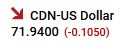
The S&P/TSX Composite Index advanced 46.11 points, or 0.14%, to close at 32,916.47. The index reversed yesterday’s loss and returned to positive territory today. Although it traded in the red for most of the session, it moved higher late in the afternoon to finish in positive territory. The index has now closed higher in four of the last five trading sessions.


Today’s TSX Market Statistics
Market breadth was positive on the TSX, with advancing issues clearly outpacing decliners. A total of 1,279 stocks advanced versus 888 declines, producing an advancer-to-decliner ratio of 1.44 to 1. This indicates broad-based participation in today’s gains, while 129 issues finished unchanged.
New 52-week highs significantly exceeded new lows, with 358 stocks reaching fresh highs compared to just 23 recording new lows. Although the number of new highs declined from yesterday’s elevated level of 538, the continued dominance of highs over lows suggests underlying strength and sustained investor confidence across multiple sectors.
Trading activity increased modestly, with total TSX volume rising 5% to 525.2 million shares. The higher volume accompanying positive market breadth supports the view that today’s advance was supported by active investor participation rather than thin trading.
Toronto Market Wrap-Up Report
The S&P/TSX Composite Index closed modestly higher, supported by positive market breadth and continued strength in cyclical and defensive sectors, despite pronounced weakness in technology. Advancers outpaced decliners by a ratio of 1.44 to 1, and new 52-week highs continued to significantly exceed new lows, reinforcing a constructive underlying tone for Canadian equities.
Sector Performance and Risk Sentiment
Energy remained the most consistent outperformer within the TSX, rising 1.67% and continuing to attract capital amid firm commodity prices and resilient global demand. Telecommunications Services gained 1.30%, reflecting investor preference for defensive, cash-flow-generating sectors in an environment of selective risk-taking. Basic Materials advanced 1.29%, further highlighting ongoing strength in the resources complex.
Financials posted a modest gain of 0.26%, suggesting steady but cautious positioning in the sector, while Discretionary Consumer Goods & Services declined 0.61%. The weakness in consumer-related stocks points to ongoing concerns around household spending, interest rates, and economic sensitivity, reinforcing a more selective approach to risk.
Technology Under Pressure
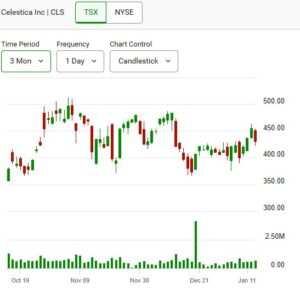
Technology was the clear laggard, plunging 5.16% and acting as the primary drag on the index. Celestica Inc. (TSX: CLS) fell 5.56% to close at $430.25 on 625,000 shares traded, while Shopify Inc. (TSX: SHOP) dropped 5.95% to $218.61 on heavy volume of 2.7 million shares. The sharp selloff in large-cap technology suggests profit-taking and valuation sensitivity, particularly as investors rotate toward sectors offering earnings stability and inflation protection.
Resource Stocks Support the Market
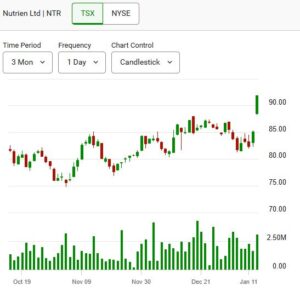
Within the resources sector, Nutrien Ltd. (TSX: NTR) continued to outperform, rising 7.99% or $6.80 on strong volume of 3.1 million shares. This followed yesterday’s solid 3.33% gain, underscoring sustained momentum and growing investor conviction in fertilizer and agricultural input themes. Strength in names like Nutrien helped offset technology weakness and reinforced the TSX’s commodity-driven resilience.
Short-Term vs. Long-Term Outlook
In the short term, sector rotation remains a dominant theme, with investors favoring energy, materials, and defensive sectors over high-growth technology and consumer discretionary names. Elevated trading volume alongside positive breadth suggests institutional participation rather than speculative activity.
From a longer-term perspective, the continued expansion in 52-week highs relative to lows points to a market that remains structurally healthy, despite near-term volatility in select sectors. As long as commodities remain supported and earnings trends stabilize, the TSX appears positioned to maintain its relative strength, even as global equity markets navigate shifting risk dynamics.
.
The US Markets
U.S. Market Indexes
U.S. equity markets finished mixed, with losses concentrated in large-cap growth and technology stocks, while small-cap shares outperformed. The Dow Jones Industrial Average slipped 42.36 points, or 0.09%, to close at 49,149.63. The S&P 500 declined 37.14 points, or 0.53%, ending the session at 6,926.60. The Nasdaq Composite led the downside, falling 238.12 points, or 1.00%, to finish at 23,471.75.
In contrast, the Russell 2000 Index gained 18.53 points, or 0.70%, closing at 2,651.64. The divergence highlights a clear rotation away from mega-cap technology and into smaller-cap stocks, which are typically more sensitive to domestic economic conditions.

Today’s U.S. Market Statistics
New York Stock Exchange (NYSE): Market breadth on the NYSE was decisively positive, with advancing issues significantly outpacing decliners. A total of 2,821 stocks advanced compared with 1,527 declines, while 406 issues finished unchanged, producing an advancer-to-decliner ratio of 1.85 to 1. This breadth strength suggests broad participation beyond headline index performance.
The NYSE recorded 518 new 52-week highs versus just 69 new lows, a sharp improvement from the prior session’s 236 highs and 28 lows. The expansion in new highs points to continued underlying momentum across multiple sectors.
Trading activity increased meaningfully, with total NYSE volume rising 8% to 5.59 billion shares. The higher volume reinforces the view that today’s market action reflected active institutional participation rather than thin trading.
NASDAQ: Breadth on the NASDAQ was positive but more restrained, reflecting ongoing divergence within the market. Advancers totaled 2,739, compared with 2,034 decliners, while 309 issues were unchanged, resulting in an advancer-to-decliner ratio of 1.35 to 1, or roughly seven advancers for every five decliners.
The NASDAQ posted 277 new 52-week highs and 131 new lows, compared with 352 highs and 132 lows in the previous session. The decline in new highs alongside elevated new lows underscores selective weakness, particularly within technology and growth-oriented names.
Trading volume surged 27% to 12.62 billion shares, well above the prior day’s levels. The spike in volume alongside index weakness suggests heightened selling pressure and rotation activity rather than a lack of liquidity.
Today’s U.S. Market Wrap-Up Report
U.S. equity markets experienced a broad-based session, even as all major indexes closed in negative territory. Sector performance, however, was notably mixed. Energy led the market with a gain of 1.89%, followed by Telecommunications Services, which rose 1.44%. In total, eight of the eleven major sectors finished higher, highlighting underlying resilience despite index-level weakness. The Financials sector also managed a modest gain of 0.18%.
Technology and Discretionary Consumer Goods & Services were the primary laggards. Technology declined 1.27%, while Consumer Discretionary fell 1.44%, reflecting continued pressure on growth-oriented and economically sensitive stocks.
Small-Cap Leadership and Economic Confidence
Small-cap stocks continue to outperform on a year-to-date basis, reinforcing the view that investors maintain confidence in the economic outlook. Rotation into small caps typically signals expectations for stable growth and accessible credit conditions, as smaller companies are more dependent on lending to finance expansion. This trend suggests a constructive view of economic prospects rather than a defensive stance.
Financials and Earnings Reaction
Bank shares came under pressure as earnings reports were released, despite generally solid headline results. Bank of America (BAC) reported higher quarterly profits, yet its shares declined 3.8%. Wells Fargo (WFC) fell 4.6% after missing net income expectations. Citigroup (C) posted a quarterly profit that was impacted by a $1.2 billion loss related to the sale of its Russia operations, sending its shares down 3.3%. The negative reaction across bank stocks points to elevated investor expectations and sensitivity to earnings quality rather than headline figures alone.
Technology Weakness and Market Rotation
Technology stocks bore the brunt of the day’s selling pressure, driving the Nasdaq’s underperformance and weighing on broader market sentiment. The pullback suggests increasing valuation discipline among investors and a selective reallocation of capital toward sectors offering perceived value, income stability, and near-term earnings visibility.
Despite today’s decline in large-cap indexes, early 2026 performance trends remain constructive. Now in the second week of the year, small-cap stocks have emerged as relative leaders, outperforming major large-cap benchmarks. If this trend persists, it could signal a broader shift in risk appetite and a more balanced market leadership profile as the year progresses.
Notable Stock Moves
Nvidia (NVDA) fell 1.44%, or $2.67, to close at $183.14 on heavy volume of 159.6 million shares, reversing a 0.5% gain from Tuesday’s session.
Microsoft (MSFT) declined 2.40%, or $11.20, to $459.38, with 28.2 million shares traded, extending its 1.4% drop from the prior session.
Meta Platforms (META) fell 2.4% to close at $615.52 on 15.5 million shares, following a 1.7% decline on Tuesday.
Global Semiconductor Outlook
Overnight in North America and during Asian trading hours, Taiwan Semiconductor Manufacturing Company (TSMC) reported fourth-quarter earnings that exceeded expectations. The company posted a 35% increase in profits, reaching a fresh record driven by strong demand for AI-related chips. The results reinforce the long-term structural growth outlook for semiconductors, even as near-term volatility persists in U.S. technology stocks.
Commodities and Bonds
Oil Prices: Oil prices fell after President Trump earlier today indicated he might refrain from attacking Iran. U.S. oil is down 3.19% at $60.04 per barrel as of 12:30 a.m. EST on Thursday.
Gold and Silver: Gold was higher earlier in the day but has since declined. Gold is down $46.00, or 0.99%, at $4,590.80 per troy ounce, while silver is down $3.66, or 4.01%, at $87.56 per ounce as of the time of this update.
Bitcoin (BTC-USD): Bitcoin is trading lower at $96,271.20, down $1,274.39, or 1.30%, as of this update.
10-Year Treasury Yield: The 10-year Treasury yield is virtually unchanged from earlier Wednesday levels, currently at 4.142% as of 12:30 a.m. EST on Thursday.
After-Hours Action: Futures are slightly lower Wednesday evening. Dow futures are down 26 points, or 0.05% versus fair value. S&P 500 futures are down 3.25 points, or 0.04%, at 6,963.75, while Nasdaq 100 futures are down 15.25 points, or 0.06%, at 25,615.75 as of 12:30 a.m. EST Thursday.
Reminder: Overnight futures often have little correlation to the following day’s regular trading session. All figures reflect market conditions at the time of capture only.
NOTICE TO READERS
The Canadian Vanguard Stock Market is about empowering you to build and manage wealth by yourself. There is certainly no magic in managing finances or wealth but one needs to know what to do and commit to doing what is needed. When you are ready to start the journey to Put Your Destiny In Your Own Hands, read The Canadian Vanguard every market day. If you wish to exchange ideas, need more information or for sophisticated market data analysis, please click Contact Us
Our readers are strongly advised to conduct their own research into individual stocks before making a purchase decision. In addition, investors are advised that past stock performance is no guarantee of future price appreciation. Any recommendation is not a guarantee of any particular stock’s future prices, and The Canadian Vanguard accepts no responsibility or liability for investors’ or readers’ purchases.
Stocks In The News/ Stocks To Watch and Market Strategy will soon be available but only to Paying Subscribers.
(c) This article is published by The Canadian Vanguard on January 14, 2026