


Fed Minutes to Reveal Internal Strategy on War-Driven Economic Risks
U.S. Federal Reserve officials knew at their March meeting that the U.S.-Iran war was going to send inflation higher for the year, but minutes of the two-day session to be released Wednesday afternoon may flesh out even further the risks policymakers and central bank staff see from a conflict that President Donald Trump has cast in civilizational terms.
A developing global oil shock was in its third week when the Fed met on March 17-18, with benchmark oil prices having risen from around $70 to $100 a barrel, and virtually all policymakers included higher 2026 inflation in updated economic projections issued after the meeting.
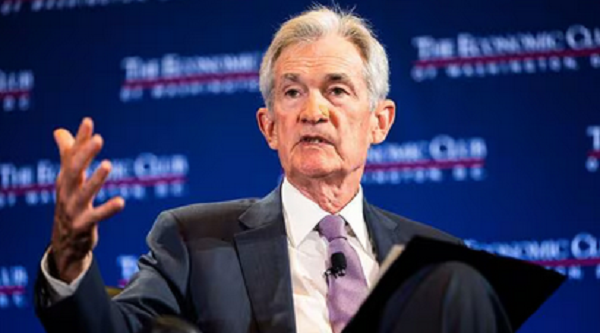
Oil was back below $100 a barrel early on Wednesday after Trump announced a two-week ceasefire to allow for negotiations on a long-term peace. Fed Chair Jerome Powell said various scenarios had been included in discussion at the March meeting.
Those would typically be part of staff presentations about the economic outlook and may be detailed in the minutes, providing a potential roadmap for how the Fed is framing its efforts to analyze an unpredictable situation.
“We did talk about alternative scenarios a little bit,” Powell said at his press conference following the March meeting.

“It’s very uncertain…We shouldn’t assume it’s going to be one thing or another” when it comes to the duration of the war and its effect on economic growth and prices in the U.S. and globally.
The Fed held the policy interest rate steady in March at the current 3.5% to 3.75% range, and gave little indication that a change was likely soon, as what was expected as a series of rate cuts this year evolved into what could now be an extended pause. Investors don’t see any change in the Fed’s policy rate now until late 2027.
As of January some Fed officials had become concerned even before the war that inflation appeared stuck at about a percentage point above the Fed’s 2% target, and indicated they were ready to signal that rate hikes might even be needed.
The Fed did not change the language in its March policy statement to indicate hikes were a possibility. But the minutes could show whether sentiment was moving further in that direction as central bankers thought through whether the oil shock posed a greater risk to their inflation target or to growth and jobs, should it spark shifts in spending and a loss of economic momentum overall as consumers cope with rising gas prices and other energy-driven cost increases.
The minutes will be released at 2 p.m. EDT.

At the meeting, policymakers raised their outlook for 2026 inflation by about a quarter of a percentage point, with the overall Personal Consumption Expenditures price index, the measure used by the Fed to set its 2% inflation target, expected to end the year at 2.7% versus 2.4% projected as of December. The inflation rate excluding food and energy prices, a less volatile number reflecting broader inflation trends, was also expected to move higher, from 2.5% projected as of December to 2.7%.
New research by Dallas Fed economists, opens new tab, however, suggests that may be a low-end estimate, hinging on oil prices not exceeding $110 a barrel and shipping through the blockaded Strait of Hormuz resuming by the end of April.
Alternative scenarios, with the strait closed an additional 3 months or 6 months, would push oil to $132 a barrel or $167 respectively, and add as much as 1.47 percentage points to headline U.S. inflation.
More than five weeks since what was expected to be a brief conflict began, officials have intensified their concerns about inflation, with a surprise surge in hiring in March at least for now easing concerns about a weak job market.
“I was optimistic that we would get back to this path to 2% inflation, but yikes, it’s going from orange to red lately,” Chicago Fed President Austan Goolsbee said this week before the ceasefire announcement on Tuesday. “We had tariffs increasing prices, that was supposed to go away, kind of didn’t go away, and now we add another stagflationary shock on top ….it’s a troubling moment.”
Reporting by Howard Schneider; Editing by Chizu Nomiyama
This article was first reported by Reuters