







U.S. Stocks Drift Lower Amid Trump’s Iran Ultimatum and Rising Geopolitical Risk
The Canadian Vanguard Stock Market Report – Tuesday April 7, 2026 Edition.
.
The Toronto Market
The Toronto Market Index
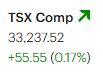
The S&P/TSX Composite Index rose 55.55 points, or 0.17%, to close at 33,237.52. The index has now posted gains in five consecutive trading sessions. While the rally attempt remains intact, it has yet to be fully confirmed.
There is a strong possibility of confirmation this week, particularly if a ceasefire agreement is reached between former U.S. President Donald Trump and Iranian leadership ahead of this evening’s deadline. Such a development would likely support positive market momentum in the near term.
Tuesday’s TSX Market Statistics
On the TSX, declining issues outnumbered advancing issues. There were 1,331 decliners compared to 798 advancers, resulting in a decliner-to-advancer ratio of 1.67:1—approximately three decliners for every two advancers. A total of 154 issues remained unchanged.
The exchange recorded 51 new 52-week highs and 23 new 52-week lows, compared with 45 new highs and 9 new lows in the previous session.
Total trading volume on the TSX reached 473,151,162 shares, representing an 11% increase from the 427,240,498 shares traded the day before.
Tuesday’s Toronto Market Wrap-Up Report
The TSX managed to eke out a modest gain today, doing so only in the final quarter hour of trading. Despite the positive close, market internals painted a weaker picture. Declining stocks outnumbered advancing stocks, highlighting narrow breadth and suggesting that underlying momentum remains fragile. The index experienced notable volatility throughout the session and spent most of the day in negative territory before a late rebound pushed it into positive ground.
Market breadth further reinforces this cautious tone. There were 1,331 decliners versus 798 advancers, resulting in a decliner-to-advancer ratio of 1.67:1—roughly three decliners for every two advancers. A total of 154 issues were unchanged. This type of divergence—where the index rises despite negative breadth—often signals that gains are being driven by a limited number of large-cap stocks rather than broad-based participation, a key consideration for traders assessing the durability of the current rally.
The exchange recorded 51 new 52-week highs and 23 new 52-week lows, an increase in both categories compared to the previous session. While the rise in new highs is constructive, the noticeable uptick in new lows suggests pockets of weakness beneath the surface. Meanwhile, total trading volume reached 473.2 million shares, up 11% from the prior session, indicating increased activity during a volatile trading day. Rising volume alongside mixed breadth can point to heightened conviction—but not necessarily clear direction.
Sector performance was uneven, with only four of the ten sectors finishing higher. Energy led the way with a 1.10% gain, followed by Utilities (+0.68%) and Financials (+0.29%). These gains suggest some rotation into more defensive and income-oriented sectors. On the downside, Technology fell 1.74% and Telecommunications Services dropped 2.11%, marking them as the session’s weakest performers and reflecting continued pressure in growth-oriented areas.
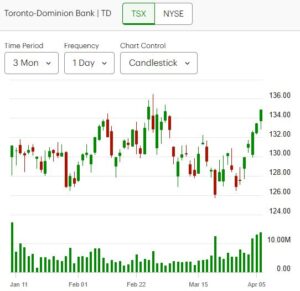
Toronto-Dominion Bank (TD) rose 1.2% and stood out due to unusually strong trading volume. Approximately 13.8 million shares changed hands—more than two and a half times its 50-day average of 5.2 million. The stock has now advanced for six consecutive sessions on rising volume, a bullish technical signal often associated with institutional accumulation. TD closed just 1.2% below its 52-week high of C$136.49, which was set only five weeks ago, placing it firmly on traders’ watchlists for a potential breakout.
In company-specific developments, Stack Capital Group Inc. (STCK), a small-cap name, surged 15.56% to close at $23.69 on volume of 178,000 shares. The move follows the company’s recent $8.75 million capital raise via a best-efforts private placement, a development that appears to have boosted investor sentiment.
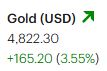
Another stock drawing attention was Wesdome Gold Mines Ltd. (WDO), which climbed 6.75% to $28.62 on 1.2 million shares traded. Strength in gold-related equities may reflect renewed interest in defensive assets amid ongoing market uncertainty.
Takeaway for Investors and Traders:
While the TSX continues its upward streak, today’s session raises some caution flags. The combination of weak breadth, increased volatility, and selective sector leadership suggests that the rally is not yet broad-based. Traders may want to remain selective, focusing on stocks with strong momentum and volume confirmation, while investors should watch for broader participation before gaining confidence in the sustainability of the current move.
.
The US Markets
U.S. Market Indexes
The Dow Jones Industrial Average slipped 85 points, or 0.18%, to close at 46,584.46. The S&P 500 edged higher by 5.02 points, or 0.08%, ending the session at 6,616.85. The Nasdaq Composite gained 21.51 points, or 0.10%, to finish at 22,017.85, while the Russell 2000 Index rose 4.30 points, or 0.17%, to close at 2,544.94.
Markets closed mixed following a highly volatile session. All major indexes traded in negative territory for most of the day before late-session buying lifted the Nasdaq and Russell 2000 into positive territory. The Russell 2000 showed intermittent strength earlier in the afternoon but repeatedly failed to hold gains, reflecting ongoing uncertainty and lack of sustained conviction among traders.
Today’s market action was largely influenced by geopolitical tensions tied to the ongoing conflict in the Middle East. Heightened uncertainty surrounding a potential ceasefire weighed on sentiment throughout the session, contributing to the choppy, back-and-forth price movement across equities.
Investor positioning appeared divided. A portion of market participants showed optimism that a ceasefire agreement could be reached ahead of the stated deadline, while others adopted a more defensive, risk-off stance amid the possibility of escalation. This split in sentiment helps explain the intraday volatility, with markets oscillating between gains and losses as new developments were anticipated.

NOTICE TO READERS
The Canadian Vanguard Stock Market is about empowering you to build and manage your wealth by yourself. There is certainly no magic in managing finances or wealth but one needs to know what to do and commit to doing what is needed. When you are ready to start the journey to Take Charge and Put Your Destiny In Your Own Hands, read The Canadian Vanguard every market day. If you need more related information, Contact Us
Our readers are strongly advised to conduct their own research into individual stocks before making a purchase decision. In addition, investors are advised that past stock performance is no guarantee of future price appreciation. Any recommendation is not a guarantee of any particular stock’s future prices, and The Canadian Vanguard accepts no responsibility or liability for investors’ or readers’ purchases.
Stocks In The News/ Stocks To Watch and Market Strategy will soon be available but only to Paying Subscribers. The dollar sign “$” in the Toronto Market section in the articles only stands for Canadian dollar and in the US market section “$” stands for US dollar.
(c) This article is published by The Canadian Vanguard on April 7, 2026