





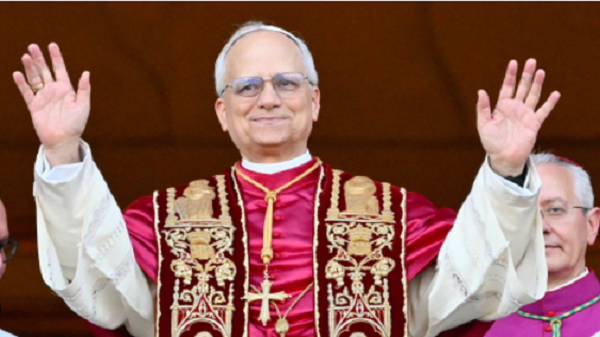
Came as a surprise: Robert Francis Prevost becomes Pope Leo XIV, first American to hold papacy in Catholic Church’s history
Cardinal Robert Prevost was elected the new pope and has taken the name Leo XIV, making him the first American in the history of the Vatican to be made leader of the Roman Catholic Church.
The election on late Thursday afternoon of the Chicago-born prelate, who is 69 – fairly young by papal standards − came as a surprise to Vatican watchers and Catholics everywhere.
While the cardinal was considered among the 20 or so papabili, Italian for pope-able, his name never emerged at the top of the lists, partly because of the global backlash against U.S. President Donald Trump.
Leo read his first address in Italian, starting with “Peace be with you all.”
“We can be a missionary church, a church that builds bridges, that is always open to receive everyone – just like in this square, to welcome everyone, in charity, dialogue and love,” he said.
At shortly after 6 p.m., billowing white smoke had emerged from the copper chimney installed on the rooftop of the Vatican’s Sistine Chapel, signalling that a pope had been elected after two days of voting. St. Peter’s Square erupted in shouts, cheers and clapping when the smoke emerged and the bells of the basilica rang.
About an hour later, Cardinal Prevost, by then Pope Leo XIV, stepped out into the loggia of St. Peter’s Basilica in front of tens of thousands of astonished pilgrims and tourists. He wore a white cassock, over which was draped a violet shoulder cape, known as a mozzetta, suggesting he was going back to sartorial tradition. When Pope Francis, who died last month at age 88, emerged on the loggia in 2013, he wore only a simple white, undecorated cassock – immediately setting the tone for his “poor church for the poor” philosophy.


“If Prevost was Italian, he would have been on everyone’s list because of his position as head of the Vatican office that nominates candidates for the episcopacy,” said Father Thomas Reese, senior analyst at Religion News Service in the United States.
Pope Leo spent most of his religious career as a missionary in Peru. “Most of us thought a U.S. cardinal would never become pope, but Prevost got strong support from cardinals from Latin America,” Father Reese added.
Mr. Trump, who drew ire last weekend after an AI-generated image of himself as Pope was posted to his social-media account, praised the new pontiff‘s election as the first American to lead the Catholic Church.
“Congratulations to Cardinal Robert Francis Prevost, who was just named Pope. It is such an honour to realize that he is the first American Pope,” Mr. Trump posted on his Truth Social platform. “What excitement, and what a Great Honor for our Country. I look forward to meeting Pope Leo XIV. It will be a very meaningful moment!”
The conclave was short by historical standards and was, by many accounts, difficult and sometimes fraught, given the broad range of views among the elector-cardinals. Some of them wanted a return to the traditional church, others wanted a pope who could carry on the liberal reforms of his predecessor, Pope Francis, and still others wanted a compromise candidate or one who was a native of Asia or sub-Saharan Africa – the two regions where the church is growing.
The conclave was the biggest in the history of the Church, with 133 elector cardinals – those under the age of 80 – from 70 countries. The previous conclave, in 2013, which elected Argentina’s Jorge Mario Bergoglio as Pope Francis, had 115 cardinals from 48 countries. During the preconclave sessions at the Vatican, some of the cardinals wore name tags, since many of them had never met one another before, and many did not speak Italian, the lingua franca of the Vatican.
The sheer diversity and size of the conclave had made it entirely unpredictable, with varying lists of those considered papabili circulating in various media sites.
None of the sites could agree who the top-five contenders were, though Pietro Parolin, the Vatican’s secretary of state who had been Francis‘s second-in-command, and Luis Antonio Tagle, the young-at-heart Filipino cardinal who was popular among young Catholics, were listed as prime contenders.
The independent conclave site, Cardinalium Collegii, which was known to be read by the elector-cardinals to learn more about their colleagues, said that as cardinal Pope Leo was close to Francis and shared many of the late pope‘s views.
“Ahead of the 2025 Conclave, Cardinal Prevost was being promoted as a possible compromise candidate if leading candidates were unable to obtain enough votes,” the site said. “His lengthy missionary service in Peru allowed him to be seen as a more universal candidate than American, which mitigated problems associated with choosing a pope from a superpower.”
Eric LeCompte, executive director of the religious development group Jubilee USA Network, which advises Vatican and Catholic Church leadership, released the following statement: “Cardinal Prevost is a strong voice for the Catholic Church’s social mission to address poverty. … he will follow the path that Francis set to build a more inclusive and transparent Church.”
Many of the pilgrims and tourists in St. Peter’s Square had expected an Italian pope after, in succession, a Polish, a German and an Argentine pope. Some of them said they had witnessed a historic moment by seeing the first American pope step onto the loggia of the basilica.
“I’m very lucky this happened when I was in Rome,” said Pablo Muñoz, 22, a Spanish university student studying in Rome. “It‘s really, really exciting. For Christians around the world, this is such a big event.”
Father Tojo Andrianarsolo, 34, from Madagascar, said he did not care about the nationality of the new pope or any of the contenders. “What interests me is someone who believes in the universal, inclusive church,” he said.
Born in 1955, Pope Leo received Bachelor of Science in Mathematics from Villanova University in 1977, a Master of Divinity from Catholic Theological Union in Chicago, and both a licentiate and doctorate in canon law from the Pontifical College of St. Thomas Aquinas in Rome.
After his ordination as a priest in 1982, Prevost joined the Augustinian mission in Peru and served as chancellor of the Territorial Prélature of Chulucanas from 1985 to 1986. In 1999, he returned to Chicago to work in the archdiocese. He went back to Peru in 2014, when Francis appointed him apostolic administrator of the Diocese of Chiclayo. He became Bishop of Chiclayo in 2015.
Pope Francis named him prefect of the Dicastery for Bishops in 2023, which is considered one of the most powerful positions in the Vatican. The role made him responsible for selecting bishops, a position he held until Francis died. In September, 2023, Francis named him Cardinal.


His media presence has been scant, but some of his positions are well known. He supported Francis on his views on the environment and on the poor and migrants, according to Cardinalium Collegii, as well as on meeting the faithful where they lived. He said last year “the bishop is not supposed to be a little prince sitting in his kingdom.”
He supported Francis‘s decision to allow divorced and remarried Catholics to receive Holy Communion. As cardinal, he appeared somewhat less favourable to currying favour with the LGBTQ lobby than Francis, the Cardinalium Collegii site said.
Pope Leo’s career is not blemish free. Last year, he was accused of not having opened a full canonical case into the alleged sexual abuses carried out by two priests in Peru‘s Diocese of Chiclayo, which he led for almost a decade, until he was made cardinal in 2023.
The public accusations came from three local women. The diocese says it handled the accusations in line with church policy and that Cardinal Prevost had met with the women and urged them to complain to civil authorities.
This article was first reported by The Globe and Mail