





Bank of Canada keeps key interest rate steady at 2.25 per cent
The Bank of Canada left its key overnight lending rate at 2.25 per cent Wednesday, but warned anything is possible as it tries to strike a balance between curbing inflation caused by the war in Iran and kick-starting a sputtering economy.
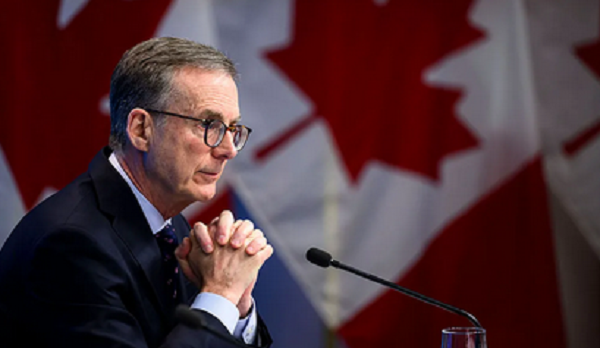
In a speech Wednesday morning, Bank of Canada governor Tiff Macklem said rates could go up, down or stay put, based on how the war in Iran goes and if U.S. President Donald Trump imposes more tariffs.
“If the United States imposes significant new trade restrictions on Canada, we may need to cut the policy rate further to support economic growth,” Macklem said. “If oil prices continue to increase, and particularly if they remain elevated, the risk that higher energy prices become ongoing generalized inflation increases. If this starts to happen, monetary policy will have more work to do — there may be a need for consecutive increases in the policy rate.”
Macklem also pointed to the looming renegotiation of the Canada-U.S.-Mexico agreement on trade as something else which could affect the direction of the economy.

In a press conference, Macklem admitted that there’s much more uncertainty than usual, making it harder for the bank to predict where the economy will go and when.
“It’s not regular economic uncertainty. They’re geopolitical events, so it’s hard to assess probability,” Macklem said. “There’s no set timeline here. It’s going to depend on conditions. It’s all going to depend on what we see.”
Deputy governor Carolyn Rogers said the war in Iran is the bigger immediate risk.
“In the near-term, it’s the war in the Middle East,” Rogers said. “Over the longer-term, the trade tensions are the bigger threat to the Canadian economy.”
It was the fourth straight meeting where the bank left rates unchanged. The overnight has been at 2.25 per cent since Oct. 29. The bank dropped rates four times in 2025 as it tried to boost the Canadian economy while it struggled with the impact of tariffs imposed by Trump.
The theory is that by making it cheaper to borrow money, consumers — and businesses — will spend more, giving the economy a boost, but also potentially pushing inflation higher. The opposite is also true: increasing interest rates makes it more expensive to borrow, cutting business and household spending, cooling inflation and slowing down the economy.
“So far, there is little evidence that higher oil prices have fed through to other goods and services prices more broadly. But it is early days and we will be watching this closely,” Macklem said.
Last week, Statistics Canada announced that the consumer price index, a broad-based measure of inflation, was 2.4 per cent higher in March compared to a year ago. Among the biggest drivers of increased inflation was a 21 per cent year-over-year increase in the price of gasoline.
Since the war in Iran began in late February with a joint U.S.-Israeli attack, the price of oil has shot up by more than 40 per cent. West Texas Intermediate has risen from $67.02 (U.S.) per barrel to $99.62, while Brent Crude has risen from $72.48 to $104.30.
The Bank also released its Monetary Policy Report, a quarterly look at the state of the Canadian and world economies, and where it expects them to go.
This article was first reported by The Star