





Canada Fast-Tracks Forced Labour Bill Amid U.S. Threats
The federal government said Thursday that it is introducing new legislation to stop the import of goods made with forced labour – the latest in a series of measures aimed at addressing U.S. concerns as Ottawa looks to strike a trade deal with Washington.
Last week, the Trump administration said it would impose tariffs on 60 countries, including Canada, for allegedly not doing enough to address forced labour in their supply chains. The move was widely seen as a bid to rebuild parts of the administration’s tariff wall that the U.S. Supreme Court struck down earlier this year.
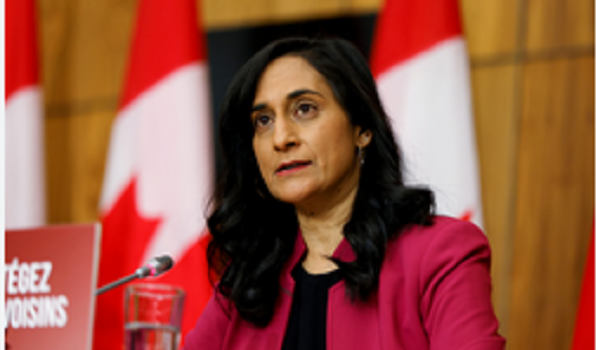
The proposed U.S. tariffs have a carve-out that means they won’t apply to products compliant with the United States-Mexico-Canada trade agreement, which covers most Canadian goods. But Ottawa’s quick response suggests an eagerness to demonstrate alignment with Washington. Foreign Affairs Minister Anita Anand announced Thursday the new forced labour legislation would be tabled in the coming days.
Read More On Our Daily Stock Market Reports – Geopolitical Relief Fuels Broad-Based Market Rally
It’s the second apparent move in recent weeks by Canada to soothe U.S. trade concerns.

Last week, The Globe and Mail reported that Ottawa was preparing to direct the federal broadcast and telecommunications regulator to scrap rules requiring foreign streaming services to help fund local news and niche broadcasters. This was a trade irritant for the U.S. because of the costs it imposes on American companies, such as Netflix and Amazon.
Prime Minister Mark Carney has said the Trump administration has a list of around 30 issues it wants Canada to address in order to reach some sort of resolution to the trade war.
Dominic LeBlanc, the minister responsible for Canada-U.S. trade, said on Thursday that he had spoken with his counterpart U.S. Trade Representative Jamieson Greer a number of times in recent weeks to discuss ways Canada could address U.S. complaints about various Canadian policies.
“We’re doing the important work of answering some of the long-standing concerns that the United States has publicly spoken about in terms of non-tariff barriers,” Mr. LeBlanc said at the U.S.-Canada Summit hosted by Royal Bank of Canada and the Eurasia Group in Toronto.
“I had a sense that ambassador Greer and his colleagues saw the progress that they have been looking for.”
Canada previously pledged to the U.S. that it would ban imports of products made with forced labour as part of negotiations that led to the USMCA, signed in 2018.
But the U.S. has complained that Canada is not doing enough to enforce its own rules – most recently in the 2026 National Trade Estimate Report on Foreign Trade Barriers, which is seen as the bible of U.S. trade concerns.
In late 2024, the former Trudeau government pledged to create an oversight agency to block foreign goods made with forced labour, measures it said would increase the onus on importers to demonstrate their shipments are free of coerced work. It did not follow through.

Mr. Carney, speaking to reporters Thursday at an unrelated announcement in Toronto, acknowledged Canada has had problems policing imports made with forced labour.
He said the new legislation is an effort to more effectively implement safeguards to stop goods made with coerced labour.
“We have a very strong legal framework and standards and responsibilities,” he said. But, the Prime Minister added, Canada has been “less effective in fully enforcing those, and some of that relates to how the responsibilities are structured legally, some of it relates to resources.”
Stephen Pike, a Toronto-based lawyer with Gowling WLG and co-leader of the firm’s environmental, social and governance advisory services practice, said it’s possible the new legislation could include mandatory human rights due diligence requirements, similar to laws already in force in France, Germany and Norway. These laws require big companies to identify, prevent and mitigate human-rights risks throughout their operations and supply chains. He said this could be quite onerous for companies, depending on how it’s structured.
Another possibility, Mr. Pike said, would a “rebuttable presumption” approach, similar to the U.S. Uyghur Forced Labor Prevention Act, under which goods from designated regions or entities would be presumed to be produced with forced or child labour unless importers can demonstrate otherwise.
Ottawa has made a number of concessions to Washington over the past year to try to move trade talks forward and get some relief for Canadian industries, such as automobiles, industrial metals and wood products, that are being hit by tariffs. This includes scrapping the digital services tax and removing most of the retaliatory tariffs Ottawa placed on U.S. products last year.
Ottawa has also tightened its own tariffs on steel and aluminum imports from overseas – partly to protect the Canadian industry and partly to address U.S. concerns about Chinese metals entering North American supply chains through Canada.
So far, these moves haven’t secured any tariff relief. But trade talks are once again heating up ahead of the six-year review of the USMCA, which is meant to take place on July 1.

The three countries have the option to renew the agreement for 16 years, although officials from all three countries have suggested this is unlikely. If they can’t agree to an extension, the agreement will remain in place but move into a period of annual reviews for 10 years. Any of the countries can also withdraw from the deal with six months notice.
Whatever happens to the USMCA itself, it’s becoming clear that any settlement of trade frictions will likely involve separate deals between Washington and Ottawa and Washington and Mexico City, Mr. LeBlanc told the Toronto audience.
“I would expect that we’ll have bilateral arrangements between Canada and the United States, between the United States and Mexico, sort of adjacent to the trilateral framework,” he said.
This echoes comments by Mr. Greer that the U.S. wants to maintain the “pillars” of the USMCA while layering separate bilateral deals with Canada and Mexico on top. In effect, the USMCA would remain the rulebook for trade, subject to annual reviews, but Mexico and Canada could strike separate arrangements with Washington, potentially trading bilateral concessions for relief from sectoral tariffs.
Mr. LeBlanc’s remarks on Thursday were the most clear he has been about the likely path forward for trade talks.
“If those [bilateral] agreements resolve issues that all three countries are trying to resolve, I’m hopeful that we might at that point have the extension [of the USMCA]. But if not, we’ll continue to do what’s necessary to preserve the trilateral framework,” Mr. LeBlanc said.
U.S. ambassador to Canada Pete Hoekstra and former U.S. Trade Representative Robert Lighthizer – who led the U.S. trade negotiating team during President Donald Trump’s first term in office – also spoke at the conference in Toronto. Both offered a fairly optimistic take on the Canada-U.S. relationship and the odds of arriving at some sort of trade deal.

Mr. Hoekstra sought to reframe Mr. Trump’s remarks a day earlier that the U.S. does not need anything from Canada and may not renew the USMCA.
“You maybe don’t like the way the President says it,” he said. “But what he’s saying is we’re open to offers. Make your case.”
Mr. Hoekstra said the Trump administration knows it needs things from international partners, even as it looks to reshore key industries and build up U.S. manufacturing. Canada, he said, can be the preferred partner across a range of industries if it can make the argument to Washington.
Mr. Lighthizer said he thought Ottawa and Washington would be able to reach some sort of trade deal, although it would not be a return to zero tariffs.
“Nobody here has a grandchild in whose lifetime America is going to be free trade, right? It’s not going to happen,” he said.
With a report from James Bradshaw
This article was first reported by The Globe and Mail