






Discerning Digital Copywriting: Practical Strategies for Detecting AI-Generated Property Descriptions
If you’ve been on the house hunt recently and wondered why a real estate ad had an unfamiliar tone, you may have been on to something. More than a third of rental and property ads in Canada are likely being written with artificial intelligence, a new report from an AI detection firm suggests.
The study, conducted by Originality.ai, looked at text from more than 15,000 rentals and 56,000 sales listings in the first two weeks of May, 2026.
Using its own AI tools, it detected that 37 per cent of listings likely used AI, while 30 per cent of listings were likely human. Thirty-three per cent were inconclusive because the ads fell under Originality.ai’s minimum requirement of 100 words.
Ads for a home for sale were more likely to be AI, with 41 per cent being marked as computer-written. Only 21 per cent of rental ads were flagged as having used AI.

The use of AI in real estate can be controversial. The technology has been used to dupe buyers with misleading photo edits, and realtors have been fined for this before.
But some realtors and experts say that AI, when used responsibly, can be an ideal tool for writing text descriptions.
“I haven’t worked in real estate, but I imagine the job is very social, very personable and interactive sales-based, and not so much a writing job,” said Michael Fraiman, one of the researchers who conducted the Originality.ai study.
“So it makes perfect sense and it’s a defensible use case for a realtor to turn to AI.”
Amanda Ku, a Calgary-based realtor, said using AI to complete listings saves her as much as 30 minutes in a process that usually takes between three to five hours.
AI also helps her understand the neighbourhood that a property is in, highlighting amenities such as schools, hospitals and trails.
“If AI can help me home down on that verbiage, it can really help me squeeze some time,” said Ms. Ku.
However, Mr. Fraiman doesn’t blame consumers who want to know when AI is used.
“I think it opens the door to dangers for the consumer. There are examples on Reddit of people who found listings that were straight-up incorrect where AI inserted hallucinations,” said Mr. Fraiman.
“The onus is on realtors to carefully read and edit what is being produced and check it against reality.”
The Globe analyzed Originality.ai‘s report to highlight the key things that show when AI is likely being used in housing listings, and the cities where its use is most prevalent. It’s worth noting that AI detection tools are evolving technologies and their results aren’t 100-per-cent accurate.
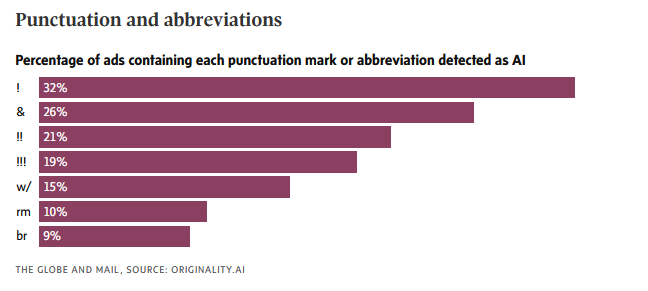
A giveaway that a real person wrote an ad is the use of informal abbreviations.
Terms such as “br” instead of “bedroom” had the biggest correlation with human-written ads. Only nine per cent of ads with that abbreviation were flagged as AI.
Ads with multiple exclamation marks in a row are also more likely to be written by a human. Only 19 per cent of ads with three exclamation marks in a row were detected as AI, whereas ads with one exclamation mark in a sentence were detected as artificial intelligence 32 per cent of the time.
“AI’s don’t write emotionally, they don’t use all caps. They write in a stoic professional manner,” said Mr. Fraiman.
Renee Sieber, an associate professor of geography at McGill University who is studying AI, compared the use of multiple exclamation marks to em-dashes. The former implies human writing, while the latter has become a classic giveaway of AI text.
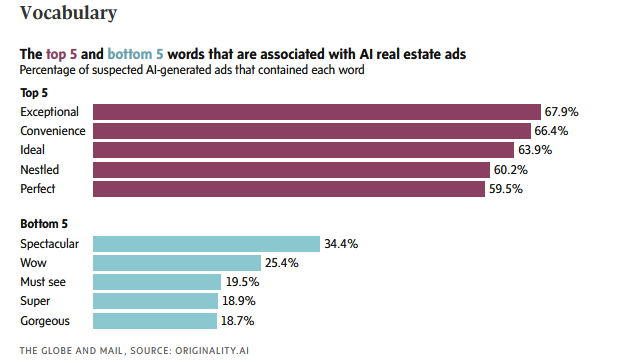
When it comes to the words used in listings, Mr. Fraiman said that superlatives usually indicate that a real estate ad is written by humans.
An AI-written listing, meanwhile, “skews more controlled, computer and distant,” Mr. Fraiman said.
Some words, including “exceptional” and “convenience,” are highly associated with being written by AI. Those two words were used in ads that were marked as computer-written two-thirds of the time, Originality.ai found.
Some words were less conclusive, such as “spacious” and “luxury.” Those two words were marked as AI in only half the ads they were used in.
Meanwhile, the words “must-see,” “super” and “gorgeous” were much more likely to appear in human ads. Those words only appeared in AI-flagged ads 19 per cent of the time.

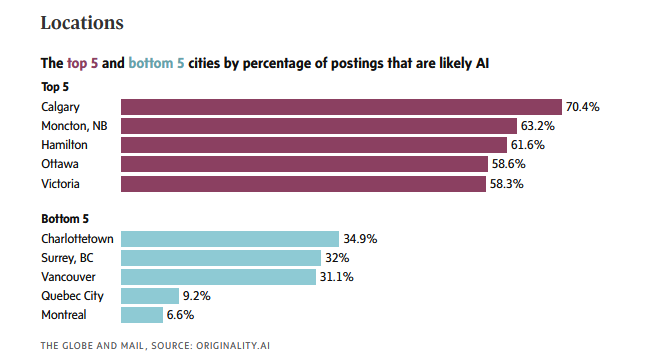
The detection of AI in real estate ads varied greatly from city to city.
Calgary had the highest proportion of AI ads, with 70 per cent of ads being flagged. Montreal had the least at just seven per cent. In English Canada, Vancouver had the lowest hit rate, with only 31 per cent of ads likely being AI-written.
While AI-detection tools can work in multiple languages, Prof. Sieber said they don’t always work as well and detection could be more difficult in Quebec.
Mr. Fraiman added that Quebec real estate descriptions were often exceptionally short compared to other parts of Canada and were under the 100 word threshold for accurate detection. That made it more difficult for Originality.ai to determine whether many of the ads from that province were human or AI.
This article was first reported by The Globe and Mail