







Dow Jones Hits Record High as AI Stocks Rebound on Growing Peace Deal Optimism
The Canadian Vanguard Stock Market Report Monday June 29, 2026 Edition
.
The Toronto Market
Monday’s Toronto Market Index
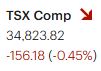
The S&P/TSX Composite Index declined 156.18 points, or 0.45%, to close at 34,823.82 on Monday. After opening modestly above the previous session’s close, the index quickly lost momentum and moved into negative territory within the first half hour of trading. Selling pressure persisted throughout most of the session, although buyers emerged late in the day, allowing the index to recover from its intraday low before the closing bell.
The TSX underperformed its major North American peers, finishing as the only major regional equity benchmark to post a loss. The relative weakness suggests a degree of sector-specific profit-taking, particularly in resource and financial stocks, which carry significant weight in the Canadian market. However, the absence of heavy selling into the close indicates that investor sentiment remains constructive rather than defensive.
From a technical standpoint, the broader trend continues to favor the bulls. The TSX remains above its 25-day, 50-day, and 200-day moving averages, confirming that the intermediate- and long-term uptrends remain intact despite Monday’s setback. The late-session rebound from the day’s lows also points to continued buying interest on market weakness, a characteristic often associated with healthy bull markets.
Year to date, the index has traded within a relatively well-defined range of approximately 32,000 to 35,000, supported by steady trading volumes and resilient investor participation. Monday’s decline appears more consistent with a normal consolidation phase following recent gains than the beginning of a broader trend reversal. Unless selling pressure accelerates and key technical support levels are breached, the prevailing outlook remains cautiously bullish, with the potential for the TSX to challenge recent highs in the coming sessions.

Monday’s TSX Market Statistics
Market breadth on the Toronto Stock Exchange remained constructive despite the decline in the S&P/TSX Composite Index. Advancing issues outnumbered declining issues by 1,413 to 785, producing an advancer-to-decliner ratio of 1.80 to 1, with 171 issues closing unchanged. The positive breadth indicates that buying interest remained broadly distributed across the market, even as weakness in several large-cap constituents weighed on the benchmark index.
Market internals also improved, with 148 stocks registering new 52-week highs compared with 26 new 52-week lows. This marked a notable improvement from Friday’s totals of 98 new highs and 44 new lows, suggesting that underlying momentum continues to strengthen despite the index’s modest pullback.
Trading activity increased modestly, with 466.4 million shares changing hands, up approximately 3.2% from 452.1 million shares traded on Friday. Volume continues to trend toward the 50-day average, indicating healthy investor participation without evidence of widespread distribution.
Monday also marked the third consecutive trading session of positive market breadth, reinforcing the view that the broader market remains stronger than the headline index performance suggests. Although the TSX traded in negative territory throughout the session, its maximum intraday decline was limited to approximately 0.62%, reflecting relatively orderly selling rather than broad-based liquidation.
From a technical perspective, the outlook remains favorable. The TSX continues to trade comfortably above its 25-day, 50-day, and 200-day moving averages, confirming that the intermediate- and long-term upward trends remain intact. Combined with improving market breadth, a growing number of new highs, and stable trading volume, the technical evidence continues to support a constructive outlook for Canadian equities. While short-term consolidation remains possible following recent gains, the market’s underlying strength suggests that investors continue to view pullbacks as buying opportunities rather than signals of a broader trend reversal.
Monday’s Toronto TSX Market Wrap-Up Report
The S&P/TSX Composite Index declined 156.18 points (-0.45%) to close at 34,823.82 on Monday. Although the benchmark index spent the entire session in negative territory, the underlying market was considerably stronger than the headline number suggested. The TSX was the only major North American equity index to finish lower, yet market internals continued to paint a constructive picture.
The index opened slightly above Friday’s close before slipping into negative territory during the first half hour of trading. Selling pressure persisted for much of the session, but buyers stepped in during the final 15 minutes, allowing the TSX to recover from its intraday low. The maximum decline during the day was a relatively modest 0.62%, suggesting that selling remained orderly rather than indicative of broad market liquidation.
Market breadth was one of the session’s most encouraging developments. Advancing issues outnumbered declining issues by 1,413 to 785, an advancer-to-decliner ratio of approximately 1.8 to 1, while 171 issues finished unchanged. In addition, the TSX recorded 148 new 52-week highs compared with only 26 new 52-week lows, a significant improvement over Friday’s figures. Trading volume rose modestly to 466.4 million shares, approximately 3% above Friday’s total, as activity continued to move closer to the 50-day average. Monday also marked the third consecutive session of positive market breadth, reinforcing the view that buying interest remains broadly distributed across the market.
Sector performance, however, was mixed. Only two of the ten major sectors finished the day higher. Healthcare led the market with a 0.71% gain, followed by Financials, which added 0.29%. Most economically sensitive sectors finished lower. Technology declined 1.30%, Basic Materials fell 0.76%, Utilities lost 0.66%, and Telecommunication Services dropped 1.53%. The Consumer Durables & Apparel sector was the weakest performer of the day.
The relatively weak performance of the Basic Materials sector warrants attention. Given its significant weighting within the Canadian equity market, sustained advances in the TSX have historically been more durable when Basic Materials ranks among the market’s stronger-performing sectors. Monday’s sector rotation suggests that the recent rally may pause until broader participation from commodity-related stocks resumes.
Among individual companies, the Financials sector continued to demonstrate resilience. Manulife Financial advanced 1.08% on trading volume of 7.68 million shares, while Royal Bank of Canada gained 1.00% on 3.13 million shares. Both stocks continue to attract attention from income-oriented investors because of their attractive dividend yields and defensive characteristics. Scotiabank currently offers the highest dividend yield among Canada’s Big Six banks, making the sector an area to monitor should market volatility increase.
Another notable performer was BlackBerry Ltd. (BB), which gained 9.9%, extending its impressive rally to a third consecutive trading session. The stock has attracted significant momentum buying, although investors should expect elevated volatility following such a rapid advance.
From a technical perspective, the broader outlook remains constructive. Despite Monday’s decline, the TSX continues to trade comfortably above its 25-day, 50-day, and 200-day moving averages, confirming that the intermediate- and long-term uptrend remains intact. Year to date, the index has traded within a relatively well-defined range of 32,000 to 35,000 and now sits just below the psychologically important 35,000 level. Provided market breadth remains positive and selling pressure does not broaden materially, another test of that resistance level appears increasingly likely in the near term.
Key Takeaways for Traders and Investors
- The headline decline overstated the market’s weakness. Strong positive breadth and a large number of new 52-week highs suggest that weakness was concentrated in a relatively small number of heavily weighted stocks rather than the broader market.
- The primary trend remains bullish. The TSX continues to trade above all major moving averages, while three consecutive sessions of positive breadth reinforce the strength of the underlying market.
- Watch the Basic Materials sector. A sustained breakout above 35,000 is more likely if mining and materials stocks begin to participate more broadly in the advance.
- Financial stocks remain leadership candidates. Continued strength in Canada’s major banks and insurers reflects investor confidence in high-quality dividend-paying companies and may provide support if market volatility increases.
- Momentum traders should continue monitoring BlackBerry. While the stock has generated exceptional short-term gains, elevated volatility and profit-taking risk are increasing after three consecutive strong advances.
Overall, Monday’s session appears to represent a healthy pause within an ongoing uptrend rather than the beginning of a broader correction. Unless market breadth deteriorates materially or key technical support levels are broken, the evidence continues to favor maintaining a constructive outlook for Canadian equities.
.
The US Markets
Monday’s U.S. Market Indexes
U.S. equities began the week on a strong note, with three of the four major benchmark indexes posting solid gains as investors rotated back into large-cap growth and technology stocks.
The Dow Jones Industrial Average gained 306.63 points (0.59%) to close at 52,182.74, extending its recent advance and recording another all-time closing high. The S&P 500 climbed 86.41 points (1.18%) to finish at 7,354.02, while the Nasdaq Composite led the market higher, surging 522.53 points (2.07%) to close at 25,820.14. In contrast, the Russell 2000 Index was virtually unchanged, edging up just 0.33 points (0.01%) to 3,010.42.
Monday’s market action suggested a notable shift in investor positioning. After outperforming for much of last week, small-cap stocks paused as capital rotated back into large-cap growth companies, particularly technology and artificial intelligence-related stocks, many of which had lagged during Friday’s session. The Nasdaq’s strong rebound reflected renewed investor appetite for higher-growth sectors and was responsible for much of the market’s overall strength.
From a technical perspective, the session produced several constructive developments. The Dow Jones Industrial Average continued to demonstrate exceptional relative strength by registering another record closing high, reinforcing the durability of its intermediate-term uptrend. More importantly for growth investors, the Nasdaq Composite reclaimed its 50-day moving average, an encouraging technical signal that could attract additional institutional buying. However, the Nasdaq still faces important resistance levels overhead, and one positive session alone is insufficient to confirm a sustained breakout. Follow-through buying over the coming days will be important in determining whether Monday’s rally marks the resumption of the broader uptrend or simply a short-term recovery.
Overall, Monday’s trading reflected improving investor sentiment and a renewed preference for market leadership in large-cap growth stocks. While the broad market remains in a constructive technical position, continued participation from both cyclical and growth sectors would strengthen the case for further gains in the weeks ahead.

Monday’s U.S. Market Statistics
New York Stock Exchange (NYSE): Market internals on the New York Stock Exchange were constructive, reinforcing the positive tone established by the major U.S. equity indexes. Advancing issues outnumbered declining issues by 2,759 to 1,789, producing an advancer-to-decliner ratio of 1.54 to 1, while 489 issues closed unchanged. The breadth figures indicate that Monday’s rally was broadly supported across the market rather than driven by only a handful of large-cap stocks.
The NYSE recorded 272 new 52-week highs and 114 new 52-week lows. Although the number of new highs declined from Friday’s 342, the sharp reduction in new lows—from 276 on Friday to 114 on Monday—suggests that downside momentum weakened considerably. This improvement in the new highs/new lows relationship is a constructive sign for overall market health.
NYSE trading volume totaled 5.94 billion shares, down approximately 40% from Friday’s elevated 9.76 billion shares. However, Monday’s activity was consistent with the exchange’s 50-day average trading volume, indicating that normal market participation resumed following Friday’s unusually heavy turnover. The exceptionally high volume on Friday likely reflected institutional sector rotation, as investors reduced exposure to technology and other recent market leaders while reallocating capital toward previously underperforming sectors.
NASDAQ: NASDAQ also reported strong market breadth, with 3,017 advancing issues and 1,919 declining issues, producing an advancer-to-decliner ratio of 1.57 to 1. An additional 364 issues finished unchanged. The positive breadth complemented the Nasdaq Composite’s 2.07% advance, indicating that the rally was broadly based across growth-oriented sectors rather than concentrated in only a few mega-cap technology companies.
The exchange recorded 276 new 52-week highs and 157 new 52-week lows, an improvement from Friday’s 324 new highs and 243 new lows. While fewer stocks reached new highs, the substantial decline in new lows points to improving market participation and strengthening investor confidence following last week’s sector rotation.
NASDAQ trading volume totaled 10.15 billion shares, approximately 43% below Friday’s exceptionally heavy volume of 17.74 billion shares. As with the NYSE, the decline in volume should not be interpreted as a sign of weakening conviction, since Friday’s turnover was unusually elevated by institutional portfolio rebalancing and sector rotation.
From a technical perspective, Monday’s session represented a meaningful improvement for the Nasdaq Composite. The index rebounded strongly to reclaim its 50-day moving average, an important technical level closely monitored by institutional investors and quantitative trading models. The Nasdaq finished just below its 25-day moving average, leaving additional work to be done before confirming that the recent correction has fully run its course. Nevertheless, recovering the 50-day moving average represents a positive shift in momentum and improves the technical outlook for growth stocks.
Key Takeaways for Traders and Investors
- Market breadth remained healthy on both exchanges, with advancing stocks outnumbering declining stocks by more than 1.5 to 1, confirming that Monday’s rally was broadly supported.
- The sharp reduction in new 52-week lows on both the NYSE and NASDAQ suggests that selling pressure has eased and overall market participation is improving.
- Lower trading volume should not be viewed negatively. Friday’s exceptionally high turnover was largely driven by institutional sector rotation, while Monday’s volume returned to levels more consistent with historical averages.
- The Nasdaq’s recovery of its 50-day moving average is technically significant. A sustained move above the 25-day moving average would provide further confirmation that leadership is returning to the technology and artificial intelligence sectors.
- Investors should continue monitoring leadership within large-cap technology stocks. If positive market breadth is accompanied by improving participation from growth stocks, the broader U.S. market could be positioned for another leg higher in the near term.
.
Monday’s U.S. Markets Wrap-Up Report
U.S. equities began the week with a broad-based advance as investors rotated back into large-cap growth and technology stocks following Friday’s bout of profit-taking. The Dow Jones Industrial Average gained 0.59% to close at another record high, while the S&P 500 advanced 1.18%. The Nasdaq Composite led the rally with a 2.07% gain as semiconductor, artificial intelligence (AI), and other growth-oriented stocks regained leadership. The Russell 2000 was essentially unchanged, rising just 0.01%, suggesting that investor preference shifted away from small-cap stocks and back toward large-cap market leaders.
Monday’s trading appeared to represent a reversal of Friday’s sector rotation rather than the beginning of a sustained move away from technology. Investors returned to many of the AI and semiconductor stocks that had underperformed during the previous session, reaffirming that growth remains the market’s primary leadership theme.
Market internals also confirmed the strength of the rally. On both the NYSE and NASDAQ, advancing issues outnumbered declining issues by more than 1.5 to 1, while the number of new 52-week lows declined sharply from Friday’s levels. Although trading volume fell significantly from Friday’s unusually elevated turnover, activity returned to levels more consistent with each exchange’s 50-day average, suggesting that Friday’s heavy volume was primarily driven by institutional sector rotation rather than broad-based selling.
Sector performance reflected the renewed appetite for growth. Technology was the strongest-performing sector, rising 2.27%, followed by Consumer Discretionary (+2.03%), Industrials (+1.53%), and Healthcare (+0.55%). Financials finished essentially unchanged, while more defensive and commodity-related sectors lagged. Energy declined 0.35%, Basic Materials fell 1.26%, and Communication Services was the weakest-performing sector, losing 2.73%.
Several individual companies attracted significant investor attention. Space Exploration Technologies Corp. (SPCX) gained 7.15% amid reports that it is expected to be added to the NASDAQ-100 Index. Inclusion in a major index often increases institutional ownership over time as index-tracking funds adjust their portfolios, although the timing and magnitude of any resulting price appreciation remain uncertain.
Rocket Lab (RKLB) surged approximately 16% after announcing an agreement to acquire satellite operator Iridium Communications (IRDM). Investors welcomed the strategic transaction as a move that could strengthen Rocket Lab’s position in the rapidly expanding space and satellite communications industry.
Tesla (TSLA) also posted a strong advance after announcing an updated version of its Full Self-Driving (FSD) software for older Tesla vehicles. The news renewed investor optimism regarding the company’s software strategy and its ability to monetize its expanding autonomous driving platform.
After the closing bell, AeroVironment (AVAV) jumped approximately 19% in after-hours trading after reporting quarterly earnings that exceeded analysts’ expectations on both revenue and earnings per share. Traders should monitor Tuesday’s opening session closely to determine whether the after-hours strength attracts additional institutional buying during regular trading hours.
From a technical perspective, Monday’s session strengthened the broader market outlook. The Dow Jones Industrial Average continued its leadership by recording another record closing high, while the Nasdaq Composite reclaimed its 50-day moving average, an important technical milestone. Although the Nasdaq remains just below its 25-day moving average, Monday’s strong recovery improves the probability that the recent pullback represented a healthy consolidation rather than the beginning of a deeper correction. Additional follow-through buying over the coming sessions would provide stronger confirmation that the primary uptrend remains firmly intact.
Key Takeaways for Traders and Investors
- Large-cap growth stocks regained market leadership. Monday’s rally suggests that Friday’s weakness in AI and semiconductor stocks was more likely a short-term profit-taking event than the beginning of a sustained sector rotation.
- Market breadth confirmed the advance. Positive advancer-to-decliner ratios on both the NYSE and NASDAQ, together with a sharp reduction in new 52-week lows, indicate improving participation beneath the surface of the market.
- The Nasdaq delivered an important technical improvement. Reclaiming the 50-day moving average is an encouraging signal for growth investors, although a move above the 25-day moving average would further strengthen the technical outlook.
- Institutional capital continues to favor technology and AI. Monday’s leadership in the Technology and Consumer Discretionary sectors suggests that investors remain willing to accumulate companies with strong earnings growth and innovation-driven business models.
- Watch Tuesday’s follow-through. Sustained buying in technology, semiconductors, and AI-related stocks, together with continued positive market breadth, would increase confidence that the broader market is preparing for another leg higher.
Overall, Monday’s session reinforced the constructive outlook for U.S. equities. Strong market breadth, renewed leadership from growth stocks, and improving technical conditions suggest that the recent pullback has, for now, evolved into a healthy consolidation within an ongoing bull market rather than the start of a more significant correction.
.
NOTICE TO READERS
The Canadian Vanguard Stock Market is about empowering you to build and manage your wealth by yourself. There is certainly no magic in managing finances or wealth but one needs to know what to do and commit to doing what is needed. When you are ready to start the journey to Take Charge and Put Your Destiny In Your Own Hands, read The Canadian Vanguard every market day. If you need more related information, Contact Us
Our readers are strongly advised to conduct their own research into individual stocks before making a purchase decision. In addition, investors are advised that past stock performance is no guarantee of future price appreciation. Any recommendation is not a guarantee of any particular stock’s future prices, and The Canadian Vanguard accepts no responsibility or liability for investors’ or readers’ purchases.
Stocks In The News/ Stocks To Watch and Market Strategy will soon be available only to Paying Subscribers. The dollar sign “$” in the Toronto Market section in the articles only stands for Canadian dollar and in the US market section “$” stands for US dollar.
(c) This article is published by The Canadian Vanguard on June 29, 2026