





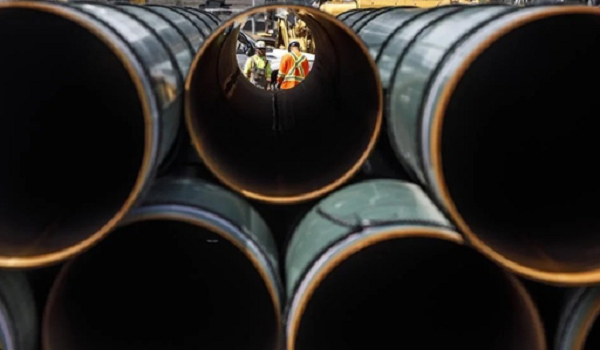
Trump Pledges Keystone XL Return While Similar Pipeline Progresses in Canada
The Keystone XL pipeline, a Canada-U.S. oil conduit derailed by two successive American presidents, may be making a comeback amid fraught trade negotiations with the U.S.
On Tuesday night, U.S. President Donald Trump wrote on Truth Social that the Keystone XL pipeline, an abandoned pipeline project that was to run from Alberta’s oilsands to Texas refineries through Steele City, “may be awoken from the grave.”
In the same post, he claimed that Canada and the U.S. have a deal and the new 50 per cent tariffs on roughly $28 billion in goods will be paused for three days as talks continue to finalize.

Is Trump reviving Keystone XL or something else?
At least one expert believes that Trump’s post may be referring to a pipeline project that is already in development: the Prairie Connector–Bridger pipeline, a new line that would follow a similar route and serve a similar purpose to what was envisioned for Keystone XL.
“The possibility that there’s another pipeline in addition to Prairie Connector and Bridger doesn’t make sense,” said Andrew Leach, an energy and environmental economist and professor at Alberta School of Business at the University of Alberta.
“If anything, I would interpret President Trump’s post as saying … we are getting the pipeline that President Biden cancelled,” said Leach.
In April, Trump granted a U.S. permit to Bridger Pipeline LLC to build a pipeline from Montana south to Guernsey, Wyoming.
The pipeline would connect with the Prairie Connector, stretching from Alberta to the border, a project proposed by South Bow Corp. that would use about 150 kilometres of pipe already in the ground on the Canadian side and originally intended for Keystone XL.
The XL pipeline was first proposed in 2008 by TC Energy Corp. as an extension of the existing sprawling Keystone system, creating a more direct route from Hardisty, Alberta, to Steele City, Nebraska, where it would connect with existing pipelines carrying Canadian crude to the U.S. Gulf Coast.
The project became a political football in the U.S., repeatedly derailed by presidential decisions as Barack Obama twice rejected it, Trump revived it during his first term, and Joe Biden pulled the plug again on his first day in office in 2021.
“So the idea that Canada has offered up something with respect to Keystone XL, I think it’s more likely that Canada has reminded the U.S. president of the fact that it’s not Canada that’s blocking energy exports into the U.S,” Leach said.
The Prairie Connector–Bridger pipeline could effectively fill the role once envisioned for Keystone XL, connecting Canada, a key source of heavy sour crude, with the Gulf Coast, the world’s largest heavy sour crude-consuming region, said Kevin Birn, chief analyst for Canadian oil markets at S&P Global.

“The industry had already been moving on the revival of that concept,” Birn said.
For Canadian producers, he said, the route could be economically attractive because of the shorter and more direct access to markets.
Does Canada need another U.S. pipeline?
But Birn said the project raises broader strategic questions for Canada, which remains heavily reliant on the U.S. as a market for its crude as calls grow to diversify its exports and reach new international buyers amid deteriorating Canada-U.S. relations.
The Atlantic Basin is already relatively well supplied and generally better suited to lighter grades of crude, whereas the Pacific Basin is viewed as a growth market with greater demand for heavy sour crude, he said.
Kate Koplovich, a senior policy analyst for energy at the C.D. Howe Institute, said she is curious to see how a revival of the XL pipeline would fit into the trade deal and who the private proponent would be, if there is one, or whether the project would receive government backing.
“I would be curious as to the inclusion of this pipeline as a part of that deal when Prime Minister Carney’s kind of ethos to date has been trade diversification away from the United States,” Koplovich said.
This article was first reported by The Star