







U.S. Market Indexes Rebound as Bond Yields Fall After Treasury Announces Larger Debt Purchases
The Canadian Vanguard Stock Market Report Wednesday August 19, 2026 Edition
.
The Toronto Market
Wednesday Toronto Market Index
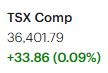
The S&P/TSX Composite Index rose 33.86 points, or 0.09%, to close at 36,401.79.
The Toronto market, in line with the broader North American markets, reversed course today and closed modestly higher with a bullish bias. Although the TSX’s 0.09% gain was relatively small, it ended a three-session losing streak.
TSX market internals remained relatively strong, but geopolitical conflicts outside North America had contributed to increased volatility despite underlying market strength. Today’s reversal, combined with the U.S. Treasury’s announcement that it plans to double its debt purchases, could help limit the risk of sharp declines in the short term.
Technically, the index remains well above its 25-day, 50-day, and 200-day moving averages, even after three consecutive sessions of declines. This continued separation from the major moving averages suggests that the broader uptrend remains intact, despite the recent short-term weakness.

Wednesday’s TSX Market Statistics
At the TSX, advancing issues (advancers) outnumbered declining issues (decliners) by a comfortable margin. There were 1,239 advancers and 981 decliners, producing an advancer-to-decliner ratio of 1.26 to 1—approximately six advancers for every five decliners. Another 134 issues were unchanged.
Market breadth turned decisively positive today. The TSX recorded 116 new 52-week highs and only 13 new 52-week lows, compared with 55 new 52-week highs and 58 new 52-week lows yesterday. The nearly 9-to-1 ratio of new 52-week highs to new 52-week lows represents a significant improvement and provides a strongly bullish signal.
The number of new 52-week highs more than doubled, while the number of new 52-week lows fell sharply. This reversal in market internals is particularly encouraging because it indicates that the underlying strength of the market broadened considerably today, rather than being concentrated in only a few stocks.
However, investors should remain mindful that the market continues to be influenced significantly by geopolitical developments in the Middle East. Such conflicts can create sudden increases in volatility and can quickly change investor sentiment. While today’s internals were decidedly bullish, investors should remain prepared to adjust positions if market conditions suddenly reverse.
Trading volume also provided additional support for today’s positive session. Total TSX volume reached 483,906,185 shares, approximately 35% higher than the 356,449,370 shares traded yesterday. The combination of positive market breadth, a sharp improvement in new 52-week highs versus lows, and significantly higher trading volume strengthens the case that today’s advance was supported by broad underlying participation.
Overall, Wednesday’s TSX market internals were strongly bullish, marking a significant improvement from yesterday and providing encouraging evidence that the recent short-term weakness may be losing momentum.
.
Wednesday’s Toronto TSX Market Wrap-Up Report
Wednesday was an all-round positive session for the Toronto market, with the S&P/TSX Composite Index rising 33.86 points, or 0.09%, to close at 36,401.79. More importantly, the market’s underlying internals improved substantially, suggesting that today’s modest index gain was supported by broad participation and a significant recovery in market breadth.
Precious Metals and Miners Lead the Market: Gold and silver mining stocks delivered some of the strongest gains of the session. Of the top 25 performers on the TSX, the top 12 were gold and silver mining companies, with each gaining at least 10%.
Agnico Eagle Mines Ltd. (AEM) was among the leaders, advancing 10.52% to close at $286.84, with approximately 1.3 million shares traded.
The strength in precious-metal miners was reflected at the sector level. Basic Materials surged 6.15%, making it by far the strongest-performing major sector of the day. The miners clearly dominated trading and were a major source of the market’s positive tone.
Other sectors also finished higher. Durable Consumer Goods & Services gained 1.20%, Healthcare rose 0.97%, Discretionary Consumer Goods & Services advanced 0.59%, and Technology increased 0.30%.
The gains were partially offset by weakness in several major sectors. Utilities declined 0.76%, Energy fell 1.31%, and Financials dropped 2.41%.
Canadian Banks Remain a Major Concern: The continued weakness in the financial sector deserves particular attention. All six major Canadian banks declined for the third consecutive trading session.
Bank of Montreal (BMO) fell 4.42% to $242.62. Canadian Imperial Bank of Commerce (CM) declined 3.69% to $162.93, while Toronto-Dominion Bank (TD) dropped 3.52% to $163.64. Bank of Nova Scotia (BNS) fell 3.30% to $121.21, Royal Bank of Canada (RY) declined 3.15% to $286.92, and National Bank of Canada (NA) was down 1.77% to $222.05.
The simultaneous decline of all six major banks for three consecutive sessions warrants close monitoring. Canada’s major banks are among the most important components of the Canadian financial system and are closely tied to credit conditions, consumer activity, business investment and the broader economy.
For traders, the key issue is whether this weakness represents a short-term sector rotation away from financials and toward commodities, or whether it signals a broader deterioration in market sentiment. Further weakness in the banks could become increasingly important for the overall TSX trend.
Market Internals Turn Decisively Bullish
The strongest feature of today’s session was the improvement in market breadth.
There were 1,239 advancing issues versus 981 declining issues, producing an advancer-to-decliner ratio of 1.26 to 1—roughly six advancing stocks for every five declining stocks. Another 134 issues were unchanged.
Even more encouraging was the dramatic improvement in new 52-week highs and lows. The TSX recorded 116 new 52-week highs and only 13 new 52-week lows, compared with 55 new highs and 58 new lows yesterday.
That produces a new-high-to-new-low ratio of approximately 9 to 1, a sharp reversal from yesterday’s market condition. The number of new highs more than doubled while new lows fell dramatically.
This is a significant bullish development because it indicates that today’s improvement was not simply the result of a handful of large-cap stocks pushing the index higher. The underlying participation broadened considerably.
Trading Volume Adds Confirmation: Trading volume also supported the positive character of today’s session. Total TSX volume reached 483.9 million shares, approximately 35% higher than yesterday’s 356.4 million shares.
A rising market accompanied by stronger volume and substantially improved breadth generally provides a more convincing signal than a market advance occurring on weak participation. Today’s combination of positive breadth, a surge in new 52-week highs, a collapse in new lows, and higher trading volume therefore deserves attention.
Technical Picture Remains Constructive
Despite three consecutive sessions of declines before today, the TSX Composite remains well above its 25-day, 50-day and 200-day moving averages.
Today’s reversal ended the three-session decline and restored a modest bullish tone. The index itself gained only 0.09%, but the much stronger market internals suggest that the underlying market was considerably more positive than the headline index gain might indicate.
For traders, this distinction is important: the index was only modestly higher, but participation underneath the index was strongly bullish.
Geopolitical Risk Remains a Wild Card
The market continues to be influenced significantly by geopolitical developments in the Middle East. Such developments can quickly alter investor sentiment, increase volatility and cause sharp rotations between sectors.
The strong performance of precious-metal miners is particularly notable in this environment, as investors may be seeking exposure to commodities and perceived safe-haven assets while geopolitical uncertainty remains elevated.
Consequently, today’s bullish market internals should be viewed positively, but traders should not assume that the recent volatility is over.
Key Takeaways for Traders and Investors
1. Today’s internals were strongly bullish.
The 1.26-to-1 advancer-to-decliner ratio, 116 new highs versus only 13 new lows, and approximately 35% increase in volume all point to substantially stronger underlying market participation.
2. Precious metals and mining stocks were the clear leaders.
The concentration of major gainers among gold and silver miners, combined with a 6.15% gain in Basic Materials, makes this the sector to watch closely.
3. Financials remain the major weak spot.
All six major Canadian banks declined for a third consecutive session. Traders should monitor whether this weakness continues or begins to reverse.
4. The TSX’s broader technical trend remains constructive.
The index remains comfortably above its 25-day, 50-day and 200-day moving averages, despite the recent three-session pullback.
5. Today’s market reversal deserves more attention than the 0.09% index gain suggests.
The headline TSX gain was small, but the breadth, new-high/new-low statistics and volume were considerably more encouraging.
6. Stay alert to sudden reversals.
Geopolitical developments remain capable of producing sharp changes in market direction. Traders should maintain disciplined position sizing, manage risk and be prepared to adjust positions if market conditions deteriorate.
Bottom line: Wednesday’s session produced a modestly higher TSX but a strongly improved underlying market. The surge in new 52-week highs, sharp decline in new lows, higher volume and strength in commodity-related stocks provide encouraging evidence that the market’s recent weakness may be losing momentum. However, continued weakness in the major banks and elevated geopolitical risk remain important warning signals. For now, the evidence from market internals has shifted back toward the bullish camp, but confirmation over the next several sessions will be important.
.
The US Markets
Wednesday’s US Market Indexes
All four major U.S. equity indexes closed higher on Wednesday, ending the recent stretch of declining sessions and restoring a modestly bullish tone to the market. However, the gains were relatively small, suggesting that investors remain cautious amid continuing geopolitical tensions in the Middle East.
The Dow Jones Industrial Average rose 119.65 points, or 0.22%, to close at 53,463.05. The S&P 500 gained 16.22 points, or 0.21%, finishing at 7,707.98. The Nasdaq Composite advanced 41.38 points, or 0.16%, to 26,331.09.
The Russell 2000 was the strongest performer, gaining 15.05 points, or 0.50%, to close at 3,032.94.

.
Nasdaq Reverses Three-Session Decline
The Nasdaq Composite reversed its recent underperformance and ended a three-session losing streak. Although the index finished higher, the relatively modest 0.16% gain suggests that the bullish reversal lacked strong conviction.
Today’s performance should therefore be viewed as an encouraging reversal rather than confirmation that the recent market weakness has completely ended. Investors should watch the next several sessions closely to determine whether today’s gains develop into a sustained recovery or prove to be only a temporary bounce.
Small-Caps Lead the Reversal: Small-cap stocks were the strongest performers among the major U.S. indexes. The Russell 2000 gained 0.50%, substantially outperforming the Dow, S&P 500 and Nasdaq.
The Russell 2000 has now advanced in six of the last seven trading sessions, demonstrating considerable relative strength. Continued strength in small-caps could be an encouraging sign for broader market participation because smaller companies are generally more sensitive to domestic economic and financial conditions.
Technical Picture Remains Constructive: Despite the recent volatility, the Nasdaq, S&P 500 and Russell 2000 remain well above their 25-day, 50-day and 200-day moving averages. This is an important technical consideration for traders because it indicates that the broader upward trend remains intact despite the recent short-term pullback.
Today’s recovery therefore occurred within a generally constructive longer-term technical environment.
Geopolitical Risk Remains a Major Factor: The U.S. markets continue to be influenced significantly by geopolitical tensions in the Middle East. These developments have the potential to produce sudden changes in investor sentiment, commodity prices and market volatility.
Today’s across-the-board gains are positive, but the relatively modest advances indicate that investors remain cautious. The markets are not completely out of the woods yet, and another reversal toward the downside remains possible if geopolitical conditions deteriorate or investor sentiment weakens.
Key Takeaways for Traders and Investors
1. All major indexes reversed higher.
The Dow, S&P 500, Nasdaq and Russell 2000 all finished in positive territory, ending the recent period of market weakness.
2. Small-caps were the strongest performers.
The Russell 2000 gained 0.50% and has advanced in six of the last seven sessions, making small-cap strength an important trend to monitor.
3. Nasdaq’s three-session decline has ended.
The reversal is encouraging, but the 0.16% gain was relatively modest and does not yet provide strong confirmation of a sustained bullish move.
4. The longer-term technical trend remains positive.
The Nasdaq, S&P 500 and Russell 2000 remain above their 25-day, 50-day and 200-day moving averages.
5. Traders should remain cautious.
Today’s reversal is bullish, but geopolitical risk remains a significant source of potential volatility. The market could reverse again if conditions change.
Bottom line: Wednesday’s U.S. market session was modestly bullish, with all four major indexes closing higher and small-caps leading the advance. The technical picture remains constructive, but the relatively small gains suggest that investors have not yet regained full confidence. Traders should watch whether the indexes can build on today’s reversal over the next few sessions before treating it as confirmation of a more durable bullish move.
.
Wednesday’s U.S. Market Statistics
Wednesday’s market statistics showed a decisive improvement in U.S. market internals, with both the New York Stock Exchange (NYSE) and Nasdaq returning to positive breadth. The improvement was particularly notable in the new 52-week highs and lows, while higher trading volume provided additional confirmation that today’s market reversal had broad participation.
However, one session of improved internals is not sufficient by itself to establish a new market trend. Traders should look for confirmation over the next several sessions.
New York Stock Exchange (NYSE): At the NYSE, 2,983 issues advanced while 1,568 declined, with 484 issues unchanged. This produced an advancer-to-decliner ratio of 1.90 to 1, or approximately two advancers for every decliner.
This represents a clear return to positive market breadth and a substantial improvement from the previous session.
The new 52-week high/low statistics were even more encouraging. The NYSE recorded 263 new 52-week highs and 93 new 52-week lows, compared with 169 new highs and 252 new lows yesterday.
The number of new highs increased by approximately 56%, while the number of new lows declined by approximately 63%. Consequently, the new-high-to-new-low ratio improved dramatically to approximately 2.8 to 1, or nearly three new highs for every new low.
This is a significant reversal in market internals. Yesterday’s statistics reflected considerably more defensive market conditions, while today’s figures returned to a decidedly bullish configuration.
Trading volume provided additional support. Total NYSE volume reached 5.27 billion shares, approximately 14% higher than yesterday’s 4.59 billion shares. The combination of higher prices, positive breadth and increased trading volume is generally more constructive than a market advance occurring on declining participation.
Overall, the NYSE internals were bullish with conviction today, although traders should avoid concluding that the broader market trend has permanently changed based on a single session.
Nasdaq Market: The Nasdaq also experienced a strong improvement in market breadth. There were 2,912 advancing issues and 2,022 declining issues, with 415 issues unchanged. This produced an advancer-to-decliner ratio of 1.68 to 1, meaning there were approximately five decliners for every eight advancers.
This represents a clear return to positive breadth following the weakness of the previous sessions.
The new 52-week high/low statistics also improved substantially. The Nasdaq recorded 206 new 52-week highs and 128 new 52-week lows, compared with 118 new highs and 168 new lows yesterday.
New highs increased by approximately 75%, while new lows declined by approximately 24%. The resulting new-high-to-new-low ratio was approximately 1.6 to 1, or roughly eight new highs for every five new lows.
The significance is not simply the ratio itself but the direction of the change. The bearish pattern visible during the previous sessions ended abruptly today. New highs returned to a more normal range, new lows declined, and overall breadth strengthened.
The Nasdaq’s trading volume also increased. Total volume reached approximately 8.53 billion shares, about 13% higher than yesterday’s 7.57 billion shares.
The combination of a higher Nasdaq index, positive breadth, improved new-high/new-low statistics and higher volume provides additional evidence that today’s reversal had meaningful participation.
Market Internals Reverse to Bullish
The most important message from Wednesday’s statistics is the broad reversal in market internals.
On both exchanges, advancing issues outnumbered declining issues, new highs increased and new lows declined. Trading volume also increased as the major indexes moved higher.
The NYSE showed the stronger improvement, with its new-high-to-new-low ratio approaching 3 to 1. The Nasdaq also returned to positive territory, with new highs again exceeding new lows.
This is a meaningful change from the bearish characteristics seen during the previous sessions.
Nevertheless, one day’s statistics are not enough to establish a confirmed change in the market’s intermediate-term trend. Traders should look for continued positive breadth, sustained new-high leadership and healthy trading volume over the next several sessions.
.
Key Takeaways for Traders and Investors
1. Market breadth turned decisively positive.
Both the NYSE and Nasdaq had substantially more advancing than declining issues.
2. The NYSE delivered particularly strong internal signals.
The exchange produced nearly three new 52-week highs for every new 52-week low, a significant improvement from yesterday’s bearish configuration.
3. Nasdaq internals also reversed sharply.
New highs increased from 118 to 206 while new lows fell from 168 to 128. The previous bearish pattern was interrupted.
4. Volume confirmed today’s positive session.
NYSE volume increased approximately 14%, while Nasdaq volume rose approximately 13%. Higher volume accompanying higher indexes and improving breadth is a constructive signal.
5. Today’s reversal had conviction—but still requires confirmation.
The improvement in market internals was broad enough to be taken seriously, but traders should avoid treating one day’s statistics as proof that a new sustained bullish trend has begun.
6. Watch the next several sessions carefully.
If advancing issues continue to dominate, new highs remain above new lows, and volume stays healthy, today’s reversal would gain considerably more credibility.
Bottom Line: Wednesday’s U.S. market statistics showed a clear and convincing improvement in market internals. The NYSE and Nasdaq both returned to positive breadth, new 52-week highs increased significantly, new lows declined, and trading volume increased as the major indexes moved higher.
The evidence therefore shifted from bearish toward bullish today. The key question for traders is whether Wednesday’s reversal represents the beginning of a sustained improvement or simply a temporary rebound within a volatile market. Confirmation over the next several trading sessions will be critical.
.
Wednesday U.S. Market Wrap-Up Report
Wednesday brought a broad but modest recovery to U.S. equity markets, with all four major indexes closing higher and market internals turning decisively more bullish. The reversal came after several sessions of weakness that had been driven in part by rising Treasury yields and concerns about geopolitical tensions.
The Dow Jones Industrial Average gained 119.65 points, or 0.22%, to close at 53,463.05. The S&P 500 rose 16.22 points, or 0.21%, to 7,707.98, while the Nasdaq Composite advanced 41.38 points, or 0.16%, to 26,331.09. The Russell 2000 was the strongest performer, gaining 0.50% to close at 3,032.94.
The gains were relatively small, but the underlying market statistics were considerably more encouraging than the headline index numbers suggest.
Treasury Buyback Announcement Helps Reverse Market Sentiment
One of the most important developments Wednesday was the U.S. Treasury Department’s announcement that it would at least double the size of its liquidity-support buyback operations for longer-dated Treasury securities. The maximum size of individual operations for 10- to 30-year securities is being increased from $2 billion to at least $4 billion, beginning September 9.
The announcement came after a sharp rise in long-term Treasury yields had contributed to pressure on stocks. The 30-year Treasury yield had reached approximately 5.34%, its highest level since 2007, before falling following the Treasury announcement.
Lower bond yields can provide some relief for equity investors because rising yields increase financing costs and can make bonds more attractive relative to stocks, particularly higher-valued growth and technology companies.
However, traders should not assume that the Treasury action has eliminated the underlying bond-market problem. The buyback program is primarily designed to support liquidity, and analysts have cautioned that it does not resolve the larger fiscal, inflation and global bond-market pressures that have contributed to elevated yields.
Therefore, Treasury yields remain an important market indicator to watch.
Market Internals Return to Bullish Territory
The strongest feature of Wednesday’s session was the dramatic improvement in market internals.
At the NYSE, advancing issues outnumbered declining issues by 2,983 to 1,568, producing an advancer-to-decliner ratio of 1.90 to 1. The exchange also recorded 263 new 52-week highs versus only 93 new lows, compared with 169 highs and 252 lows yesterday.
That represents a major improvement. New highs increased by roughly 56%, while new lows declined by approximately 63%. The resulting new-high-to-new-low ratio was close to 3 to 1, a strongly bullish configuration.
The Nasdaq also returned to positive breadth, with 2,912 advancing issues versus 2,022 declining issues, producing a ratio of 1.68 to 1. Nasdaq new 52-week highs increased from 118 to 206, while new lows declined from 168 to 128.
Trading volume provided additional confirmation. NYSE volume increased approximately 14% to 5.27 billion shares, while Nasdaq volume rose approximately 13% to 8.53 billion shares.
The combination of higher indexes, positive breadth, more new highs, fewer new lows and increased volume represents a meaningful improvement from the previous sessions.
One day does not establish a new market trend, but Wednesday’s internals were bullish with considerably more conviction than the modest index gains alone would suggest.
Small-Caps Show Relative Strength
The Russell 2000 was Wednesday’s best-performing major index, rising 0.50%. More importantly, the small-cap index has now advanced in six of the last seven trading sessions. Continued strength in small-caps would be encouraging because it suggests that market participation is extending beyond the largest U.S. companies.
The Russell 2000 also remains well above its 25-day, 50-day and 200-day moving averages, keeping its broader technical structure constructive.
Technology Remains Under Pressure
Despite the overall improvement in market breadth, technology did not participate as strongly as some other areas of the market.
The Technology sector declined 0.40%, while semiconductors and optoelectronic stocks experienced particularly sharp weakness. Sandisk Corp. (SNDK), for example, fell 3.50% to close at $1,568.87.
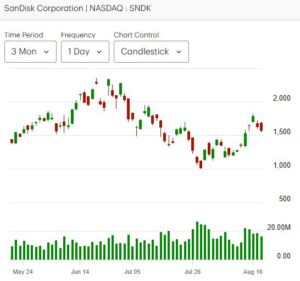
This remains an area worth monitoring. The recent weakness in technology and semiconductor stocks has occurred alongside elevated bond yields, making the relationship between Treasury yields and high-growth stocks particularly important for traders.
If long-term yields continue to decline, technology and growth stocks could receive additional support. Conversely, another sharp rise in yields could renew pressure on these sectors.
Sector Performance Was Mixed
Five major sectors gained during Wednesday’s session.
Healthcare was the strongest-performing sector, rising 3.38%. Durable Consumer Goods & Services gained 1.93%, while Discretionary Consumer Goods & Services advanced 0.82%.
Several sectors remained under pressure. Basic Materials declined 3.09%, Energy fell 0.20%, Utilities declined 0.22%, Technology lost 0.40%, and Financials fell 0.84%. Industrials was the weakest major sector, declining 1.19%.
Financials have been among the weaker areas of the market this week and remain worth monitoring for signs of either stabilization or continued deterioration.
Moderna Becomes the Stock Story of the Day
The standout individual stock story was Moderna Inc. (MRNA). Moderna announced that its personalized mRNA cancer vaccine, developed with Merck and administered in combination with Keytruda, met its primary goal in a Phase 3 trial involving patients with high-risk melanoma. The companies said the trial demonstrated statistically significant benefits, marking a potentially important development for Moderna’s cancer-treatment pipeline.
The market reaction was extraordinary. Moderna closed Tuesday at $62.96, opened Wednesday at $116.02, traded as low as $114.46, and ultimately closed at $174.38—a gain of approximately 177% in a single session. Moves of this magnitude are extremely unusual for a large, established company and demonstrate how rapidly biotechnology stocks can reprice when major clinical-trial results change the investment thesis.
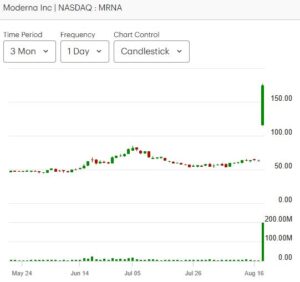
For traders, Moderna belongs on the watchlist, but Wednesday’s enormous price increase also makes risk management especially important. A stock that rises more than 170% in one session can experience extreme volatility in both directions as traders reassess its valuation, future earnings potential and the probability of regulatory and commercial success.
The Phase 3 result is significant, but investors should distinguish between a highly promising clinical result and the eventual regulatory, commercial and financial outcome.
Geopolitical Risk Remains a Major Wild Card
The market continues to be influenced by geopolitical tensions in the Middle East, and progress toward resolving the U.S.-Iran conflict remained stalled Wednesday. Oil prices also remained elevated, adding another source of uncertainty for investors.
This means the market is still vulnerable to sudden changes in sentiment.
Wednesday’s bullish reversal should therefore be welcomed, but traders should not assume that volatility has disappeared. A renewed geopolitical escalation could quickly push Treasury yields, oil prices and equity markets in the opposite direction.
Technical Picture Remains Constructive
The Nasdaq, S&P 500 and Russell 2000 remain well above their 25-day, 50-day and 200-day moving averages.
That is an important technical consideration. Despite the recent short-term weakness, the broader trend remains constructive.
Wednesday’s session also ended the Nasdaq’s three-session decline, while the Russell 2000 continued its recent relative strength.
The key question now is whether the market can build on Wednesday’s reversal. Continued positive breadth, sustained new-high leadership and healthy volume would provide stronger confirmation that the recent pullback has run its course.
Key Takeaways for Traders and Investors
1. Wednesday’s market reversal was more significant beneath the surface than the index gains suggest.
The major indexes rose only modestly, but market breadth, new-high/new-low statistics and trading volume all improved substantially.
2. Market internals turned decisively bullish.
NYSE breadth was 1.90-to-1, while Nasdaq breadth was 1.68-to-1. The NYSE produced almost three new highs for every new low.
3. Higher volume adds credibility to the reversal.
NYSE volume increased about 14% and Nasdaq volume approximately 13% while the indexes advanced.
4. Treasury yields remain critical.
The Treasury’s expanded buyback program helped push long-term yields lower and supported stocks, but it does not eliminate the underlying fiscal, inflation and global bond-market risks.
5. Small-caps remain an important source of strength.
The Russell 2000 gained 0.50% and has advanced in six of the last seven sessions.
6. Technology remains a vulnerability.
Technology and semiconductor stocks continued to struggle. Traders should watch Treasury yields closely for clues about whether growth stocks can regain leadership.
7. Moderna demonstrates the potential—and risk—of biotechnology catalysts.
MRNA’s approximately 177% surge shows how powerful a successful Phase 3 result can be, but such extreme moves also create substantial short-term volatility and valuation risk.
8. Do not assume the market is completely out of the woods.
Wednesday’s statistics were bullish, but one session does not establish a lasting trend. Geopolitical developments and bond yields can still produce a rapid market reversal.
Bottom Line
Wednesday was a constructive reversal for U.S. stocks. The headline gains were modest, but the improvement in market internals was substantial. Positive breadth, a sharp improvement in new 52-week highs versus lows, higher trading volume and continued small-cap strength all suggest that buyers returned with meaningful participation.
The Treasury’s decision to expand long-term debt buybacks provided an additional catalyst by helping ease pressure in the bond market, but traders should continue to monitor Treasury yields closely.
For now, the evidence has shifted back toward the bullish side, but confirmation is still needed. The next several trading sessions will be important: if positive breadth and new-high leadership persist while Treasury yields remain contained, Wednesday’s reversal could develop into a more durable recovery. If geopolitical tensions intensify or yields resume their climb, however, the market could quickly return to its recent defensive posture.
.
NOTICE TO READERS
The Canadian Vanguard Stock Market is about empowering you to build and manage your wealth by yourself. There is certainly no magic in managing finances or wealth but one needs to know what to do and commit to doing what is needed. When you are ready to start the journey to Take Charge and Put Your Destiny In Your Own Hands, start with reading The Canadian Vanguard every market day. If and when you need more related information or to advertise your business products or services in The Canadian Vanguard, Contact Us
Our readers are strongly advised to conduct their own research into individual stocks before making a purchase decision. In addition, investors are advised that past stock performance is no guarantee of future price appreciation. Any recommendation is not a guarantee of any particular stock’s future prices, and The Canadian Vanguard accepts no responsibility or liability for investors’ or readers’ purchases.
Stocks In The News/ Stocks To Watch and Market Strategy will soon be available only to Paying Subscribers. The dollar sign “$” in the Toronto Market section in the articles only stands for Canadian dollar and in the US market section “$” stands for US dollar.
(c) This article is published by The Canadian Vanguard on August 19, 2026