





Canada and EU Partner to Bridge Modernized Payment Infrastructure
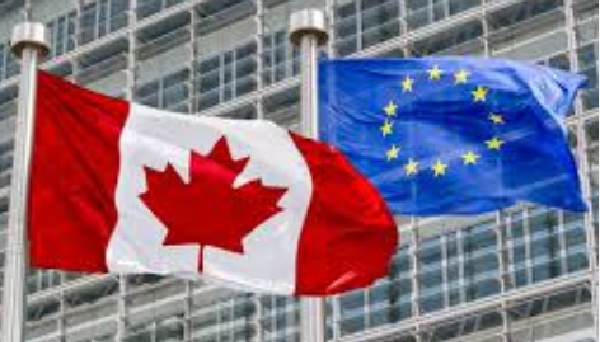
Canada and the European Union plan to link next-generation payment systems to enable faster cross-border transactions, according to a draft joint statement prepared for a summit between Ottawa and Brussels later this month.
This will help remove obstacles to business and investment between the two jurisdictions, according to the statement, an early version of a summit communiqué that was viewed by The Globe and Mail. It adds that the new partnership will be called an “Alliance for the Future.”
Read More On Our Daily Stock Market Reports – TSX Slips While U.S. Markets Edge Higher as Bond Yields Ease and Oil Prices Rise
The draft statement doesn’t detail what next-generation payment systems include, but this term has been used by others to refer to a major upgrade of a country’s core payment infrastructure, usually built around real-time payments. The core infrastructure is a central set of systems that clear and settle payments between financial institutions.
The Prime Minister’s Office declined to offer any response to the draft joint statement, saying it would not comment on leaked documents.
Canada and the EU are working to modernize the electronic systems that their businesses and people use to move money from place to place.
Both have identified the United States’s sway over the current generation of payment systems as a risk, given that Washington has grown increasingly unpredictable and protectionist under President Donald Trump.
Earlier this month, Prime Minister Mark Carney identified a country’s control over payment systems as a feature of modern sovereignty. In an address to the European Parliament on Sept. 17, he said Canada and Europe should “secure our strategic autonomy” through co-operation in strategic capabilities including “critical minerals, defence industrial capacity, AI and compute, energy security, space, and payments.”
Mr. Carney is welcoming EU officials in Montreal at the end of October to begin to define a new relationship with Brussels – one that European Commission President Ursula von der Leyen has said could make Canada an “associate member” of the 27-country bloc.
The draft of the coming summit’s joint statement, dated Sept. 21, says Canada and the EU will commit to stitching together payment systems. It is a work in progress of the text that the two sides are planning to release at the Montreal event.
“We will also work toward connecting next-generation payment systems to facilitate faster, lower-cost and more seamless cross-border transactions, making it easier for Canadians and Europeans to conduct business, invest and transfer funds internationally,” the statement says. “These efforts will help mobilize capital for strategic sectors and support long-term economic growth and competitiveness.”
The U.S.’s power over international payments was demonstrated in 2025 when Mr. Trump imposed sanctions on Winnipeg-born International Criminal Court judge Kimberly Prost over her work on a case involving American troops in Afghanistan. The U.S. sanctions left Ms. Prost unable to use most credit cards or multinational services such as Amazon or airlines.
Vass Bednar, managing director of the Canadian Shield Institute think tank, pointed out that several major European digital payment networks and wallet providers, including Bizum, Bancomat and Wero, are joining forces to create a cross-border payments network that would challenge the U.S. dominance of payment systems.
“If we’re serious about digital sovereignty, we should expect stronger positioning on alternative payment infrastructure from the government,” she said.\
BMO chief economist Douglas Porter said he sees linking payment systems between Canada and Europe as a defensive step, providing “an alternative option, or almost a possible shield in case the payments system comes under duress.”
The draft Canada-EU statement maps out future co-operation including the joint purchase of 50 water bombers to fight forest fires in Canada and on the continent. It says the aircraft would be purchased from De Havilland and enter into service starting in 2030.
The pact also commits Ottawa and Brussels to study where they might add new subsea cables between Europe and Canada and Asia “to enhance digital links.”
Mr. Carney, speaking to The New York Times earlier this month, said he sees more opportunity for Canadian economic gains in Europe than in China. “If you look at revealed comparative advantage in Canada, where we can grow our economy and grow our exports, it is our biggest opportunity. Greater penetration of Europe is a bigger opportunity for Canada than China is,” he said.

The draft statement shows that Canada and the EU plan to announce that they’ve completed a Digital Trade Agreement “to allow for faster, lower-cost secure digital trade and transactions” and that they plan deeper co-operation on critical minerals
It says Ottawa and Brussels plan to announce that Canada and the European Investment Bank have “completed negotiations of an agreement that will facilitate European Investment in critical Canadian resources, in particular, critical minerals.”
The capitals also plan to announce a deal between competition watchdogs in the EU and Canada “to effectively address anti-competitive conduct” as well as the launch of negotiations “toward a framework” for Canada to participate in the European Union’s Galileo space program.
In addition, the Canada-EU draft statement says they plan a “long-term feasibility study on Liquefied Natural Gas (LNG) exports to Europe” from Canada.
And, it says, Canada and the EU will launch negotiations toward participation in Erasmus+, the EU’s flagship education and mobility program that enables students to study at universities in the bloc.
With reports from The Canadian Press
This article was first reported by The Globe and Mail