




Alberta Voters Affirm Canadian Unity, Rejecting Separation Referendum
Alberta has decided to remain in Canada, with voters in the province emphatically rejecting an effort by separatists to pursue a permanent rupture with the country.
Roughly 76 per cent of Albertans voted in favour of staying in Canada and 24 per cent for a binding referendum, according to preliminary results from Elections Alberta, which had counted ballots from 80 per cent of voting locations by 8 a.m. MT (10 a.m. ET) on Tuesday.
It marked the failed culmination of decades of effort by disaffected Albertans who have demanded a chance to create their own independent country.

“I’m very pleased to see the initial results from Elections Alberta show widespread support for remaining in Canada,” Alberta Premier Danielle Smith wrote late Monday on social media. “Albertans have voted for a stronger Alberta in a united Canada.”
Prime Minister Mark Carney promised a future in which “Albertans and all Canadians will move forward together with renewed purpose and high ambition.”
“Canada is so much greater than the sum of its parts,” he wrote in a statement. “Now it is our opportunity to take all that we have been given as Canadians – and we have been given the greatest country in the world – and make our country better for all of us.”
Thomas Lukaszuk, who led Forever Canadian, which campaigned for a remain vote, told a rally late Monday night that “Alberta will not be the weak link in Confederation. We Albertans are as proud to be Canadians as any other Canadians across the country.”
Public-opinion surveys had long shown that a large majority of Albertans support preserving Confederation and the province’s 121-year history as part of Canada.
The Prime Minister, in urging Albertans to remain, had appealed to the strength of a country united and called on shared memories of patriotic pride. Separatist leaders demanded rupture, promising an independent Alberta would deliver better fortunes and decisions unfettered by people outside the province.
Separatists had mounted a vocal campaign that garnered significant attention both in this country and south of the border.
On Monday night, the results brought dejection to an event hosted by the pro-independence Alberta Prosperity Project, where supporters who were gathered at The Parlour, an Edmonton bar, voiced their displeasure with expletives when the first results were released.
But leaders of the movement had already begun to pivot, describing new ways to foment separation.
“You have to get involved in government,” said APP leader Mitch Sylvestre.
Lawyer Jeff Rath, who has also helped lead APP, renewed threats to unseat Premier Smith through a party leadership vote.
“The next phase for us moving forward is an institutional phase where we move forward to take control back of our party, which is the United Conservative Party of Alberta,” he said. “And we will form government. Period.”
Ballots for the 10-question referendum were being counted by hand, and early results included smaller numbers of votes for the nine questions outside the one related to secession. The full count is likely to take two days to complete.
The referendum drew great numbers of Albertans. Even before voting centres opened Monday, more than 1.3 million people had cast ballots, 43 per cent of those eligible to vote, according to Elections Alberta.
Many more came out on Monday. In Edmonton, turnout surpassed expectations for Barbara Schmidt, an Elections Alberta officer who worked at multiple polling stations, each with lengthy queues of voters.
For some, it was a moment years in the making.
“If we can get free of the rest of Canada, I’ll be the happiest man on Earth,” said Roy Mears, 76.
He began questioning Alberta’s place in Canada in the 1970s. He persisted in his beliefs through the National Energy Program, the controversial imposition of federal power on Alberta’s energy resources. In 2015, when Justin Trudeau won election as a Liberal prime minister, Mr. Mears founded a Facebook group called The Republic of Western Canada.
“If we don’t separate, we’re screwed. I mean, the immigration’s killing us,” he said on Monday as he voted in the town of Vulcan, Alta.
Albertans voted in community centres, schools, hotels, golf clubs, a Hindu temple, sports complexes, churches and outposts of the Royal Canadian Legion, with neighbours and colleagues making ballot choices that would steer their homes toward radically different futures.
“I love Canada. We need Canada. We need the whole of it, not just part of it,” said Carol Shaw, who moved to Alberta from Britain in 1981. She voted in Gleichen, a small railroad hamlet east of Calgary, where more than a dozen people arrived as morning temperatures dipped below freezing.
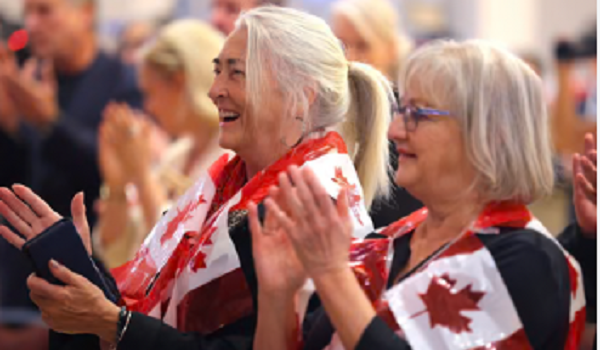
Some came determined to stand not merely against Alberta independence but against the fracturing of Canada at a time when U.S. President Donald Trump has repeatedly threatened annexation.
“There’s people that would like to join the U.S. – it’ll be over my dead body,” said Leslie Leckie, a retired snowplow and cable ferry operator. On Monday morning, he put on a pink hat emblazoned with a maple leaf, arriving to vote struggling to comprehend how it had to come to this.
“This is foolishness. As people, can we not get together? Can we not negotiate?”
When Ms. Smith first proposed a nine-question referendum, she said she was seeking a “mandate” from Albertans. Critics have accused her of seeking to mollify xenophobic factions in her own party, while proposing constitutional amendments that Alberta itself has no power to enact.
The addition of the 10th question, on a possible vote for secession, has carried considerably more consequence, prompting competing displays of patriotism across the province on referendum day. In Edmonton, a man rollerbladed over the North Saskatchewan River on the Walterdale Bridge, holding aloft a hockey stick attached to a giant Canadian flag, waving through the wind.
Near Cochrane, drivers sounded their horns at two friends who stood beside a highway flying large Alberta flags in favour of the separatist cause.
At the Royal Canadian Legion in Sundre, Delena Barker, a retired accountant and union leader, enthusiastically voted yes to all the referendum questions and to taking steps toward separation. She said she would also vote yes in a future secession ballot.
Ms. Barker moved to Alberta from Toronto 15 years ago.
“We’re a different type of people,” she said, “and I say ‘we’ now because I feel I’m an Albertan.”
In Wainwright, the eastern town reeling from a deadly weekend grass fire that killed four military members at a nearby base, voters marked ballots near a memorial of bouquets that has grown around the town’s war memorial.
“In the service of Canada,” one of the plaques read.
“I hope everyone is doing all right, the best they can,” said local resident Brandon Barss.
“And I hope this vote goes in the way of not needing another referendum.”
The results of the referendum will reflect separatist sentiment, although only partly. Some voted against remaining in Canada, even if they had no real intention of seeking independence in a secession vote.

In Edmonton, Sheila Taylor said she had been “a fence-sitter,” not sure which side she’d vote for. On Monday, she chose to support a binding separation vote.
“Ultimately, for me, it became a decision of just saying that I’m okay with Prime Minister Mark Carney doing whatever he wants with the rest of the country – but just leave us in Alberta alone and out of it, please,” she said.
James Wocknitz, a retired drilling rig worker in Vulcan, was among those who signed a petition demanding a referendum. Yet he remains skeptical that the province could ever achieve independence.
“People think this is about leaving. It’s about leverage. It’s about getting the ability to have a say,” Mr. Wocknitz said.
Others, though, questioned the damage done by a referendum that has brought to the fore disagreements that could leave wounds for generations to come.
In Calgary, Mayor Jeromy Farkas recounted a question he was asked during a recent elementary school visit to City Hall.
“I have never felt my heart so broken as when one of the children asked me, ‘Am I a real Canadian?’”
That is a question, he said, that “no child should ever have to ask.”
With reports from Temur Durrani, Matthew Scace, Carrie Tait, Emma Graney, Jana G. Pruden, Jeff Gray and Alanna Smith.
This article was first reported by The Globe and Mail