




No Post-Midterm Relief: U.S. Maintains Tough Stance On Vietnam Trade
Businesses expect no near-term change in the US trade stance toward Vietnam after the midterm elections weakened President Donald Trump, as the two countries seek to seal a trade deal at a time when Vietnam has become the country with the largest trade surplus with the US.
The Trump administration imposed in July a general 12.5% tariff on Vietnamese goods over alleged failures to prevent imports of products made with forced labour, partly replacing 20% duties that had been struck down by the Supreme Court.
Businesses expect no near-term change in the US trade stance toward Vietnam after the midterm elections weakened President Donald Trump, as the two countries seek to seal a trade deal at a time when Vietnam has become the country with the largest trade surplus with the US.

The Trump administration imposed in July a general 12.5% tariff on Vietnamese goods over alleged failures to prevent imports of products made with forced labour, partly replacing 20% duties that had been struck down by the Supreme Court.Two other probes could result in additional duties as early as this month, amid repeated accusations from White House officials that Vietnam serves as a transshipment hub for Chinese exports to the United States.
That stance is unlikely to change in the short term despite Democrats’ gains in this week’s elections, according to Vietnam-based businesspeople.
“The core foundations of the US trade policy toward Vietnam, namely managing trade deficits and cracking down on transshipment from China, will likely remain unchanged,” said Sun Hong, honorary chairman of the South Korean Chamber of Business in Vietnam, which represents major Korean corporations, including Samsung, which is the largest foreign investor in Vietnam and a top exporter to the US market.
He said no immediate policy changes were expected, although Congress could place greater emphasis on labour and environmental standards when shaping trade priorities.

“Foreign and trade policy are largely dictated by the president and not by the congress, so the problems of today will remain the problems of tomorrow until further notice,” said Bruno Jaspaert, who is the head of DEEP C Industrial Zones, a network of industrial parks in northern Vietnam hosting export-oriented factories operated by multinational companies.
A spokesperson for Vietnam’s Foreign Ministry said on Thursday that trade talks continued. Hanoi has launched campaigns against illegal transshipment and other violations flagged by Washington and has strengthened rules to prevent import of forced-labour goods.
SURGING GAP
US-Vietnam negotiations for a trade deal that could end tariff uncertainty have continued for more than a year, complicated by the growing US deficit with Hanoi.
Vietnam has overtaken China and Mexico to become the country with the largest goods trade surplus with the United States, according to US trade data released on Wednesday, thanks to a variety of exports, including electronic goods, apparel, footwear and wood products.
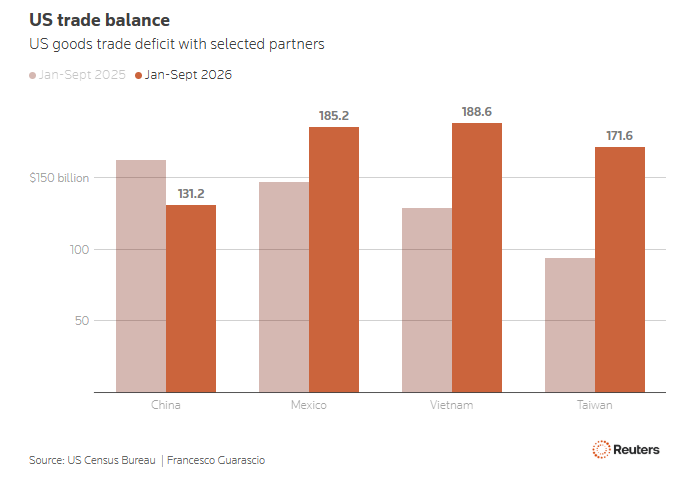
In the first nine months of the year, Vietnam’s record surplus reached nearly $190 billion, about 47% higher than a year earlier. China’s surplus fell to roughly $130 billion from nearly $163 billion.
Pressure on Vietnam may become less acute as Congress may oppose some measures, “but the President still has a lot of tools,” said another representative of foreign businesses in Vietnam, who declined to be named to speak more freely.
Other business representatives said uncertainty persisted.
Reporting by Francesco Guarascio Editing by Alexandra Hudson
This article was first reported by Reuters