






US Stocks Fall as Treasury Yields Surge and NVIDIA Sells Off; CoreWeave Earnings Offer a Bright Spot
The Canadian Vanguard Stock Market Report Tuesday, November 10, 2026, Edition
.
The Toronto Market
Tuesday’s Toronto Market Index
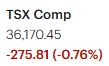
The S&P/TSX Composite Index declined 275.81 points, or 0.76%, to close at 36,170.45.
After closing below the psychologically important 36,000 level on Friday, the TSX recovered and moved back above that threshold today. Market breadth was positive, suggesting that more stocks advanced than declined despite the index’s lower closing level.
Nevertheless, traders and investors should remain cautious and prioritize capital preservation. It may be prudent to maintain appropriate risk-management measures and consider limiting market exposure to approximately 30%–60% of portfolio value for now. This approach may help protect capital while allowing investors to participate selectively in the market as we wait for a sustainable turnaround to emerge and receive confirmation.
From a technical perspective, the TSX Composite Index closed slightly above both its 25-day and 50-day moving averages while continuing to trade comfortably above its 200-day moving average. These technical levels will be important to monitor as investors assess the market’s near-term direction and the possibility of a broader recovery.
Tuesday’s TSX Market Statistics
At the Toronto Stock Exchange (TSX), declining issues (decliners) significantly outnumbered advancing issues (advancers). Specifically, there were 1,465 decliners and 801 advancers, resulting in a decliner-to-advancer ratio of approximately 1.83 to 1. In other words, there were nearly two declining stocks for every advancing stock. An additional 135 issues remained unchanged.
Overall, market breadth was negative, indicating continued weakness in the broader market. The substantial imbalance between declining and advancing issues suggests that the market’s internal condition remains fragile, despite some encouraging developments in other market indicators.
The exchange recorded 20 new 52-week highs and 16 new 52-week lows, compared with 14 new 52-week highs and 16 new 52-week lows on Monday.
The ratio of new 52-week highs to new 52-week lows improved considerably. Today’s ratio was 5 to 4, equivalent to 1.25 or 125%, compared with Monday’s ratio of 7 to 8, equivalent to 0.875 or 87.5%. This improvement indicates that more stocks were reaching new annual highs relative to those recording new annual lows. It represents an encouraging development in the market’s internal indicators, although it is not yet sufficient to confirm a broader market recovery.
Total trading volume on the TSX reached approximately 475,731,000 shares, compared with 533,744,000 shares traded on Monday, representing a decline of approximately 11%. The lower trading volume, combined with the improvement in the new 52-week highs-to-lows ratio, provides a somewhat encouraging picture, although the negative market breadth remains a concern.
Overall, there were mixed signals in Tuesday’s market statistics. While the number of new 52-week highs improved relative to new lows, declining issues continued to substantially outnumber advancing issues. Consequently, the broader market’s internal condition remains weakened, despite some signs of improvement.
The TSX has performed well year to date, and there are indications that the index may be attempting to regain the more buoyant upward trend observed earlier this year. However, this potential recovery has not yet been confirmed.
Investors and traders should continue to monitor market breadth, trading volume, new 52-week highs and lows, and other market internals closely. These indicators can provide valuable early signals of a potential market turnaround. As always, patience and disciplined risk management are essential. It is prudent to wait for convincing confirmation of a sustainable market recovery before committing to major positions or undertaking significant new trades.
Tuesday’s Toronto Stock Exchange (TSX) Market Wrap-Up Report
A Broadly Negative Trading Session Despite Pockets of Sector and Stock Resilience
The Toronto Stock Exchange experienced a broadly negative trading session on Tuesday, with declining stocks substantially outnumbering advancing issues. Although several sectors managed to post gains, weakness across a number of important market segments, particularly Non-Energy Minerals, Distribution Services, and Health Services, contributed to the overall negative tone.
The S&P/TSX Composite Index declined 275.81 points, or 0.76%, to close at 36,170.45. Despite the decline, the index managed to remain above the psychologically important 36,000 level, which it had closed below on Friday.
From a technical perspective, the TSX closed slightly above its 25-day and 50-day moving averages and continued to maintain a comfortable margin above its 200-day moving average. These developments suggest that the broader longer-term technical structure has not yet deteriorated significantly, although the recent weakness warrants continued attention.
Sector Performance: Mixed Results Across the Market
Sector performance was mixed, although the overall trading environment was decidedly negative.
Miscellaneous and Electronic Technology were the two strongest-performing sectors during Tuesday’s session, followed by Energy Minerals and Utilities.
Among the other advancing sectors, Industrial Services gained 0.79%, while Technology Services advanced 0.49%. Commercial Services rose 0.28%, Transportation gained approximately 0.25%, and Finance edged higher by 0.17%.
On the declining side, Health Services fell 1.94%, while Distribution Services dropped 1.98%. Non-Energy Minerals was the weakest-performing sector, declining 3.96%.
The substantial decline in Non-Energy Minerals, which includes important mining stocks, was particularly notable and contributed to the negative tone across the resource-related segment of the market.
Overall, Tuesday’s sector performance reflected a market struggling to maintain positive momentum, despite some pockets of resilience.
Company and Stock Developments
Aerospace and Defence
Magellan Aerospace Corporation (TSX: MAL) reported its third-quarter financial results on Tuesday. According to the company’s report, commercial markets accounted for 66.9% of its revenues during the first nine months of the year, while defence markets contributed the remaining 33.1%.
The company had previously announced, on October 27, the signing of a Memorandum of Understanding with Saab. The agreement is intended to explore opportunities for local manufacturing of advanced aerostructures, composite structures, and structural assemblies in Canada, should the Government of Canada select the Gripen as part of the Royal Canadian Air Force’s future fighter capability.
Magellan Aerospace shares advanced 1.39% to close at $34.22, with approximately 67,060 shares changing hands.
Bombardier Inc. (TSX: BBD.B) also performed well, gaining 2.29% to close at $341.95, on trading volume of approximately 210,500 shares.
The company’s shares have benefited from encouraging business developments. On November 5, Bombardier announced stronger-than-expected orders, highlighting continued demand for its business jets. The company also indicated that services revenue was continuing to come in ahead of expectations.
For the three months ended September 30, Bombardier reported revenue of $2.37 billion, compared with $2.31 billion in the corresponding period.
The positive performance of both Magellan Aerospace and Bombardier provided some resilience within the aerospace segment on an otherwise difficult trading day.
Technology
Shopify Inc. (TSX: SHOP) declined 0.93% to close at $208.12, with approximately 1.5 million shares traded.
The decline reflected the generally weaker trading environment, although the stock’s performance should also be assessed against its own price action, trading volume, and technical indicators.
Canadian Banking Sector
The Canadian banking sector experienced a predominantly negative session, with Toronto-Dominion Bank being the only one of Canada’s Big Six banks to finish in positive territory.
Toronto-Dominion Bank (TSX: TD) gained 0.19% to close at $175.87, with approximately 3.5 million shares traded.
The other five major Canadian banks finished lower:
- National Bank of Canada (TSX: NA) declined 0.93% to close at $215.48, with approximately 1.3 million shares traded.
- Bank of Nova Scotia (TSX: BNS) fell 0.31% to close at $131.36, with approximately 1.9 million shares traded.
- Royal Bank of Canada (TSX: RY) slipped 0.26% to close at $287.56, with approximately 3.4 million shares traded.
- Bank of Montreal (TSX: BMO) declined 0.23% to close at $245.21, with approximately 2.5 million shares traded.
- Canadian Imperial Bank of Commerce (TSX: CM) fell 0.33% to close at $164.24, with approximately 2.6 million shares traded.
The broadly negative performance among the major Canadian banks is worth monitoring, particularly given the important role that financial stocks play in the TSX Composite Index.
Gold Mining Stocks
Gold mining companies also experienced considerable selling pressure on Tuesday.
Agnico Eagle Mines Limited (TSX: AEM) declined 4.52% to close at $270.50, with approximately 641,400 shares traded.
The weakness in Agnico Eagle, together with the significant decline in the Non-Energy Minerals sector, highlights the pressure experienced by mining-related stocks during the session.
Investors should continue monitoring the performance of major gold producers, particularly their relative strength, trading volumes, and ability to stabilize following recent declines.
Market Internals and Trading Activity
Tuesday’s market internals presented a mixed picture, with negative market breadth but some improvement in the number of stocks reaching new 52-week highs relative to new lows.
At the TSX, declining issues significantly outnumbered advancing issues. There were 1,465 decliners compared with 801 advancers, producing a decliner-to-advancer ratio of approximately 1.83 to 1. An additional 135 issues remained unchanged.
This negative breadth indicates that selling pressure was relatively widespread across the exchange and that the weakness was not limited to a handful of large-cap stocks.
However, there was an encouraging development in the new 52-week highs and lows statistics.
The exchange recorded 20 new 52-week highs and 16 new 52-week lows, compared with 14 new highs and 16 new lows on Monday.
Consequently, the ratio of new highs to new lows improved to 5 to 4, or 1.25 (125%), compared with Monday’s ratio of 7 to 8, or 0.875 (87.5%).
This improvement suggests that a greater number of stocks were demonstrating positive longer-term price momentum relative to those reaching new annual lows.
Total trading volume reached approximately 475.7 million shares, compared with 533.7 million shares on Monday, representing a decline of approximately 11%.
The lower trading volume, combined with the improvement in the new-high-to-new-low ratio, provides a somewhat encouraging signal. Nevertheless, the substantial imbalance between declining and advancing issues remains a concern.
Taken together, Tuesday’s market internals were mixed rather than uniformly negative. The improvement in new highs relative to new lows is encouraging, but the negative market breadth suggests that a convincing recovery in the broader market has yet to materialize.
Key Takeaways for Traders and Investors
Tuesday’s market performance reinforces the importance of maintaining a cautious and disciplined investment approach. Although the TSX remains above its 200-day moving average and has recovered above the 36,000 level, the deterioration in market breadth suggests that investors should not assume that a sustainable market turnaround is already underway.
The following considerations are particularly important:
1. Monitor the 36,000 Level and Moving Averages
The TSX’s ability to remain above 36,000 is worth watching. Traders should also monitor whether the index can maintain its position above its 25-day and 50-day moving averages. A sustained recovery above these technical reference points, accompanied by improving market breadth, would provide a more constructive signal.
2. Pay Close Attention to Market Breadth
The 1.83-to-1 decliner-to-advancer ratio is a significant warning signal. Traders should watch for an improvement in advancing issues relative to declining issues. A sustained improvement in breadth would provide stronger evidence that buying interest is spreading across the broader market.
3. Watch the New 52-Week Highs-to-Lows Ratio
Tuesday’s improvement to a ratio of 1.25 is encouraging. Continued expansion in the number of new highs relative to new lows could provide early evidence of improving market participation and underlying strength.
4. Be Selective With Individual Stocks
The positive performances of Magellan Aerospace and Bombardier demonstrate that individual stocks can outperform even during broadly negative market sessions. Traders should continue looking for stocks displaying relative strength, positive price momentum, and supportive trading volume rather than assuming that the entire market will move in the same direction.
5. Maintain Disciplined Portfolio Exposure
Given the mixed market internals and the absence of a confirmed broader market turnaround, investors may wish to maintain a defensive portfolio posture. Limiting market exposure to approximately 30%–60% of portfolio value may be an appropriate risk-management consideration, depending on individual investment objectives, risk tolerance, and existing portfolio positions.
Capital preservation should remain a priority while waiting for stronger evidence of a sustainable recovery.
Overall Market Assessment
Tuesday’s TSX trading session was broadly negative, with the Composite Index declining 0.76% and declining issues substantially outnumbering advancing issues.
Nevertheless, there were some encouraging developments. The index remained above its 200-day moving average, the new 52-week highs-to-lows ratio improved, and selected sectors and individual stocks demonstrated resilience.
The market is therefore presenting a mixed technical picture. While there are early signs that the TSX may be attempting to regain the more buoyant upward trend experienced earlier this year, the negative market breadth suggests that investors should remain cautious.
For now, patience, selectivity, and disciplined risk management remain essential. Traders and investors should continue monitoring the TSX’s price action, market breadth, trading volume, and new 52-week highs and lows for convincing confirmation that a sustainable market turnaround is taking shape.
A confirmed recovery, rather than an isolated improvement in the index, should be the signal that guides a more aggressive deployment of investment capital.
.
The US Markets
Tuesday’s US Market Indexes
Major US Stock Market Indexes Finish Lower, but Recover From Session Lows
All four major US stock market indexes finished Tuesday’s trading session in negative territory. However, despite the widespread declines, the indexes staged a gradual recovery after falling during the late morning and managed to close well above their respective session lows.
The Dow Jones Industrial Average declined 157.86 points, or 0.30%, to close at 52,231.89.
The S&P 500 fell 29.01 points, or 0.38%, to finish at 7,520.93.
The Nasdaq Composite dropped 187.26 points, or 0.74%, closing at 25,065.87.
The Russell 2000 Index declined 19.44 points, or 0.68%, to close at 2,821.38.
Among the four major indexes, the Dow Jones was the relative outperformer, recording the smallest percentage decline at 0.30%, followed by the S&P 500, which lost 0.38%. The Russell 2000 declined 0.68%, while the Nasdaq Composite was the weakest performer, falling 0.74%.
Although the market opened under pressure and all four indexes experienced further weakness during the late morning, buying interest subsequently emerged and helped lift the indexes from their session lows.
This recovery is worth noting because it suggests that investors were willing to step in and provide some buying support at lower price levels. Nevertheless, the recovery was not sufficient to bring any of the four indexes into positive territory.
Technical Analysis: Moving Averages Remain an Important Concern
The technical picture across the major US indexes remains mixed, with several indexes trading below important short- and intermediate-term moving averages. This suggests that the market’s near-term technical condition continues to warrant caution.
Dow Jones Industrial Average: The Dow Jones has moved back below its 21-day and 50-day moving averages, indicating some deterioration in its short- and intermediate-term technical position.
However, the index remains above its 200-day moving average. This is an important distinction because the longer-term technical trend has not yet experienced the same degree of deterioration as the shorter-term trend.
Traders should monitor whether the Dow can recover above its 21-day and 50-day moving averages while maintaining its position above the 200-day moving average.
Nasdaq Composite: The Nasdaq Composite continues to display a weaker technical position.
The index remains clearly below its 25-day and 50-day moving averages and closed only slightly above its 200-day moving average.
Its proximity to the 200-day moving average is particularly important. A sustained move below this longer-term technical reference point could further weaken the index’s technical outlook and increase concerns about additional downside pressure.
For now, the Nasdaq’s position calls for continued caution, particularly among traders with significant exposure to technology and growth-oriented stocks.
S&P 500: The S&P 500 also remains under technical pressure.
The index closed considerably below its 25-day and 50-day moving averages, suggesting that its short- and intermediate-term momentum remains weakened.
However, it continues to trade above its 200-day moving average, indicating that its longer-term technical position remains relatively more constructive.
The ability of the S&P 500 to maintain this position will be important in determining whether the current weakness develops into a more significant market correction.
Russell 2000: The Russell 2000 remains below its 25-day and 50-day moving averages, reflecting continued weakness among smaller-capitalization stocks.
However, the index moved closer to its 200-day moving average during Tuesday’s session. This makes the 200-day moving average an important technical level to watch.
A sustained move below this level could indicate further deterioration in the small-cap market, while a successful recovery above it would provide a more encouraging technical signal.
Key Takeaways for Traders and Investors
Tuesday’s trading session produced a mixed message. Although all four major indexes closed lower, their recovery from session lows suggests that some buying support remains present.
However, the broader technical picture continues to call for caution.
The following are important considerations for traders and investors:
- Do not confuse an intraday recovery with a confirmed market turnaround. The recovery from session lows is encouraging, but all four indexes still finished in negative territory.
- Monitor the 200-day moving averages closely. The Nasdaq Composite and Russell 2000 deserve particular attention because of their proximity to this important longer-term technical reference point.
- Watch the short- and intermediate-term moving averages. The inability of the major indexes to regain their 21-day/25-day and 50-day moving averages suggests that near-term market momentum remains under pressure.
- Remain selective with new positions. Traders should pay particular attention to individual stocks demonstrating relative strength, improving price momentum, and supportive trading volume.
- Prioritize capital preservation. Until the indexes demonstrate a more convincing recovery, investors should consider maintaining disciplined portfolio exposure and avoiding unnecessarily aggressive positioning.
Overall US Market Assessment
Tuesday’s US market performance was broadly negative, with all four major indexes recording losses. The Nasdaq Composite and Russell 2000 experienced the largest percentage declines, while the Dow Jones demonstrated relative resilience.
The recovery from the session lows was a constructive intraday development, but it should not yet be interpreted as evidence of a sustainable market reversal.
From a technical perspective, the continued weakness relative to the short- and intermediate-term moving averages, together with the Nasdaq’s proximity to its 200-day moving average, reinforces the need for caution.
The immediate priority for traders and investors should remain capital preservation, disciplined risk management, and close monitoring of the major indexes for confirmation of a sustainable market recovery.
A more aggressive investment posture would be better supported by a broad-based recovery in the major indexes, accompanied by improving market breadth and a return above important moving averages.
Tuesday’s US Market Statistics
Weak Market Breadth and Deteriorating Market Internals Reinforce the Need for Caution: Tuesday’s US market statistics revealed further deterioration in the internal condition of both the New York Stock Exchange (NYSE) and NASDAQ. Declining stocks substantially outnumbered advancing stocks on both exchanges, while the number of stocks recording new 52-week lows increased considerably relative to new highs.
These developments suggest that selling pressure remains widespread and that the underlying market condition has not yet established a convincing foundation for a sustainable recovery.
1. New York Stock Exchange (NYSE)
Market Breadth: Significantly Negative
At the New York Stock Exchange, declining issues substantially outnumbered advancing issues.
There were 1,817 decliners, 936 advancers, and 56 issues unchanged. This produced a decliner-to-advancer ratio of approximately 1.94 to 1, meaning that nearly two stocks declined for every stock that advanced.
The negative market breadth indicates that selling pressure was widespread across the exchange and that the majority of participating stocks experienced downward price pressure during Tuesday’s session.
New 52-Week Highs and Lows: Further Deterioration
The NYSE recorded 47 new 52-week highs and 114 new 52-week lows, compared with 55 new highs and 80 new lows on Monday.
This represents a decline of approximately 14.5% in the number of new 52-week highs and an increase of 42.5% in the number of new 52-week lows.
Consequently, the ratio of new 52-week highs to new 52-week lows deteriorated to approximately 0.41, or 41%, compared with 0.69, or 69%, on Monday.
In practical terms, the exchange recorded considerably more stocks reaching new annual lows than stocks reaching new annual highs. This is a concerning development because it suggests that the underlying weakness extends beyond the daily movements of the major market indexes.
Trading Volume
Total NYSE trading volume reached approximately 5.17 billion shares, compared with approximately 5.94 billion shares on Monday. This represented a decline of approximately 12.9%.
Although trading volume declined, the deterioration in market breadth and the worsening new-high-to-new-low ratio indicate that the underlying market condition remains weak.
NYSE Market Internals: Assessment
The NYSE’s internal indicators weakened further on Tuesday.
The reduction in new 52-week highs, combined with the substantial increase in new 52-week lows, suggests that the broader market continues to experience underlying deterioration.
The market will need several consecutive sessions of improving breadth and a stronger balance between new highs and new lows before investors can become more confident that market internals are recovering.
For now, the NYSE’s market internals remain weak, and traders should continue to exercise considerable caution when initiating new positions.
2. NASDAQ Exchange
Market Breadth: Substantially Negative
NASDAQ also experienced significantly negative market breadth on Tuesday.
The exchange recorded 3,441 declining issues and 1,554 advancing issues, with 159 issues unchanged.
This produced a decliner-to-advancer ratio of approximately 2.21 to 1. In other words, there were more than two declining stocks for every advancing stock.
This is a particularly concerning development because it indicates that selling pressure was widespread across NASDAQ-listed stocks.
New 52-Week Highs and Lows: Significant Weakening
NASDAQ recorded 80 new 52-week highs and 305 new 52-week lows, compared with 120 new highs and 216 new lows on Monday.
The number of new 52-week highs declined by approximately 33.3%, while the number of new 52-week lows increased by approximately 41.2%.
As a result, the ratio of new 52-week highs to new 52-week lows deteriorated sharply to approximately 0.26, or 26%, compared with approximately 0.56, or 56%, on Monday.
This represents a significant deterioration in NASDAQ’s internal condition.
The decline in new highs, accompanied by the substantial increase in new lows, effectively reversed the modest improvement recorded in the previous session.
The statistics indicate that the underlying weakness among NASDAQ-listed stocks remains considerable. The exchange will need a sustained improvement in both market breadth and the new-high-to-new-low ratio before a meaningful recovery in its internal indicators can be established.
Trading Volume
Total NASDAQ trading volume reached approximately 8.83 billion shares, compared with approximately 9.53 billion shares on Monday.
This represented a decline of approximately 7.4%.
Although trading volume was lower, the deterioration in market breadth and the new-high-to-new-low ratio remains the more important concern.
NASDAQ Market Internals: Assessment
NASDAQ’s market internals weakened considerably on Tuesday.
The decliner-to-advancer ratio of 2.21 to 1, combined with the new-high-to-new-low ratio of only 0.26, points to substantial underlying weakness.
This is particularly important given that the Nasdaq Composite is already trading below its 25-day and 50-day moving averages and only slightly above its 200-day moving average.
The combination of deteriorating market internals and a technically weakened index calls for considerable caution.
At this stage, aggressive trading and substantial new commitments to equities are difficult to justify based on the available market statistics.
3. Key Takeaways for Traders and Investors
Tuesday’s market statistics reinforce the importance of capital preservation and disciplined risk management. Both the NYSE and NASDAQ recorded negative market breadth, while their respective new-high-to-new-low ratios deteriorated.
The following considerations deserve particular attention:
1. Capital Preservation Should Remain the Priority
The deterioration in market internals suggests that traders and investors should avoid unnecessary exposure to market risk.
For retail investors, we continue to consider a relatively defensive portfolio posture appropriate. As a general risk-management guideline, investors may wish to consider keeping equity exposure at approximately 30% or less of portfolio value at this stage, depending on their individual circumstances and investment objectives.
2. Avoid Aggressive New Positions
This is not an ideal environment for aggressive trading. Investors should be selective and concentrate on identifying stocks that demonstrate relative strength rather than attempting to anticipate a broad market recovery prematurely.
3. Build and Maintain a Watchlist
The current period of market weakness can be used productively to identify fundamentally sound companies and technically attractive stocks.
Investors should prepare a watchlist of potential opportunities and monitor which stocks demonstrate resilience during market weakness. Those stocks may become candidates for future investment when broader market conditions improve.
4. Wait for Confirmation of a Market Turnaround
Although the major indexes may be approaching an opportunity for recovery, improving index prices alone are insufficient confirmation.
We would like to see several positive trading sessions accompanied by improving market breadth, fewer new 52-week lows, more new 52-week highs, and strengthening market internals.
A recovery supported by these developments would provide a more convincing basis for gradually increasing market exposure.
5. Remain Flexible and Manage Risk Actively
Traders should establish appropriate exit strategies and remain prepared to reduce or close positions when market conditions deteriorate or individual trades move against their investment thesis.
Capital protection should take precedence over the pursuit of short-term trading opportunities.
4. Overall US Market Internals: A Cautious Outlook
Tuesday’s market statistics indicate that the internal condition of the US stock market remains weakened.
Both the NYSE and NASDAQ experienced negative market breadth, with declining issues substantially outnumbering advancing issues. Furthermore, both exchanges recorded fewer new 52-week highs and more new 52-week lows relative to Monday.
NASDAQ’s statistics were particularly concerning, with a decliner-to-advancer ratio of 2.21 to 1 and a new-high-to-new-low ratio of just 0.26.
The NYSE also recorded a substantial deterioration, with its new-high-to-new-low ratio falling to approximately 0.41.
These developments suggest that the market’s internal weakness has not yet been repaired. Indeed, the deterioration in the latest statistics indicates that the recovery process may require more time.
We should not rule out the possibility that the major indexes could stage a recovery in the coming sessions. However, such a recovery must be supported by meaningful improvements in the broader market’s internal indicators before it can be considered sustainable.
Our position remains defensive. We recommend that traders and investors prioritize capital preservation, avoid aggressive new positions, and use this period to build their watchlists in preparation for more favourable market conditions.
The repair of the market’s internal condition could take several weeks or even months, depending on developments in the economy, corporate earnings, interest rates, investor sentiment, and other factors influencing financial markets.
We will continue monitoring the NYSE and NASDAQ market internals and report on meaningful improvements as they emerge.
Patience remains essential. Protecting investment capital today will preserve the flexibility to take advantage of opportunities when a sustainable market turnaround is eventually confirmed.
Tuesday’s US Market Wrap-Up Report
Hotter-Than-Expected Inflation Raises Interest-Rate Concerns as Wall Street Struggles to Recover
Tuesday’s US stock market session was characterized by renewed investor caution following the release of a hotter-than-expected consumer inflation report. Concerns that persistent inflation could force the Federal Reserve to maintain restrictive monetary policy for longer, or even consider additional interest-rate increases, weighed on investor sentiment.
All four major US stock market indexes finished the session lower. Although the indexes recovered from their intraday lows, the buying interest was insufficient to reverse the earlier losses.
The Nasdaq Composite and Russell 2000 were the weakest performers, declining 0.74% and 0.68%, respectively. The Dow Jones Industrial Average demonstrated relative resilience, falling just 0.30%, while the S&P 500 declined 0.38%.
The weakness in technology and small-cap stocks was particularly noteworthy, reflecting investor concerns about higher interest rates, elevated valuations, and the potential implications for growth-oriented companies.
Two developments attracted considerable market attention during the session: the latest US consumer inflation report and reports concerning an investigation involving NVIDIA’s CEO. Both developments added to the uncertainty surrounding the market, although inflation and its potential implications for Federal Reserve policy were the more significant macroeconomic concern.
1. Hotter-Than-Expected Inflation Report Raises Federal Reserve Concerns
The consumer inflation report released Tuesday morning was considerably hotter than market participants had anticipated.
The inflation surprise increased concerns that the Federal Reserve might have to maintain higher interest rates for longer than previously expected. It also raised the possibility of additional monetary tightening if inflationary pressures remain persistent.
Ahead of the inflation report, S&P 500 futures were modestly higher, following Monday’s impressive 2.35% rebound, which represented the index’s largest one-day gain in seven months.
However, the inflation report changed the tone of the market.
Investors became increasingly concerned about the possibility that the Federal Reserve could reverse course and resume raising interest rates rather than moving toward monetary easing.
According to the CME Group FedWatch figures cited in the original market report, interest-rate futures were indicating a 100% probability of a 25-basis-point rate increase at the December 9 meeting, alongside a 10% probability of a 50-basis-point increase.
The market was also assigning an approximately 80% probability to a further increase that could take the federal funds target range to 4.25%–4.50%.
These changing expectations represented a significant shift in interest-rate sentiment and introduced another source of uncertainty for equity investors.
For stock traders and investors, the implications are important. Higher interest rates generally increase borrowing costs, put pressure on corporate financing, and can reduce the present value of future corporate earnings.
Growth-oriented companies, particularly technology and artificial intelligence businesses whose valuations depend heavily on anticipated future earnings, can be especially sensitive to changes in interest-rate expectations.
2. Treasury Yields Rise as Bond Markets React to Inflation
The US Treasury market also attracted considerable attention following the inflation report.
The yield on the 10-year US Treasury note reportedly climbed toward the psychologically important 5% level, having previously been around 4.86%.
At one point during the session, the yield reportedly advanced by approximately 14 basis points.
The increase in Treasury yields reflected investor concerns that persistent inflation could prevent the Federal Reserve from easing monetary policy as quickly as previously anticipated.
Rising Treasury yields are important for equity investors because they increase the return available from government bonds, potentially making equities less attractive on a relative basis.
They can also increase the discount rate used in valuing future corporate earnings, placing additional pressure on highly valued growth and technology stocks.
The movement in Treasury yields will therefore remain an important indicator for traders to monitor in the coming sessions.
3. Oil Prices Decline, Providing Some Relief on the Energy Front
Oil prices also experienced considerable weakness during Tuesday’s trading session.
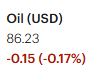
West Texas Intermediate (WTI) crude oil was reported to have declined, with the settlement price quoted at approximately $86.04 per barrel, its lowest settlement since August 31.
The decline in crude oil prices offers a potentially favourable development for consumers and businesses because lower energy costs can help reduce transportation, manufacturing, and operating expenses.
Lower energy prices could also provide some relief from inflationary pressures over time, although the impact will depend on how persistent the decline proves to be and how other components of inflation behave.
For equity investors, falling oil prices can have mixed implications.
Energy producers may experience pressure on revenues and profit margins, while transportation companies, manufacturers, and other energy-intensive businesses may benefit from lower operating costs.
Investors should therefore monitor the relationship between oil prices, inflation expectations, and the performance of energy-related stocks.
4. NVIDIA Faces Additional Scrutiny as Reports of an Independent Investigation Emerge
NVIDIA Corporation (NASDAQ: NVDA) also attracted considerable attention following reports that its board intended to initiate an independent investigation into allegations involving CEO Jensen Huang and an alleged foreign intelligence-related espionage plot.
The reports added another source of uncertainty surrounding the world’s leading artificial intelligence chipmaker.
NVIDIA shares were reported to have declined approximately 5.4% ahead of the market opening.
The developments are particularly noteworthy because NVIDIA remains one of the most influential companies in the artificial intelligence investment theme.
Any uncertainty involving its senior leadership, corporate governance, or international business relationships could affect investor sentiment toward the company and potentially influence the broader AI investment sector.
NVIDIA’s share price weakness also comes against the background of an extended period of selling pressure. According to the market reports cited in the original draft, the stock had experienced a five-week losing streak.
Investors have also been concerned about the possibility of more restrictive policies affecting data centers and artificial intelligence infrastructure following the US midterm elections.
Nevertheless, it is important to distinguish reported allegations from established facts. Investors should follow official company disclosures and verified developments before drawing conclusions about the investigation.
Cathie Wood’s ARK Invest Adds to Its NVIDIA Position
Despite the selling pressure, there was also an interesting development involving Cathie Wood’s ARK Invest.
According to reports, ARK Invest purchased approximately 90,443 NVIDIA shares on Monday, valued at more than $15.4 million based on the reported transaction valuation.
Cathie Wood is a prominent investment manager whose investment decisions are closely followed by many market participants, particularly in the technology and disruptive innovation sectors.
The purchase attracted attention because it demonstrated that at least one major investment manager was willing to increase exposure to NVIDIA despite the recent share-price weakness.
However, traders should be careful not to interpret a large institutional purchase as automatic confirmation that a stock has reached its bottom.
A more constructive technical signal would involve improving price momentum, stronger trading volume on advancing sessions, and evidence that selling pressure is subsiding.
For now, NVIDIA remains an important stock to monitor as investors assess the outlook for the broader artificial intelligence sector.
5. AI Infrastructure: CoreWeave Delivers Better-Than-Expected Revenue
There was also some encouraging corporate news from the artificial intelligence infrastructure industry following CoreWeave Inc.’s (NASDAQ: CRWV) quarterly earnings announcement after Tuesday’s market close.
CoreWeave reported better-than-expected quarterly revenue and raised its 2026 guidance, suggesting that demand for artificial intelligence infrastructure remains strong despite growing concerns about a potential slowdown in the AI investment trade.
The company’s reported revenue increased approximately 168% from about $1.36 billion a year earlier.
According to the earnings figures provided in the original report, CoreWeave’s results compared with LSEG consensus expectations as follows:
- Adjusted loss per share: $0.95, compared with an expected loss of $1.16.
- Revenue: $3.66 billion, compared with an expected $3.55 billion.
Despite the strong revenue growth, CoreWeave reported a net loss of approximately $709 million, or $1.27 per share, compared with a net loss of $110 million a year earlier.
The substantial net loss highlights the significant costs associated with expanding AI infrastructure capacity.
CoreWeave shares had reportedly lost approximately 40% of their value over the preceding month, alongside a broader decline in AI infrastructure stocks.
The company’s latest results therefore provide an interesting contrast between the concerns reflected in recent share-price performance and the continued growth in demand for AI infrastructure.
What this means for investors:
CoreWeave’s results provide encouraging evidence that demand for AI computing infrastructure remains substantial. However, investors should also examine capital expenditure, financing requirements, operating costs, profitability, and cash flow.
Strong revenue growth does not automatically translate into sustainable shareholder returns.
The results will be worth watching for their potential implications for other companies involved in AI infrastructure, cloud computing, data centers, and semiconductor manufacturing.
6. A Positive Development for American Consumers: Gasoline Prices Fall Below $4
Not all the economic news was negative.
US gasoline prices reportedly fell below $4 per gallon on Monday for the first time since July.
This is an encouraging development for American consumers, particularly at a time when inflation remains a major concern for financial markets.
Lower gasoline prices can help reduce household transportation expenses and provide consumers with some additional purchasing power.
They may also contribute to easing headline inflation if the decline is sustained.
However, investors should distinguish between temporary improvements in energy prices and a broader, more durable reduction in inflationary pressures.
The Federal Reserve will continue to assess a much wider range of economic indicators when determining its monetary policy direction.
7. US Market Internals: Weak Breadth and Deteriorating New-High/New-Low Ratios
Tuesday’s market statistics provided further evidence that the weakness in US equities extended beyond the movements of the major indexes.
Both the New York Stock Exchange (NYSE) and NASDAQ recorded substantially more declining stocks than advancing stocks.
On the NYSE, there were 1,817 decliners compared with 936 advancers, producing a decliner-to-advancer ratio of approximately 1.94 to 1.
The exchange also recorded 47 new 52-week highs and 114 new 52-week lows. The ratio of new highs to new lows deteriorated to approximately 0.41, compared with approximately 0.69 on Monday.
NASDAQ presented an even weaker picture.
There were 3,441 declining issues and 1,554 advancing issues, producing a decliner-to-advancer ratio of approximately 2.21 to 1.
The exchange recorded 80 new 52-week highs and 305 new 52-week lows, resulting in a new-high-to-new-low ratio of approximately 0.26.
This was a considerable deterioration from Monday’s ratio of approximately 0.56.
Trading volume also declined on both exchanges, with NYSE volume falling approximately 12.9% and NASDAQ volume declining approximately 7.4%.
The combination of negative market breadth and deteriorating new-high-to-new-low ratios indicates that the underlying market condition remains weak.
This is particularly concerning for NASDAQ, given that the Nasdaq Composite is already trading below its 25-day and 50-day moving averages and only slightly above its 200-day moving average.
For investors, the market internals are an important warning that a recovery in the major indexes, by itself, would not necessarily indicate that the broader market has regained its strength.
A sustainable recovery will require broader participation from individual stocks.
8. Key Takeaways for Traders and Investors
Tuesday’s market developments reinforce the importance of maintaining a defensive investment posture until there is stronger evidence that market conditions are improving.
The following considerations deserve particular attention.
1. Inflation and Federal Reserve Policy Remain Major Market Drivers
The hotter-than-expected inflation report has increased uncertainty surrounding the Federal Reserve’s next policy decisions.
Traders should closely monitor inflation data, Treasury yields, and changes in interest-rate expectations. These factors could continue influencing equity valuations, particularly among technology and growth stocks.
2. Watch the 200-Day Moving Averages
The Nasdaq Composite’s position just above its 200-day moving average deserves particular attention.
A sustained breakdown below this level could further weaken the technical outlook.
The Dow Jones, S&P 500, and Russell 2000 also require close monitoring as investors assess whether their respective technical positions can stabilize.
3. Do Not Ignore Weak Market Internals
The negative breadth on both the NYSE and NASDAQ, combined with the increase in new 52-week lows, suggests that the market’s internal condition remains fragile.
Traders should look for several consecutive sessions of improving breadth and strengthening new-high-to-new-low ratios before treating a market recovery as sustainable.
4. Be Selective With AI and Technology Stocks
NVIDIA’s weakness and the broader decline in AI infrastructure stocks highlight the risks associated with concentrated exposure to high-growth technology companies.
However, CoreWeave’s results also demonstrate that underlying demand for AI infrastructure can remain strong even when investor sentiment toward the sector deteriorates.
Investors should distinguish between companies with strong business fundamentals and stocks whose valuations may have become particularly sensitive to changing market expectations.
5. Prioritize Capital Preservation
Given the deteriorating market internals and continuing uncertainty surrounding inflation and interest rates, aggressive trading is not advisable.
As a general defensive portfolio guideline, retail investors may wish to consider limiting equity exposure to approximately 30% of portfolio value at this stage, depending on individual circumstances and risk tolerance.
Investors should also maintain appropriate risk controls and avoid allowing individual positions to expose their portfolios to unnecessary losses.
6. Prepare for Opportunities Rather Than Anticipating a Turnaround
This period of market weakness can be used to identify attractive companies and build a watchlist.
Stocks demonstrating relative strength, sound financial fundamentals, and improving technical indicators deserve particular attention.
The objective should be to prepare for a potential recovery without committing substantial capital before the market provides convincing confirmation.
9. Overall US Market Assessment
Tuesday’s US stock market session was characterized by renewed investor caution, driven primarily by hotter-than-expected inflation and concerns about the implications for Federal Reserve monetary policy.
All four major indexes finished lower, with the Nasdaq Composite and Russell 2000 experiencing the largest percentage declines.
The rise in Treasury yields, weakness in technology stocks, and deteriorating market internals further reinforced the cautious tone.
There were, however, some encouraging developments beneath the surface of the negative market performance.
CoreWeave’s better-than-expected revenue and improved 2026 guidance suggest that demand for AI infrastructure remains substantial. Lower gasoline prices also provide some relief for consumers and could eventually contribute to easing inflationary pressures.
Nevertheless, these positive developments have not yet translated into a meaningful improvement in the broader stock market’s internal condition.
The NYSE and NASDAQ continue to display weak market breadth, while new 52-week lows substantially outnumber new highs.
Our investment outlook therefore remains cautious.
We believe traders and investors should continue prioritizing capital preservation, maintaining disciplined portfolio exposure, and preparing watchlists of potential investment opportunities.
Although a market recovery could develop in the coming sessions, we would prefer to see sustained improvements in the major indexes, market breadth, and new-high-to-new-low ratios before recommending a more aggressive investment posture.
The recovery process could take weeks or even months, depending on inflation, Federal Reserve policy, economic developments, corporate earnings, and investor sentiment.
For now, patience and disciplined risk management remain essential.
The objective is not to predict the exact bottom of the market. It is to preserve capital, recognize improving market conditions early, and be prepared to participate when a sustainable market turnaround is confirmed.
.
NOTICE TO READERS
The Canadian Vanguard Stock Market is about empowering you to build and manage your wealth by yourself. There is certainly no magic in managing finances or wealth but one needs to know what to do and commit to doing what is needed. When you are ready to start the journey to Take Charge and Put Your Destiny In Your Own Hands, start with reading The Canadian Vanguard every market day. If and when you need more related information or to advertise your business products or services in The Canadian Vanguard, Contact Us
Our readers are strongly advised to conduct their own research into individual stocks before making a purchase decision. In addition, investors are advised that past stock performance is no guarantee of future price appreciation. Any recommendation is not a guarantee of any particular stock’s future prices, and The Canadian Vanguard accepts no responsibility or liability for investors’ or readers’ purchases.
The dollar sign “$” in the Toronto Market section in the articles only stands for Canadian dollar and in the US market section “$” stands for US dollar.
(c) This article is published by The Canadian Vanguard on November 10, 2026